 Thanksgiving has a remarkable ability to convince us that nothing can possibly go wrong because we have made a plan. The turkey is scheduled, the potatoes are peeled, the rolls are rising, somebody has been assigned to bring pie, and then, at precisely 12:07 p.m., the power goes out. Suddenly, the most important person at Thanksgiving is whoever knows how to cook without electricity.
That may sound like a quirky holiday scenario, but Thanksgiving dinner is one of the most energy-dependent meals many of us prepare all year. The oven is running, several burners are going, the refrigerator has been opened approximately 137 times, and at least one countertop appliance is humming away. Take electricity out of the equation and things can get interesting very quickly.
First, Stop Opening the Refrigerator
When the power goes out, everybody immediately wants to open the refrigerator and look inside as though electricity might be hiding behind the cranberry sauce. Resist the urge. An unopened refrigerator will generally keep food cold for about four hours, while a full freezer can stay cold for about 48 hours and a half-full freezer for roughly 24.
That means you usually have a little breathing room before you need to start moving food around. It also means appliance thermometers are one of those boring little preparedness purchases that suddenly become very useful because they tell you what actually happened inside the refrigerator instead of forcing you to guess later.
What About the Turkey?
If your turkey is halfway cooked when the oven dies, you need another safe source of heat. Ultimately, the turkey still needs to reach 165°F in the appropriate places, so a food thermometer matters more than whether the bird looks beautifully browned.
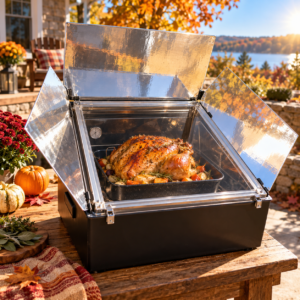
This is where alternative cooking methods earn their keep. I’ve actually cooked a Thanksgiving turkey in a solar oven before. One year at my brother’s place in Los Angeles, we let the sun do the work, and that turkey was SO good. It came out tender, flavorful, and basically sun-kissed.
That experience permanently cured me of the idea that a conventional oven is the only legitimate way to cook a turkey. Obviously, solar cooking depends on weather and location. A sunny Los Angeles Thanksgiving and a snowy Thanksgiving in Michigan are not the same thing, but that is exactly why I like having more than one option.
My Backup Cooking Setup
My own alternative cooking setup is pretty simple: I use butane stoves and solar ovens. But I also think about fuel conservation, because having a backup stove does not help much if you burn through your fuel too quickly. That is where a pressure cooker becomes especially useful.
For potatoes, for example, I bring the pressure cooker up to high pressure and actively cook them for about seven minutes. Then I remove it from the burner and let retained heat continue doing the work while I insulate the pot with towels, making sure not to interfere with any vents or safety mechanisms.
The principle is simple: use fuel to create heat, then stop paying for heat you already have. That can make a small supply of butane last considerably longer.
You May Need to Change the Menu
If the power goes out at noon, I would not insist that every dish on the Thanksgiving menu still happen exactly as planned. That is how dinner turns into a military operation.
Keep the turkey going if you have a safe way to cook it, prioritize anything already partially prepared, use foods that may spoil first, and simplify anything that requires long cooking. Maybe the casserole does not happen. Civilization will continue. Maybe the potatoes go into the pressure cooker, the vegetables get cooked on the butane stove, and dessert is pie that was already baked.
And if things really go sideways, have pie for dinner. Frankly, I think pie for dinner has been unfairly overlooked by emergency-management professionals.
Know Which Cooking Methods Belong Outside
Backup cooking is useful only when it is safe. Grills, charcoal, many camp stoves, and other fuel-burning equipment can produce dangerous carbon monoxide and should never be brought indoors just because the weather is bad. Opening the garage door does not magically turn the garage into outdoors.
If you use butane or any other portable stove, follow the manufacturer’s directions for ventilation and indoor use, and have a working carbon-monoxide detector nearby. Preparedness should get dinner cooked, not leave everyone unconscious before dessert.
Practice Before Thanksgiving
The worst time to learn how your backup cooking equipment works is while twelve hungry people are waiting for turkey. Use your solar oven before you need it. Cook on the butane stove. Figure out how much fuel you actually use. Learn how your pressure cooker behaves. Try making a normal dinner with your emergency cooking setup.
Practice when failure means ordering pizza. Survivor Steve may own a tactical stove capable of surviving the apocalypse, but that does not mean Survivor Steve knows how to make gravy on it. There is a difference.
The Real Preparedness Lesson
The point is not to guarantee a perfect Thanksgiving dinner no matter what happens. The point is to know that if the power disappears, dinner does not necessarily disappear with it.
Maybe the turkey gets cooked by the sun. Maybe the potatoes come out of a pressure cooker. Maybe the menu gets smaller. Maybe dinner is late. And twenty years later, nobody remembers the Thanksgiving when every appliance behaved perfectly. They remember the year everyone stood outside checking on the sun-kissed turkey.
That is what preparedness really gives us: enough skill, equipment, flexibility, and sense of humor to make a new plan when the first one stops working.


0 Comments