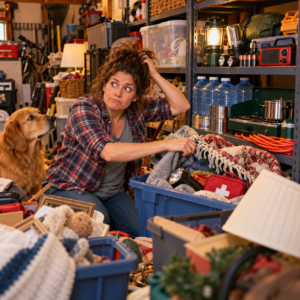
 There is a special kind of preparedness problem that doesn’t require a hurricane, an earthquake, a power outage, or civil unrest. It requires a closet.
More specifically, it requires a closet containing three flashlights, twelve extension cords, a perfectly good first-aid kit, four unopened packages of batteries, an emergency radio, and one camping stove that nobody has actually seen since the Obama administration. Technically, you own all of these things. Practically speaking, they may as well belong to someone in Nebraska.
This is the preparedness tax we pay for clutter. We spend money acquiring useful things, store them somewhere “safe,” and then slowly bury them beneath enough unrelated possessions that they cease to exist in any operational sense. And the maddening part is that clutter can make a well-prepared household behave exactly like an unprepared one.
Owning It Is Not the Same as Having It
Preparedness people are particularly vulnerable to this because we tend to accumulate useful things. We have buckets, tarps, tools, lanterns, water containers, medical supplies, batteries, canning equipment, propane accessories, extension cords, work gloves, radios, chargers, seeds, food storage, emergency blankets, camping gear, and at least one mysterious adapter that nobody remembers buying but everybody is afraid to throw away because it will undoubtedly become critical seventeen minutes after the garbage truck leaves.
Useful things multiply. Survivor Steve buys a second flashlight because one is none and two is one. Then he buys another because it was on sale. Then somebody gives him one for Christmas. Eventually, Survivor Steve owns seven flashlights but cannot locate a single one during an actual blackout. At that point, seven is apparently none.
The problem isn’t that he failed to prepare. He prepared enthusiastically. What he failed to do was maintain access to what he prepared. That matters, because if the water starts coming through the ceiling, knowing you own a tarp somewhere in the garage is not terribly comforting. If someone gets cut badly, “I think the gauze is in one of those bins downstairs” is not a medical plan. If the lights go out, nobody should need an archaeological permit to locate the lantern.
In preparedness, accessibility is part of ownership.
Clutter Charges Interest
Clutter doesn’t merely take up space. It takes time. Every unnecessary thing you must move, open, inspect, climb over, dig through, or mentally eliminate during a problem charges you a little fee. Normally, that fee is annoying. During an emergency, it can become expensive.
Imagine waking up to the smell of water and discovering that a pipe has burst. Somewhere in your basement is the wrench you need. Unfortunately, it is living beneath two boxes of Christmas decorations, a broken fan, three paint trays, a folding chair, and something nobody recognizes but apparently felt very strongly about keeping in 2018.
The water is not impressed by your sentimental attachment to the folding chair.
Emergencies often reward speed. A shutoff valve found in thirty seconds is very different from a shutoff valve found after fifteen minutes of moving things. The same applies to medical equipment, fire extinguishers, evacuation bags, emergency lighting, backup cooking supplies, and anything else we may need quickly.
Organization buys time. Clutter sells it back to us at a ridiculous markup.
You May Be Buying Things You Already Own
There is another little financial insult hidden inside clutter: duplication. Not preparedness duplication. Intentional redundancy is often wise. I’m talking about buying another roll of duct tape because you can’t find the four rolls you already own.
Or another set of batteries. Another can opener. Another flashlight. Another package of work gloves. Another bottle of ibuprofen. Another bag of rice because apparently six bags of rice have successfully entered the witness protection program somewhere in your pantry.
When we cannot see what we have, we stop managing inventory and start guessing. Guessing is expensive.
This is one reason grocery stores organize products instead of dumping everything into a giant room and wishing us well. Imagine shopping for dinner that way.
“Do you have tomato sauce?”
“We absolutely do.”
“Where?”
“That sounds like a you problem.”
And yet some of us run our preparedness supplies under approximately this system.
Food Storage Has Feelings About This Too
Food storage becomes particularly vulnerable to clutter because food has an additional complication: rotation. If you cannot see what you own, older products slowly migrate toward the back of shelves where they eventually become pantry fossils.
Then one afternoon you discover a can of something you apparently purchased when fax machines were still feeling optimistic about their future.
This is why I prefer food storage that can be seen, reached, and rotated. I don’t mean you need alphabetized cans standing at attention while a tiny warehouse manager carries a clipboard through the pantry. I mean you should have enough order that you know what you have, where it is, and what needs to be used next.
Preparedness food is supposed to reduce stress. If accessing the rice requires removing a waffle maker, seventeen grocery bags, a dehydrator tray, two decorative pitchers, and something that may once have been a crockpot lid, the rice is beginning to create stress before the emergency has even arrived. That seems rude.
The Goal Is Not Minimalism
This is where I want to make an important distinction. I am not suggesting that everybody become a minimalist and reduce their worldly possessions to one wooden spoon and a tasteful houseplant.
Prepared people legitimately own more supplies than average households because we have planned for situations average households haven’t. That isn’t clutter. Clutter is anything that interferes with the usefulness of the things you deliberately chose to keep.
A box of emergency candles is preparedness. Six half-empty boxes of candles scattered across four rooms because nobody knows where candles live anymore is clutter. Having several methods of cooking without electricity is redundancy. Having all the components distributed among five unlabeled totes so that no single cooking method can actually be assembled is a scavenger hunt.
Preparedness should create capability. If our possessions are reducing our capability, something has gotten backward.
Give Important Things a Home
One of the simplest improvements you can make is deciding where categories of preparedness supplies live. Not eventually. Not when you finally organize the entire house during that mythical three-day weekend in which you are apparently also going to clean the garage, reorganize your photographs, learn Spanish, and make homemade sourdough.
Just start with the things you would actually need quickly. Where are the flashlights? Where are the batteries? Where is the first-aid equipment? Where are the fire extinguishers? Where are the water supplies? Where is the backup cooking equipment? Where are the important documents? Where are the evacuation bags?
A household should be able to answer those questions without calling a family meeting. And if several people live in the home, more than one person should know the answers. Otherwise, you haven’t created a system. You’ve created a system with a single human password.
Labeling Is Not a Moral Failure
I am a big believer in labels because labels eliminate conversations with yourself. You know the ones.
You open a tote. Christmas lights.
Second tote. Old towels.
Third tote. Camping equipment.
Fourth tote. A collection of electrical cords apparently breeding in captivity.
Fifth tote. There it is—the propane heater.
A label would have saved four disappointments and whatever emotional experience occurred when you opened the cord tote.
Labels do not need to be beautiful. This is not a Pinterest emergency. “LIGHTING.” “WATER.” “MEDICAL.” “CAMP COOKING.” “WINTER CAR.” Those five seconds with a marker can save several minutes when minutes matter.
And while you’re labeling, make the label specific enough to help. A tote labeled “MISC.” is simply a plastic confession that you have given up.
Practice Finding Things Before You Need Them
One of my favorite preparedness exercises is ridiculously simple. Pretend the power just went out. Now go get the flashlight. Don’t turn on your phone light. Don’t cheat. Go get the flashlight you believe you would use.
Then pretend somebody has a serious cut. Go get your medical supplies. Then pretend you need to shut off the water. Go find the valve and the tool required to operate it.
This exercise reveals problems immediately because our imagined preparedness systems are often much more efficient than our actual ones. In our minds, we stride confidently to the emergency supplies. In reality, we stand in the garage muttering, “I know I put it here somewhere.”
That sentence has preceded a remarkable amount of unnecessary aggravation throughout human history.
Preparedness Should Make Life Easier
The funny thing about organizing preparedness supplies is that you don’t have to wait for an emergency to benefit. You stop rebuying things. You rotate food better. You find tools faster. You notice shortages sooner. You reclaim space. You can actually explain to somebody else where things are.
And perhaps most importantly, your preparedness begins to feel usable instead of theoretical.
That matters because preparedness isn’t a collection. It’s a capability.
The goal was never to own the most buckets, stack the most cans, or accumulate enough survival gear to make the garage look like it has its own FEMA field office. The goal is to be able to solve problems when problems show up.
So sometime this week, take a look at your preparedness supplies and ask one simple question: Could I actually find this when I needed it?
Because if the answer is no, your emergency supplies may be perfectly prepared.
They’re just hiding from you.
0 Comments