 The other day I realized I know exactly how to order groceries from my phone, transfer money to a friend, stream a movie, summon a ride, check the weather, and find the fastest route to an unfamiliar destination. What I wasn’t entirely sure about was whether I still remembered how to sew on a button.
Now, before you judge me too harshly, understand that I own a sewing kit. In fact, I own several. There’s one in a kitchen drawer, one in an emergency kit, and one that somehow migrated home with me from a hotel years ago. Apparently, I believe strongly in being prepared to sew. Actually, sewing, however, is another matter.
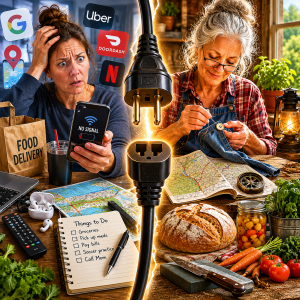
As I sat there staring at a loose button dangling by a thread, it occurred to me that somewhere along the way, many of us stopped learning skills and started collecting solutions. Need directions? GPS. Need dinner? Delivery app. Need to remember a phone number? Contacts list. Need to know how to fix something? YouTube. Need entertainment? Well, take your pick from the 87 streaming services currently trying to convince you that your happiness depends on one more monthly subscription.
None of those conveniences are bad. I use most of them myself. Convenience is wonderful. The problem comes when convenience quietly replaces capability.
Our grandparents lived in a very different world. They weren’t necessarily smarter than we are, and they certainly didn’t have access to the technology we enjoy today. But they possessed a broad collection of practical skills that were simply considered part of everyday life. My grandmother could mend clothing, preserve food, cook from scratch, stretch a meal when unexpected company arrived, identify plants in her yard, and somehow predict rain without consulting a weather app. I still don’t know how she did that last one. I suspect she had some sort of private arrangement with the clouds.
The point is, she never thought of herself as especially skilled. She just thought of herself as an adult.
Today, many of us have outsourced so many ordinary tasks that we don’t realize how dependent we’ve become until the tool isn’t available. I can still remember the phone number of the house I grew up in, and I haven’t lived there in decades. Meanwhile, there are people I talk to every week whose phone numbers I couldn’t recite if someone offered me a lifetime supply of Diet Dr Pepper. Why? Because my phone remembers them for me.
That’s incredibly convenient, but it also means I’ve quietly handed off a responsibility that previous generations simply considered normal. The problem isn’t that technology helps us remember. The problem is that we’ve become so accustomed to the help that we’ve forgotten how much we’re relying on it.
The same thing has happened with navigation. Survivor Steve, for example, owns enough GPS equipment to guide a moon landing. He’s got navigation apps, backup navigation apps, and probably a backup for the backup. Yet if every electronic device suddenly stopped working, he’d be standing in a grocery store parking lot trying to remember whether home is north, south, east, west, or “somewhere past the Dairy Queen.”
Before we laugh too hard at Survivor Steve, many of us aren’t much different. How many people could drive across town using only a paper map? How many could identify north without consulting a device? How many could get home if GPS simply wasn’t an option?
Preparedness isn’t about expecting satellites to fall out of the sky. It’s about recognizing where our capabilities have quietly been transferred to something else.
Cooking is another example. Many people today can prepare a meal by opening boxes, heating containers, and pushing buttons. But cooking from basic ingredients is becoming increasingly rare. The irony is that most preparedness plans revolve around storing ingredients—flour, rice, beans, pasta, wheat, dehydrated foods, and pantry staples. Yet if we lose the skill of turning ingredients into meals, then all we’ve really stored is potential.
The same can be said for gardening, sewing, preserving food, reading maps, sharpening tools, making basic repairs, balancing a budget, or even memorizing important information. None of these skills are glamorous. Nobody is becoming an internet sensation because they know how to sharpen a kitchen knife properly. Well, probably nobody. But these small competencies create something remarkably valuable: confidence.
Preparedness is the quiet confidence that comes from thinking ahead. Part of thinking ahead means occasionally asking yourself an uncomfortable question: “What have I outsourced that I should probably know how to do myself?”
You don’t need to become a master carpenter, mechanic, gardener, seamstress, electrician, and wilderness guide all at once. In fact, trying to do everything is often what prevents people from doing anything. Instead, pick one skill. Learn how to sew on a button. Memorize the phone numbers that matter most. Cook a meal completely from pantry ingredients. Learn to read a paper map. Grow one edible plant. Repair one household item instead of replacing it.
Small skills have a way of stacking up over time. Before long, what started as a hobby becomes capability. Capability becomes confidence. And confidence is one of the most valuable forms of preparedness you’ll ever possess.
After all, preparedness isn’t predicting the future. It’s refusing to be surprised by it. And sometimes that journey starts with something as simple as a loose button hanging by a thread.