 There’s a moment after you’ve embraced the importance of fats when a new question sneaks in…
Usually right when you’re staring at a jar of something golden and wondering if it’s going to outlive you or betray you.
Because unlike your buckets of rice that seem emotionally committed to sticking around forever…
Fats are a little more complicated.
They’re loyal—but only if you treat them right.
The Shelf-Life Reality Check
Let’s just get this out in the open:
Fats do not last forever.
I know. Deep breaths.
But some last long enough to make them incredibly valuable—if you know which ones to rely on.
Here’s the real-world breakdown:
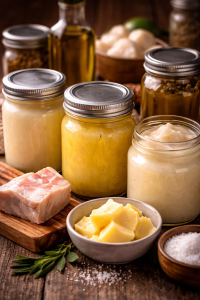
- Tallow (beef fat):
About 1–2 years at room temp when stored properly
3–5+ years in cool, dark conditions
Even longer if refrigerated or frozen - Lard (pork fat):
6–12 months at room temp
1–2 years in cool storage
Several years frozen - Coconut oil:
2–5 years (sometimes longer if unopened and kept well) - Ghee (clarified butter):
Around 1–2 years at room temp - Olive oil:
18–24 months unopened
Best used within 6–12 months after opening - Avocado oil:
Roughly 1–2 years
So no—these aren’t “bury it and forget it for 30 years” foods.
But they’re also not fragile little divas… unless you treat them like one.
What Actually Makes Fats Go Bad
If fats had a villain origin story, it would include three enemies:
- Heat
- Light
- Air
These three work together like a tiny, invisible sabotage team.
Expose your fats to them consistently, and you’ll end up with rancid oil that smells like something you found behind the couch in 2007.
Keep them protected?
They stay stable, useful, and ready when you need them.
How to Store Fats So They Actually Last
This is where self-reliance stops being theory and starts being skill.
Keep It Cool and Dark
Think pantry… not countertop.
If your oil is sitting next to the stove getting a daily sauna session, it’s aging faster than it should.
Use Airtight Containers
Oxygen is not your friend here.
Seal it well, and your fats will thank you by sticking around longer.
Buy Smart, Not Just Big
A gallon of olive oil sounds impressive…
…until half of it goes bad before you use it.
Smaller containers = better rotation = less waste.
Rotate Like a Pro
Use what you store. Replace what you use.
This isn’t a museum—it’s a working system.
Let’s Talk About Canning Fats (Because You Knew We Would)
Alright… here we go.
This is one of those topics that can turn a calm conversation into a full-blown family reunion debate.
On one side, you’ve got official guidelines saying:
“There are no approved methods for canning pure fats.”
On the other side, you’ve got generations of people saying:
“We’ve done it, we do it, and we’re still here.”
So instead of pretending one side doesn’t exist…
Let’s talk about what actually matters.
If You Choose to Can Fats, Here’s What Makes the Difference
Success here doesn’t come from guessing.
It comes from doing things right.
Start with Clean, Properly Rendered Fat
This is non-negotiable.
You want:
- No meat particles
- No moisture
- Thoroughly strained fat
Anything left behind becomes your weak point.
Heat and Handle Consistently
Hot fat into clean jars.
Consistent process.
Proper sealing.
No shortcuts. No “eh, that’s probably fine.”
Pay Attention After Storage
This is where self-reliance really shows up.
Before using:
- Check smell
- Check color
- Check texture
If anything seems off, it’s out.
No heroics. No debates.
The Strategy That Actually Works Long-Term
Here’s the part most people miss while arguing about methods:
You don’t need just one approach.
You build layers.
- Long-term anchors: tallow, lard, coconut oil
- Medium-term options: ghee, properly stored butter
- Short-term rotation: olive oil, avocado oil
Add in your preferred storage methods—whether that includes canning, freezing, or traditional storage—and now you’ve got a system that doesn’t rely on a single point of failure.
The goal isn’t to have fats.
The goal is to have fats that are:
- Available when you need them
- Safe to use
- Actually enjoyable to eat
Because when fats are dialed in…
Your entire food supply levels up.
Meals improve. Energy stabilizes. Life feels a little more normal—even when everything else isn’t.
And that?
That’s what we’re really after.
Not just getting through…
…but living well while we do.