 If preparedness were a fashion show—and let’s be honest, sometimes it kind of is—you’d see people strutting down the runway with:
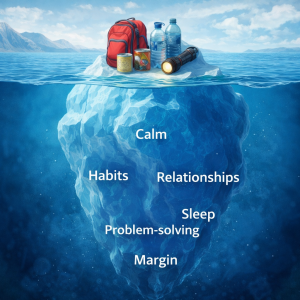
a bug-out bag that weighs more than a golden retriever,
a flashlight bright enough to signal satellites,
and enough freeze-dried stroganoff to feed a small village… twice.
And hey, no judgment. We love a well-stocked pantry.
But here’s the thing nobody’s putting on display:
The stuff that actually saves you?
You can’t stack it on a shelf.
You can’t organize it in matching bins.
And you definitely can’t buy it at 11:47 p.m. after watching a documentary that made you side-eye your entire life.
These are the invisible preps.
And quietly… they’re doing most of the heavy lifting.
Staying Calm (While Everyone Else Is Auditioning for a Disaster Movie)
Every stressful situation has that one person who immediately forgets how to function.
They’re spinning in circles like they’re trying to find their Wi-Fi signal.
“Where are my keys?!”
“Where’s my phone?!”
“Why is everything happening to me?!”
Meanwhile, their keys are in their hand. Their phone is in their other hand. And everything is happening because… life.
Now contrast that with the person who pauses.
Takes a breath.
Looks around.
And thinks.
That person isn’t lucky.
They’re practiced.
Calm isn’t something you’re born with like blue eyes or a love of Diet Dr. Pepper. It’s something you build—little by little—by choosing not to panic over every minor inconvenience life throws at you.
Because when something actually goes wrong, your brain doesn’t magically upgrade.
It defaults.
Your Habits (a.k.a. Your Daily “Autopilot” Settings)
Here’s a truth that may sting just a little:
In a crisis, you will not suddenly become a highly organized, decisive, perfectly functioning human being.
You will become… you.
Just faster.
If your daily life looks like:
“I know where things are.”
“I take care of small problems before they become big ones.”
“I generally have my act together…”
Congratulations—you’re going to be very helpful in a crisis.
If your daily life looks like:
“I’ll deal with that later…”
“Where did I put that?”
“I swear it was right here yesterday…”
Well… at least you’ll be consistent.
Preparedness isn’t just what you store.
It’s what you repeat often enough that it becomes automatic.
Your Relationships (Because Being a Lone Wolf Sounds Cool… Until It Isn’t)
There’s this idea floating around that preparedness means being completely self-sufficient.
Just you.
Your supplies.
And your ability to dramatically stare into the distance like you’re in a movie trailer.
But real life?
Real life works better with people.
Neighbors who know your name.
Friends who answer your call.
People who can help, share, and show up.
Because when things go sideways, having someone say,
“Hey, I’ve got you—what do you need?”
is worth more than another box of anything in your storage room.
Preparedness isn’t just about independence.
It’s about interdependence—even if we don’t use that word at parties.
Problem-Solving (Without Asking the Internet for Permission)
We’ve all been there.
Something breaks.
Something stops working.
Something doesn’t go according to plan.
And the first instinct is:
“Let me Google this.”
Which is great… until you can’t.
Prepared people aren’t the ones who know everything.
They’re the ones who look at a situation and think:
“Okay… what can I do?”
They adapt.
They improvise.
They figure it out.
Not perfectly.
But effectively.
Because at the end of the day, preparedness isn’t about having all the answers.
It’s about being willing to work your way toward one.
Your Sleep (Yes, This Counts—Put Down the Cocoa and Listen)
I know, I know.
Sleep feels like the thing you sacrifice so you can:
get more done
read one more article
organize one more shelf
But here’s the truth:
A tired brain is basically a toddler in an adult body.
It makes poor decisions.
It overreacts.
It forgets things.
And occasionally, it just wants to sit down and cry for no clear reason.
Meanwhile, a well-rested person?
They’re calm.
They’re clear.
They’re capable.
So if you needed permission to go to bed at a reasonable hour and call it preparedness…
Consider this your official approval.
Margin (The Space That Keeps Life From Smacking You Around)
Margin is the unsung hero of preparedness.
It’s not flashy.
It doesn’t photograph well.
No one’s posting on social media like:
“Look at all this emotional stability I’ve stored up!”
But margin is everything.
A little extra food.
A little extra money.
A little extra time.
A little extra patience.
It’s the difference between:
“This is inconvenient…”
and
“This is a full-blown meltdown.”
Without margin, life feels like it’s constantly one step ahead of you.
With margin?
You get to breathe.
And breathing—turns out—is very helpful in emergencies.
The Things That Actually Carry You Through
Preparedness isn’t just what you can point to on a shelf.
It’s what shows up when things don’t go as planned.
Your calm.
Your habits.
Your relationships.
Your thinking.
Your rest.
Your margin.
None of these come in a box.
None of them can be delivered in two days with free shipping.
But all of them can be built—quietly, steadily—over time.