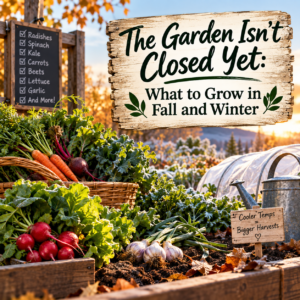
 There’s a funny thing that happens when summer starts packing up its things. The tomatoes slow down, the zucchini finally stops trying to take over the neighborhood, and a lot of gardeners mentally put the whole operation to bed until spring.
But the garden isn’t necessarily closed.
In fact, depending on where you live and how willing you are to work with the season instead of arguing with it, fall can be one of the easiest times to grow food. Cooler temperatures mean fewer pests, less heat stress, and crops that actually prefer sweater weather. Some vegetables even taste better after they’ve experienced a little frost.
The trick is to stop thinking about fall gardening as “planting late” and start thinking about it as planting the right things at the right time.
One of the biggest mistakes people make is looking at the first frost date as if that’s the day gardening ends. It isn’t. Some crops can handle light frost just fine, and others can keep producing with a little protection. What matters more is how many growing days you have left and how quickly the crop matures.
That means working backward.
If a packet says a radish needs 25 days to mature and you’ve got six reasonably decent weeks left before the weather gets serious, you’ve still got time. Spinach, lettuce, radishes, kale, carrots, beets, turnips, and other cool-season crops can all be possibilities depending on your climate.
Radishes are particularly satisfying because they don’t waste time. Some varieties can be ready in three or four weeks, which makes them a good choice when the calendar is already staring at you impatiently.
Spinach is another terrific fall crop because it actually prefers cooler temperatures. Summer spinach has a tendency to bolt the minute it decides life is too warm and stressful. Fall spinach, on the other hand, can be quite happy in chilly weather, and established plants can tolerate temperatures that would send a tomato plant into therapy.
Kale is practically the overachiever of the fall garden. It handles cold surprisingly well, and a little frost can actually make the leaves taste sweeter as the plant converts some of its stored starches into sugars. There aren’t many foods that improve after being partially frozen. Ice cream has been bragging about that advantage for years.
Root vegetables are another good bet. Carrots, beets, turnips, and similar crops are protected to some degree by the soil around them, and many can remain in the ground after the weather turns cold. Mulch can extend that protection even further.
Lettuce is worth planting too, especially if you choose varieties suited to cooler weather. It doesn’t need blazing summer sun to be productive, which is one reason fall lettuce can be so pleasant to grow. A little protection on colder nights can stretch the harvest considerably.
And then there’s garlic, which is really playing the long game.
Garlic is generally planted in the fall, settles in before winter, and then gets back to business in the spring. You’re not planting it because you need dinner next Thursday. You’re planting it because Future You would like to discover that Past You was surprisingly organized.
That is preparedness in miniature.
If you want to stretch the season even further, you don’t necessarily need an elaborate greenhouse. Cold frames, row covers, cloches, and even simple protective structures can make a remarkable difference by trapping a little warmth and shielding plants from wind and frost.
Mulch matters too. A layer of leaves, straw, or other suitable mulch helps insulate the soil, protect roots, and moderate temperature swings. It can also turn something you might otherwise rake into bags and haul away into a useful gardening resource.
Even if you don’t want to grow vegetables through the colder months, your garden can still be doing something useful.
Cover crops such as clover, rye, or other region-appropriate choices can protect bare soil, reduce erosion, suppress weeds, and add organic matter. Instead of leaving the garden exposed all winter, you’re giving the soil a job.
And that may be the bigger lesson here.
A lot of preparedness is simply learning to see useful time where other people see an ending.
Summer ends, so people assume the garden ends. Electricity goes out, so people assume cooking ends. The grocery store closes, so people assume dinner ends.
Prepared people get very good at asking, “What can I still do with what I have?”
Your fall garden may not look like July. It probably won’t give you towering tomato vines or zucchini large enough to qualify for their own ZIP code.
But it can still give you food.
And every time you learn how to produce food for a few more weeks, protect a crop from one more frost, or use a season most people ignore, you become just a little less dependent on everything going according to schedule.
Because preparedness isn’t about demanding that nature cooperate.
It’s about getting better at cooperating with nature.
And as it turns out, the garden may have a few more weeks of work left in it than you thought.
0 Comments