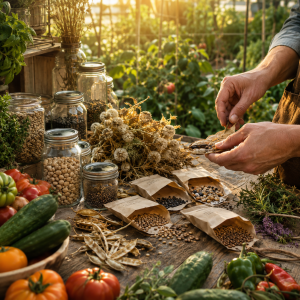
 Every spring, gardeners begin dreaming about the harvest. We imagine juicy tomatoes, crisp cucumbers, sweet peppers, baskets of green beans, and enough zucchini to make the neighbors turn off the porch light and pretend they aren’t home. We picture jars lined up on pantry shelves, fresh produce on the table, and that deeply satisfying moment when dinner came from the dirt instead of a drive-through window.
But somewhere along the way, many of us forgot that the most valuable part of the harvest may not be what we eat.
It may be what we save.
The seeds.
One tomato can hold dozens, sometimes hundreds, of seeds. One lettuce plant can produce thousands. A single bean pod may contain the beginning of next year’s garden, and a handful of properly saved seeds can multiply into enough food to feed a family and still leave more seed behind for the following season.
Those tiny seeds are food, insurance, independence, and hope packaged in something small enough to disappear into the bottom of your purse beside three receipts and a cough drop from 2019.
I’ve spent years purchasing seeds for exactly this reason. In fact, I have thousands of them stored away. I don’t expect to plant every one of them next spring, and I’m not quietly planning to convert my yard into a regional agricultural empire, although Survivor Steve would already have the tractor financed and a laminated crop-rotation chart.
I collect seeds because they represent something canned food never can.
Renewability.
Open a can of green beans and, after dinner, you have an empty can. Plant a handful of green bean seeds and you may harvest dozens of pods, each containing the makings of next year’s crop. That isn’t merely storage. That’s multiplication.
It’s the difference between owning dinner and owning the possibility of dinner for years to come.
What Yesterday’s Gardeners Understood
Our great-grandparents rarely thought twice about saving seeds because buying fresh packets every spring wasn’t always practical or even possible. There was no clicking “add to cart,” no two-day shipping, and no cheerful email announcing that your pole beans had left the warehouse.
They selected seeds from their healthiest and most productive plants, allowed those plants to mature fully, collected the seeds, dried them carefully, and tucked them away until the following season.
They weren’t merely preserving food.
They were preserving genetics.
Over time, families and communities developed varieties uniquely suited to their own soil, climate, and growing conditions. A tomato that handled the heat well, a bean that kept producing despite poor soil, or a squash that survived the local bug population’s annual all-you-can-eat buffet was worth saving.
Those seeds became more than gardening supplies. They became part of a family’s accumulated knowledge and, in some cases, part of its legacy.
Today, many of us have become consumers instead of stewards. We buy seeds, plant them, harvest the vegetables, clear the garden, and then purchase the whole operation again the following spring. There’s nothing wrong with buying seeds. I’ve clearly done my part to keep seed companies solvent.
But learning to save them restores a layer of independence that gardeners relied upon for thousands of years.
Not Every Seed Is Created Equal
Before you start saving every seed you encounter, there’s one important distinction to understand.
Open-pollinated and heirloom varieties generally produce offspring that resemble the parent plant, assuming they haven’t cross-pollinated with another compatible variety nearby. Save the seed from a good heirloom tomato, for example, and you can usually expect a similar tomato next year.
Hybrid seeds are different.
They’re produced by intentionally crossing two parent varieties to create specific traits in the first generation. You can sometimes save and grow their seeds, but the next generation may not look, taste, or produce like the plant you started with.
You might get a perfectly good vegetable.
Or you might get something that looks like a tomato, tastes like a pumpkin, and spends the summer making you question every decision that led you to gardening.
That unpredictability is why gardeners who plan to save seed often favor heirloom and open-pollinated varieties.
Saving Seeds Is a Skill Worth Learning
Owning seeds is valuable, but knowing how to produce and save your own is far more powerful.
A seed collection can eventually lose viability, get damaged by moisture, or simply run out of the varieties you depend on most. The skill of collecting new seed from a healthy crop allows you to replenish what you have instead of permanently depending on what you bought years ago.
Some seeds are obvious. Beans and peas can be left on the vine until their pods become dry and brittle, then shelled and stored. Mature pepper seeds can be removed, dried, and saved. Tomato seeds take a little more work because of the gel coating around them, but a short fermentation process helps separate the viable seeds and prepares them for storage.
Other seeds are less obvious because we usually harvest the plant long before it reaches that stage.
Lettuce is a perfect example.
Most of us pull lettuce once it bolts because the leaves turn bitter and the plant starts looking like it has abandoned all personal grooming standards. A seed saver, however, allows one or two of the healthiest plants to remain in the garden.
The lettuce sends up a tall flowering stalk and eventually produces small yellow flowers. Once those flowers mature and dry, they develop fluffy seed heads that look like miniature dandelions. The seeds can be collected by gently rubbing the dry heads over a paper bag or container.
What appears to be the sad, overgrown remains of a lettuce plant is actually hundreds, possibly thousands, of future salads waiting for someone to stop calling it ugly.
The same principle applies to many herbs. Basil, dill, cilantro, parsley, and others will all produce seed if allowed to complete their natural life cycle. Radishes grow seed pods after flowering. Carrots, being biennial, usually need to survive a winter and flower during their second season before producing seed.
Each plant has its own method and timing, but none of this is beyond the reach of an ordinary gardener. It simply requires learning what the plant looks like after the point when most of us would have yanked it out and thrown it on the compost pile.
That’s the part of seed saving I find most fascinating.
We’ve become accustomed to recognizing plants only at the stage that benefits us immediately. We know lettuce as leaves, radishes as roots, and carrots as orange things we intend to eat but somehow keep forgetting in the crisper drawer.
The plant, however, has an entire life story after our dinner plate, and the ending contains the seed for the next beginning.
A Tiny Packet With Enormous Value
Seeds require no electricity and very little room. They can be stored, shared, gifted, traded, and carried far more easily than the food they may eventually produce.
In the right circumstances, a small packet of seed could be worth far more than its weight would ever suggest.
Imagine a prolonged disruption in which fresh produce becomes scarce or expensive. A can of corn may provide part of one meal, but a packet of appropriate corn seed could potentially create food for years, provided someone has the soil, knowledge, growing season, and willingness to use it.
The seed isn’t instant food, of course. You can’t hand someone a packet of carrots at lunchtime and tell them to chew slowly.
Seeds are something different.
They are productive potential.
They can also become valuable for barter or community cooperation. One gardener may have an abundance of bean seed but no squash. Another may have saved a tomato variety that performs especially well in the local climate. Exchanging seeds allows both people to increase their options without waiting for a distant supplier to restock the right packet.
That’s another reason I’ve accumulated so many seeds over the years. They aren’t only for me. They represent the ability to help someone else begin growing food, replace a failed crop, or try a variety better suited to their conditions.
A jar of seeds may not look very impressive sitting on a shelf, but neither does a spark until you need a fire.
Storing Seeds Properly
The primary enemies of stored seeds are heat, moisture, and light. Seeds generally last longer when they’re kept cool, dry, and dark.
Many gardeners place thoroughly dried seeds in labeled paper envelopes and then store those envelopes inside an airtight container. A small food-safe desiccant packet can help control moisture, especially in humid climates.
Labeling matters more than you might imagine.
At harvest time, you may feel absolutely certain you’ll remember which tiny brown seeds came from which plant. Six months later, you’ll be staring at twelve envelopes containing what appears to be identical agricultural confetti, wondering whether you’re about to plant lettuce, basil, or something that will quietly take over the county.
Write down the variety name, harvest year, and any useful notes about the plant. Was it particularly productive? Did it resist disease? Did it taste wonderful? Did it survive drought better than the others? Did it produce enough zucchini to damage neighborhood relations?
Those details help turn a pile of seeds into a useful record of what actually performed well in your garden.
Stored seeds should also be tested periodically. A simple germination test using a damp paper towel can show whether an older batch is still viable. Even seeds with reduced germination rates may still be useful; you may simply need to plant more of them.
The point is to know what you have before you’re counting on it.
The Difference Between a Consumer and a Gardener
One of the biggest differences between a consumer and a gardener is what each person notices at the end of the season.
A consumer sees the last tomato.
A gardener sees next year’s tomato plants.
A consumer sees a dried lettuce stalk that should have been pulled weeks ago.
A gardener sees thousands of future salads.
A consumer sees the end of the harvest.
A gardener sees the beginning of the next one.
That shift in perspective is at the heart of preparedness. It teaches us to look beyond immediate use and recognize the future contained inside the resources we already have.
Seeds are small enough to spill through your fingers, yet they carry the ability to reproduce food, preserve varieties, strengthen communities, create barter value, and give another family a place to begin.
The greatest harvest isn’t always what you gather this year.
Sometimes it’s what makes next year’s harvest possible.
And if nothing else, it may finally give you a noble reason for letting that lettuce plant stand there looking like it lost a fight with a weed whacker.
0 Comments