 Yes, I’m really writing an article about eating insects.
There are moments in life when you realize your career has taken an unexpected turn, and researching the best way to cook a cicada is apparently one of mine. But stay with me, because someday this information may actually be useful. Maybe you’ll be in a real emergency and conventional protein sources will be scarce. Maybe you’ll want to impress your grandchildren with knowledge they desperately wish you did not possess. Or maybe you’ll simply find yourself at a Boy Scout activity where somebody hands you a cricket and says, “Go ahead.”
At least now you’ll know whether dinner is looking back at you legally.
And before anyone thinks I’ve finally wandered too far into the preparedness woods, edible insects have become mainstream enough that the FDA actually has regulatory categories for whole edible insects, insect bars, insect baked goods, insect candy, insect trail mix, insect jerky, insect ice cream, insect smoothies, insect soups, and even simulated meat made from insect protein. Somewhere in Washington, a government employee has had to type “edible insect candy” with a completely straight face. I would very much like to have been in the room when that category was approved. FDA Access Data
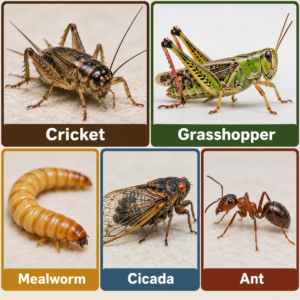
There are far more edible insects than the five we’re going to talk about here. People around the world eat numerous species of beetles, caterpillars, ants, bees, wasps, grasshoppers, crickets, termites and other insects. But unless this article suddenly becomes The Encyclopedia of Things That Crawl, we’re going to stick with five fairly recognizable options that make sense for North American readers.
Before Survivor Steve grabs a frying pan and heads into the backyard, however, we need one important rule: edible does not mean every insect in that category is automatically safe to eat. Identification matters. Where the insect came from matters. What chemicals it may have encountered matters. And in most cases, cooking it matters.
Now that I have temporarily ruined everyone’s breakfast, let’s talk protein.
1. Crickets: The Gateway Bug
If edible insects had a public-relations department, I suspect crickets would be running it.
They’re already farmed commercially for human food, sold roasted and seasoned, and ground into cricket flour or protein powder. Of all the bugs on this list, crickets may be the easiest psychological entry point because somebody else has already done the unpleasant part of turning them from “thing hopping across the basement” into “ingredient.”
If you were gathering them yourself, crickets are generally found in grassy places, gardens, fields, under vegetation, and around other protected areas. But for ordinary experimentation, I would much rather start with crickets raised specifically for human consumption than scoop up whatever has been living behind the lawn mower. Knowing the food source and how the insects were raised eliminates quite a few variables.
Crickets can be roasted, toasted, pan-fried, or dried and ground into flour. Seasoned roasted crickets are probably the least intimidating whole-bug approach because they become crisp and can be treated much like a crunchy snack. Cricket flour takes things a step further for people who would prefer their protein not retain its original number of legs.
This raises an important philosophical question: if you cannot see the cricket anymore, does it still count as eating a cricket?
I’m going with no.
2. Grasshoppers: Remove the Gym Equipment First
Grasshoppers are eaten in many parts of the world and are closely related to crickets. They are abundant in grassy fields, meadows, gardens and agricultural areas, particularly during warm weather.
If you ever had to collect them, cooler mornings can make the job easier because grasshoppers are less active before the day warms up. Attempting to catch them at peak performance may cause you to discover that your emergency protein has substantially better cardio than you do.
Traditionally, grasshoppers are commonly roasted or fried. The legs and wings are often removed because they can be tough and unpleasant to eat. That leaves the body, which can then be cooked until crisp and seasoned.
This is probably the first point in the article where someone is saying, “Kellene, I was perfectly happy not knowing any of this.”
I understand.
But someday you may be the only person at Scout camp who knows to take the wings off dinner, and suddenly everyone will respect you.
Or avoid you.
Either result has advantages.
One caution here is especially important: do not collect grasshoppers from agricultural fields, lawns or other places that may have been sprayed with pesticides or herbicides. A field full of grasshoppers may look like an all-you-can-eat buffet, but if that field has recently been chemically treated, I would graciously decline the reservation.
3. Mealworms: Unfortunately, the Name Is Accurate
Mealworms are actually the larvae of darkling beetles, which somehow does not improve the marketing.
Fortunately, they are one of the easiest edible insects to obtain because they are widely farmed. Again, if the goal is human consumption, I would choose mealworms raised and sold as food for people, rather than raiding the pet-food section and assuming everyone at the factory had your dinner plans in mind.
Mealworms can be roasted until crisp, pan-fried, incorporated into baked foods, or dried and ground into powder. Because they’re small and relatively mild, they also disappear nicely into other foods—which I consider a strong culinary virtue in anything that was recently crawling.
For preparedness purposes, this is where insect farming becomes interesting. Unlike hunting for grasshoppers or waiting seventeen years for the cicadas to show up on schedule, mealworms can be raised in contained systems with relatively little space. I’m not suggesting that everyone immediately convert the guest bedroom into a mealworm ranch. I’m merely pointing out that protein production can look very different when circumstances change.
Also, imagine explaining to your houseguests why the spare bedroom is humming with agricultural productivity.
That alone may reduce overnight visitors.
4. Cicadas: Dinner Arrives by the Billion
Cicadas may be the most fascinating edible insect on the list simply because of the sheer numbers that can appear during a major emergence. When periodical cicadas emerge, nature basically announces, “Protein aisle open.”
University of Illinois Extension specifically discusses eating periodical cicadas and recommends collecting them just after they molt, while they are still pale, soft-bodied and before the new exoskeleton hardens. They climb trees and other vertical surfaces to shed their nymphal skin, so tree trunks can be excellent places to find them during an emergence. Illinois Extension
Illinois Extension recommends avoiding cicadas from areas with heavy pesticide use or contaminated soil because the insects can potentially accumulate unwanted contaminants during their long underground lives. The Extension also recommends cooking them before eating. Illinois Extension
Once harvested, cicadas can be blanched and then roasted, fried, battered or incorporated into other foods. Illinois Extension employees went considerably farther and produced cicada pesto, tempura cicadas and even cicada ice cream.
I admire their commitment to science.
Personally, once someone reaches the sentence “Would you like cicadas on your ice cream?” I feel we have crossed from preparedness into a dare.
People who have eaten cicadas have described the flavor in different ways, including nutty or almond-like. Illinois Extension even notes reports of an almond flavor. Illinois Extension
There is one very important warning with cicadas and other edible insects: people who have a shellfish allergy may also react to insects because they can share allergenic proteins such as tropomyosin. Illinois Extension specifically advises people with shellfish allergies to avoid eating cicadas or consult an allergist. Illinois Extension
Apparently cicadas are basically shrimp that chose real estate instead of waterfront property.
5. Ants: Please Don’t Just Eat the Anthill
Yes, ants are eaten in various parts of the world, including regions of Mexico, and certain species are considered delicacies.
No, that does not mean I want anyone marching outside with a spoon.
Different species have different chemical defenses and flavors, so positive identification matters enormously. This is the insect on our list where I would be most reluctant to give anyone a blanket “go harvest these” recommendation. If you’re curious about ants as food, commercially prepared edible ants or guidance from someone experienced with the edible species in your area is far more sensible than choosing one based on enthusiasm.
Edible ants are often roasted or toasted, and some species have naturally tart or citrus-like flavors because of the acids they produce. They can be eaten whole, ground into seasonings, or incorporated into other dishes.
It turns out the phrase “there are ants in the food” can either indicate a sanitation problem or a recipe.
Context is everything.
A Few Rules Before You Start Looking at the Backyard Differently
Wild insects should be treated as wild food, not as novelty candy. You need to know exactly what you’re collecting and exactly where it came from. Avoid insects from lawns, orchards, agricultural fields and gardens where pesticides may have been used, as well as areas near roads, polluted water, contaminated soil, garbage, manure or other questionable environments.
And cook them.
That is not merely because a warm cricket sounds marginally more appetizing than a cold one. Insects can carry microorganisms just as other foods can. FDA import records even include edible insect products among foods subject to Salmonella-related controls, which should remove any lingering notion that bugs somehow arrive with their own tiny food-safety exemption. FDA Access Data
I would also avoid the very common survival-show temptation of grabbing an unidentified grub, caterpillar or beetle and announcing, “Protein!”
Maybe.
Or maybe that caterpillar has been feeding on a plant full of chemical defenses and would prefer to continue living its life without becoming part of yours.
Knowing that some insects are edible is not the same as knowing that this particular insect in your hand is edible.
That distinction seems worth making before lunch.
So…Why Would Anyone Actually Need to Know This?
For most of us, eating insects is unlikely to become tomorrow’s dinner plan.
And I am completely comfortable with that.
But preparedness has never been only about the things we expect to use. It is also about understanding the resources around us. In a prolonged emergency, a wilderness situation, an interrupted food supply, or even a simple survival-training exercise, knowing that certain insects can provide food and protein is useful information.
There is also something valuable about confronting the assumptions we make about food. Americans tend to look at a cricket and think “pest” while people elsewhere look at the same cricket and think “snack.” Neither reaction is encoded into the cricket. Culture did that.
And preparedness has a wonderful habit of making us reconsider categories.
A weed becomes food.
A bedsheet becomes a bandage.
A stale bottle of cooking oil becomes lamp fuel.
A cotton T-shirt becomes a wick.
And apparently, if things get strange enough, the thing chirping outside your window becomes an appetizer.
I sincerely hope you never need this article for survival.
But if nothing else, the next time someone at a Boy Scout activity passes around roasted crickets, you can calmly remove a leg, look everyone else directly in the eye, and say:
“Oh, this? I’ve researched this.”
Survivor Steve will be so proud.
0 Comments