 If you have been preparing for any length of time, you have heard it.
“If things ever get really bad, I’m coming to your house!”
Usually it is said with a laugh. Sometimes with a little wink. Occasionally with enough confidence that you begin to suspect the person has already assigned themselves a bedroom.
Prepared people tend to attract this kind of comment because preparedness creates a visible sense of security. You have food. Water. Skills. Backup plans. Maybe a generator. Maybe a garden. Maybe you know how to cook without power and can distinguish a water filter from something purchased at a sporting-goods store merely because it looked tactical. To the unprepared, that can look less like self-reliance and more like a reservation system.
And that is where things get complicated.
Because I absolutely believe in charity. I believe in helping people. I believe in sharing what I have when someone is genuinely in need. My Christian faith does not permit me to look at suffering with indifference and say, “Well, you should have planned better.”
But neither does my faith require me to become the emergency cruise director for every person who decided that preparedness was unnecessary because apparently I was doing enough of it for both of us.
**Charity is given. It is not demanded. **That distinction matters.
“I’m Coming to Your House” Is Not Actually a Plan
There is something almost endearing about a person announcing that their entire emergency strategy consists of locating you. It is also revealing.
When someone says, “I’m coming to your house,” what they often mean is, “I have noticed that you have spent time, money, effort, and thought preparing for difficult circumstances, and I have decided that my contribution will be transportation.”
That is not quite the same thing.
Every additional person entering a household during a crisis adds needs. They need water, food, sleeping space, sanitation, heat or cooling, medication, clothing, emotional support, information, safety, and sometimes, depending on the person, an astonishing amount of toilet paper. They also add personalities, habits, pets, dietary needs, medical issues, and opinions about how everything should be managed.
You also have to decide ahead of time that if you take people into your home, one rule is not negotiable: you are still in charge of your household. It’s your schedule, your supplies, your chore list, and your responsibility to make the decisions that keep everyone functioning. Anyone you welcome in needs to understand that they’re joining your household—not taking a vote on how it should be run.
A prolonged emergency is already stressful enough without discovering that Cousin Larry has strong views about rationing despite having brought nothing but a duffel bag and an appetite.
This is why the conversation needs to happen before the crisis, not during it.
You do not have to be rude. You do not need preparedness membership cards or a velvet rope outside the pantry. But you do need boundaries, and you need them before fear, guilt, exhaustion, or surprise begins making decisions for you.
Everyone Contributes
This may be the most important rule in my house: if you become part of the household during a prolonged emergency, you become part of the functionality of the household.
No freeloaders. Not even the dogs.
And I am only half joking about the dogs. A well-trained dog can contribute enormously to a household in difficult circumstances. A dog that comes when called, stays when told, walks calmly on a leash, settles quietly, alerts appropriately, and can tolerate being handled or crated is far easier to manage when life is already chaotic. So if your dog currently believes “come” is merely an interesting suggestion, now would be an excellent time to revisit that arrangement.
The people have even less excuse.
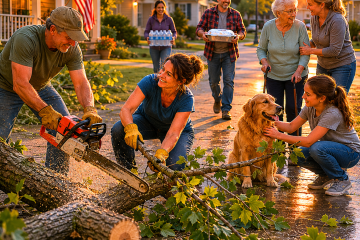
Someone can cook. Someone can clean. Someone can haul water. Someone can manage children. Someone can tend a garden, inventory supplies, care for animals, handle sanitation, repair things, chop wood, wash dishes, stand watch, administer first aid, or simply make sure the household does not dissolve into a committee meeting every time something needs doing.
Not every contribution requires physical strength. An elderly family member may not be carrying five-gallon water containers, but perhaps she can prepare meals, mend clothing, supervise children, organize supplies, or teach skills. Someone with physical limitations may be perfectly capable of keeping records, handling communications, managing medications, or preparing food.
Contribution is not about proving your worth. It is about recognizing that a functioning household requires work.
In normal life, electricity, running water, grocery stores, garbage pickup, washing machines, dishwashers, and modern plumbing do enormous amounts of labor for us. Remove a few of those conveniences and suddenly everyone discovers that survival has a staffing requirement.
Survivor Steve arrives with three cans of soup and announces that he is “mostly here for morale.”
Wonderful.
Morale can start by washing the dishes.
Make the Chore List Before You Need the Chore List
One very practical thing you can do now is make a list of the jobs that would keep your household functioning during a prolonged disruption.
Think through your likely needs before anyone is tired, scared, hungry, or arguing over whose turn it is to fetch water. What needs to happen every morning? What needs to happen before dark? Who checks the animals? Who manages food? Who handles sanitation? Who monitors fuel? Who maintains security? Who communicates with family? Who is responsible for medication schedules? What jobs can children handle? Which tasks require two people?
You are not trying to predict every crisis. You are simply giving your future household some structure to fall back on.
That matters because when normal systems disappear, people naturally begin searching for order. If you have already thought through the basic work of keeping your household running, you are not inventing a civilization while standing in your kitchen with a flashlight in your mouth.
You already have a framework. And framework creates calm.
The Prepared Household Cannot Become a Free Resort
This is where good-hearted people can get themselves into trouble.
When we see someone in need, especially someone we love, the instinct is to give. Good. Keep that instinct. But giving does not mean surrendering responsibility for your household.
If I have carefully stored enough food for six people and suddenly fifteen people arrive expecting meals, my generosity does not create more food. Compassion cannot override mathematics.
The same applies to water, medicine, fuel, sanitation supplies, sleeping space, security, and every other finite resource.
And here is the part I think we forget far too often: every yes contains a no somewhere else.
If I say yes to feeding one more person from a limited supply, I may be saying no to future meals for someone already under my care. If I say yes to giving away fuel, I may be saying no to heat later. If I say yes to one additional household, I may be saying no to another person with greater need.
That does not mean the answer should always be no. It means the answer should be thoughtful.
Even Scripture gives us permission to be clear rather than endlessly evasive. Christ taught, “Let your communication be, Yea, yea; Nay, nay.” A yes can be righteous. A no can be righteous too. What matters is that we are honest, wise, and accountable in what we promise.
Wise charity considers consequences. That does not make it less Christian. It makes it responsible.
Do Not Let Your Christian Heart Be Manipulated
This is an uncomfortable subject, but it needs to be said plainly. A Christian heart can be generous. It can also be manipulated.
There is an enormous difference between someone humbly asking for help and someone using guilt, entitlement, Scripture, family obligation, or emotional pressure to demand access to what you have prepared.
“You call yourself a Christian?”
“Jesus said to feed the hungry.”
“You have plenty.”
“You would really turn away family?”
“You can’t possibly need all of that.”
Those statements can cut deeply because they target the very values that make generous people generous. But charity obtained through coercion is not charity. It is compliance.
I believe I answer to God for how I treat people in need. I do not answer to manipulative people for whether my generosity meets their preferred quantity.
Christian charity should be freely given, prayerfully guided, and wisely administered. It should not be extracted through guilt.
Compassion and boundaries are not enemies. They belong in the same household. Preferably one where everybody has chores.
Decide Before Emotions Decide for You
A crisis is a terrible time to determine your boundaries.
Imagine someone you love standing at your door frightened, hungry, and carrying children. That is not the moment you want to begin calculating water consumption.
Prepare emotionally as well as materially.
Who would you unquestionably take in? Parents? Children? Grandchildren? Siblings? Close friends? What about extended family? Neighbors? Members of your congregation? Someone stranded nearby?
There is no universal answer. Your house, resources, family responsibilities, location, security situation, and spiritual convictions are your own.
But thinking about these questions ahead of time gives you the ability to respond thoughtfully instead of reactively.
You may even decide to store extra specifically for charity. I love that idea. A separate supply of food, hygiene items, water, blankets, or basic necessities that you have intentionally designated for helping others changes the emotional equation considerably.
Now you are not deciding whether to take food from your household. You have already created room for generosity. That is preparedness too.
What Do You Actually Say?
Because sooner or later somebody really will say it:
“If things get bad, I’m coming to your house.”
You do not need to launch into a preparedness sermon or hand them a residency contract. A light but truthful response can accomplish a lot.
You might say:
“You’re welcome to come prepared to work. Everybody in this house contributes.”
Or:
“You’d better start bringing supplies over now, because my preparedness plan does not currently include feeding your entire household.”
Or, a little gentler:
“I’d much rather help you get prepared now so neither of us has to worry about that later.”
Or, more to the point:
“I don’t think I have you on my list…yet.” And then you can get into a discussion about what skills or assets they would have to contribute in order to consider your home a haven in a crisis.
For family:
“We would always want to help if we could, but please don’t make us your whole emergency plan. Let’s get you started on your own supplies.”
And for the person who is clearly joking but perhaps not entirely joking:
“Fine. I’ll put you down for sanitation duty.”
Suddenly the conversation becomes much less theoretical.
The important thing is to communicate that your home is not a guaranteed emergency destination simply because you prepared. If you eventually choose to help, that decision belongs to you. It is not an entitlement someone else can claim in advance.
Help People Prepare Before They Need Your Help
One of the most charitable responses to “I’m coming to your house!” may be:
“I’d love to help you get prepared so you don’t have to.”
Help them start with water. Help them build a pantry. Give preparedness items as gifts. Teach them how to cook from stored foods. Show them inexpensive ways to create backup lighting. Help them make an evacuation plan. Encourage them to store medications, pet supplies, hygiene items, and basic necessities.
Sometimes people joke about coming to your house because they genuinely do not know where to begin.
That is an opportunity.
Invite them into preparedness now instead of inviting them into your pantry later.
Guests Become Team Members
If circumstances truly require additional people to live in your household, establish expectations quickly.
Everybody should understand how food is being managed, how water is being used, what sanitation procedures are required, where people sleep, how household chores are divided, what security rules exist, and how decisions are made.
This is not authoritarian. It is organizational survival.
A household without clear responsibilities quickly becomes one person doing all the work while everyone else continually asks what is for dinner.
Assign tasks according to ability. Rotate unpleasant jobs. Include children where appropriate. Keep people useful and productive.
Work itself can be psychologically stabilizing during a crisis because it gives people purpose and structure. People who contribute begin to see themselves not as refugees from somebody else’s disaster plan but as members of a functioning little community.
That shift matters. There is dignity in contribution and resentment in entitlement. Choose dignity.
And Yes, Even the Dogs
The dog joke is funny, but there is a serious preparedness principle behind it.
Pets consume resources. They need water, food, medication, sanitation, warmth, transportation, and sometimes specialized care. If someone plans to arrive at your home with four children, two dogs, three cats, and a parrot named Winston, that information changes your calculations considerably.
People arriving with animals should bring supplies for those animals whenever possible.
And again, train the animals you already have.
A dog that reliably follows basic commands during an ordinary Tuesday will be dramatically easier to protect and manage when alarms are sounding, doors are open, strangers are coming and going, or everyone needs to evacuate quickly.
Your emergency dog-food reserve should not automatically become the neighborhood kennel buffet. The animals may be innocent freeloaders. Their humans are not.
Generosity Works Better With Boundaries
Preparedness should make us more capable of helping others, not less willing. That is one of the reasons I prepare. I want margin. Margin allows generosity.
When I have enough food, I can share food. When I have backup water, I can give someone water. When I have knowledge, I can teach. When I have stability, I can provide calm.
But margin disappears quickly when generosity has no boundaries. So yes, if something terrible happens, perhaps you can come to my house. But understand what that means.
You are not checking into the Preparedness Pro Bed & Breakfast. There is no concierge. Room service has been discontinued. The continental breakfast requires somebody to grind the wheat.
If you come through the door, you become part of the household. You contribute, conserve, help, respect the rules, and take your turn doing the jobs that keep everybody functioning.
And if Survivor Steve is already there, congratulations.
He has been promoted to dishes.


0 Comments