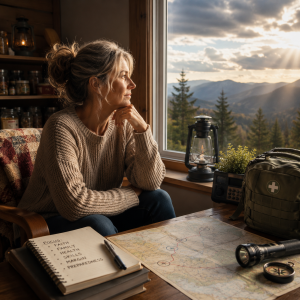
 Have you ever noticed that some people seem to spend more time preparing for the end of the world than they do preparing for Tuesday?
I have.
In fact, somewhere along the way, parts of the preparedness community started acting as though the grand prize goes to whoever can predict the next catastrophe first. If someone sneezes on the other side of the world, somebody else is already posting a video explaining how it signals the collapse of civilization as we know it. Give it another twenty minutes and someone else will explain why the squirrels have been acting suspicious lately. Okay…I made that last one up. At least I hope I did.
Don’t misunderstand me. I absolutely believe in paying attention to what’s happening in the world. I’ve spent nearly twenty years encouraging people to prepare for life’s interruptions and emergencies. Ignoring reality has never been a preparedness strategy. But neither is living as though every headline deserves to rent space in your head.
Fear has always been a powerful motivator. It captures our attention, keeps us clicking, and convinces us that if we don’t read one more article or watch one more video, we’ll somehow be caught off guard. The problem is that fear doesn’t simply capture our attention—it lingers. It follows us into our kitchens, our family dinners, our vacations, our church pews, and sometimes even into bed at night. I don’t believe that’s healthy, and I certainly don’t believe it’s what preparedness was ever meant to become.
Somehow, exhaustion has become a badge of honor in parts of the preparedness community. People spend hours doom-scrolling, watching one “breaking news” video after another, and consuming an endless stream of alarming predictions. At the end of the day, they aren’t actually more prepared—they’re simply more mentally exhausted.
I’ve come to believe there’s a tremendous difference between being informed and being emotionally exhausted. Unfortunately, too many people have started confusing the two.
I sometimes picture Survivor Steve sitting in front of six computer monitors with enough browser tabs open to make his laptop beg for mercy. He knows what every foreign government is doing, has memorized the latest conspiracy theory, and can explain three different scenarios for an EMP attack. Unfortunately, he can’t remember the last time he tested his smoke detectors, changed the batteries in his flashlight, or rotated the food in his pantry. Somewhere along the way, he became an expert on tomorrow while neglecting today.
The irony is that Tuesday is still far more likely to arrive than the apocalypse. A dead car battery, a job loss, a broken water heater, an unexpected medical bill, or a week-long power outage are the kinds of disruptions most of us are actually going to face. They don’t make dramatic headlines because they aren’t dramatic enough to generate clicks. But they happen every single day, and they’re exactly the kinds of situations preparedness was designed to help us handle.
The goal of preparedness should never be to carry tomorrow’s burdens before they arrive. The goal is to become more capable so that when tomorrow finally does arrive, we’re ready to meet it with confidence instead of panic. Those are two very different ways to live, and only one of them actually creates margin.
That’s one of the reasons I’ve become convinced that we need to be just as intentional about protecting what enters our minds as we are about protecting what enters our homes. Most of us already understand that what we eat affects our physical health. We read labels, try to avoid things that are harmful, and make thoughtful choices about what we bring into our kitchens. Perhaps it’s time we became just as careful about the information we consume, because what we feed our minds affects our peace every bit as much as what we feed our bodies affects our health.
I’ve started asking myself a simple question whenever I finish reading an article or watching a video: Do I feel more equipped…or merely more alarmed? That’s become one of the healthiest filters I know. If the information I’m consuming consistently leaves me exhausted instead of equipped, then it probably isn’t helping me become more prepared. It’s simply consuming the very margin I’m trying to create.
I’m not suggesting that we ignore reality or pretend difficult things can’t happen. They can. They always have. But I do think we should ask ourselves whether all that consumption is producing anything worthwhile. Has it strengthened your faith? Has it improved your health? Has it taught you a practical skill? Has it helped you become more financially resilient? Has it strengthened your relationships? Or has it simply convinced you that you should be more afraid than you were yesterday?
That’s not preparedness.
That’s surrendering today’s peace to tomorrow’s possibilities.
You’ve spent years reading articles about what to prepare.
I think the next chapter of Preparedness Pro is about teaching how to think about preparedness.
That means learning to protect our minds as carefully as we protect our pantries. It means recognizing that preparedness should strengthen our confidence instead of feeding our anxiety. It means remembering that becoming more informed is only valuable if it also helps us become more capable.
My hope is that Preparedness Pro continues to be a haven for common sense—a place where peace is valued more than panic, wisdom more than worry, and margin more than mayhem. There are already enough voices trying to convince us that every headline signals the end of the world. I don’t think our families need more fear. I think they need more wisdom.
Preparedness should reduce your stress, not become another source of it.
Preparedness should leave you with a plan, not panic.
If my articles ever leave you exhausted instead of equipped, then I’ve failed my mission.
Preparedness Pro will never compete to see who can predict the next disaster. I’d rather help you become the kind of person who can handle whatever tomorrow brings.
So the next time a frightening headline flashes across your screen, don’t just ask yourself whether it’s true.
Ask yourself whether it’s useful.
Ask yourself whether it’s helping you become more capable.
Ask yourself whether it’s creating more margin.
And perhaps most importantly, ask yourself one simple question:
Do I feel more equipped…or merely more alarmed?
I have a feeling the answer to that one question may change not only the information you consume, but the peace you enjoy every single day.

0 Comments