 When you can get meat at a killer deal–can it!
All Rights Reserved 2012 Preparedness Pro/Kellene
I think if the real Suzy Homemaker had to can 100 pints of meat, or anything, she would be haggard and worn. However, modern day technology and science makes the tasks of our ancestors a proverbial cake walk. I often tell my students that I truly am the laziest preparedness person they will ever meet. If there is an easy way to do something, I find it. I work full-time nearly 6 days a week and have to manage my physical and emotional energy wisely. I assure you that if canning meat was a real torture, I certainly wouldn’t be doing it. So today, I’m going to hold your hand and walk you through this task step by step. Why? Because it’s too easy and too cheap for you NOT to be doing it. I find that it’s about a quarter of the price of canned meats—even those at Costco. Not only that, but there is a distinct difference in taste between the commercially canned meat and that which you can yourself. Seriously; I’ve NEVER tasted store-bought canned chicken that’s as moist and tender as the meat I can myself. It’s truly a delight!
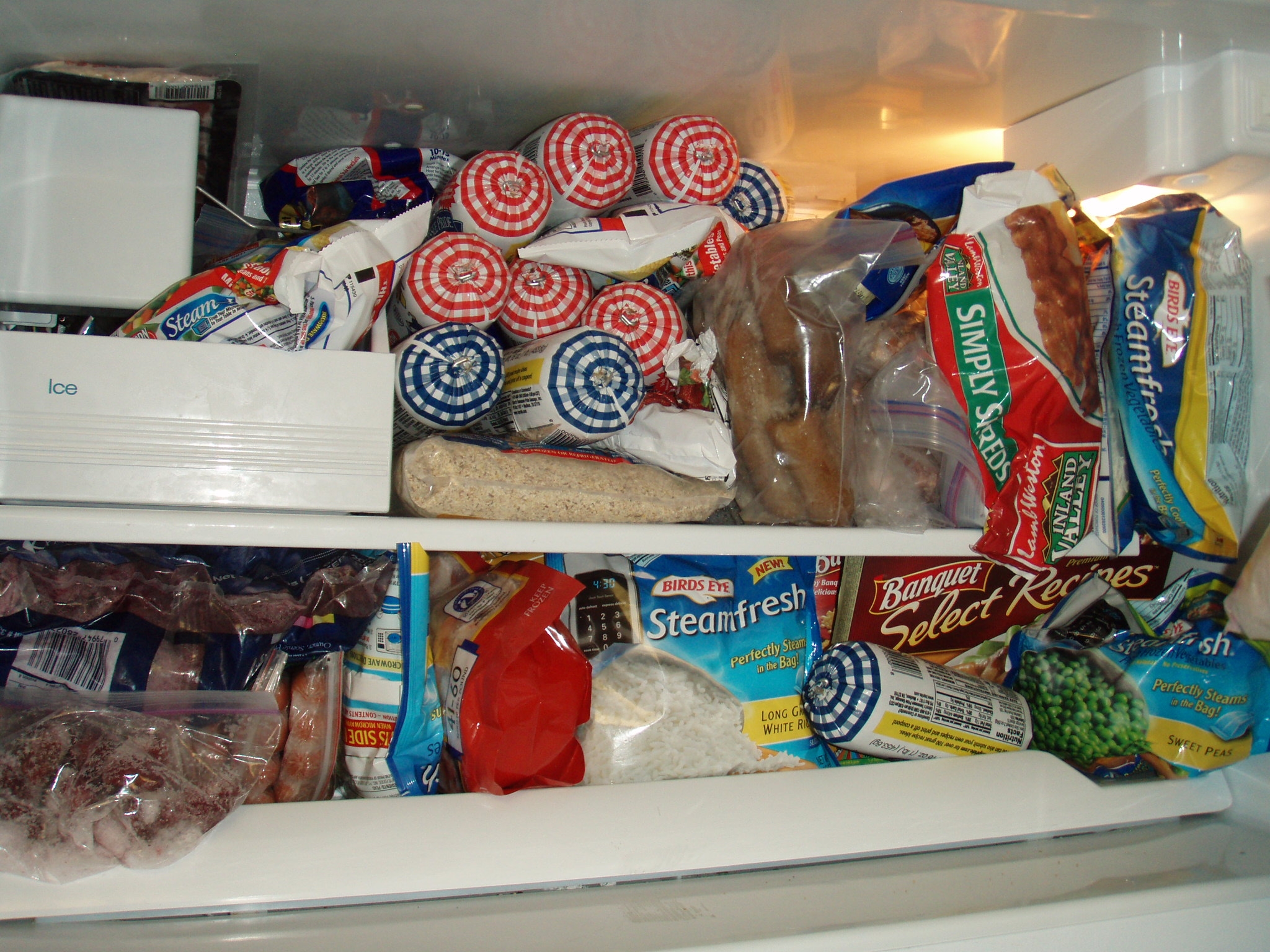 When your freezer is full–it’s time to can meat!
All Rights Reserved 2012 Preparedness Pro/Kellene
Why I love to can my own meat
Oh yeah, and another reason why I love canning meat is because my freezer is always FULL but I hate to miss out on buying loads of meat when it hits a rock bottom price just because I’m out of room. I mean really, I’m going to wish I had it later, right? So, when I can the meat instead of trying to find room in my freezer, I’m only limited by the number of jars I have on hand. Considering I can get those in abundance at Goodwill or at Salvation Army type stores; that really isn’t an insurmountable problem.
Just to answer a few anticipated questions initially; no, you do not have to add water to your canned meat. The meat, just like our own bodies already has sufficient moisture in it. However, I do so because I look at it as “free” broth that gets a deeper flavor over the years; so why not? Also, yes, you are able to can any kind of meat. I even can bacon! You can even can shrimp, halibut, ground beef, turkey, and steak.
 Try to keep the meat in as big of a piece as possible so you don’t have limited uses for it once it’s opened.
All Rights Reserved 2012 Preparedness Pro/Kellene
I try to keep the meat in as big of a piece as I can so that I don’t get pigeon-holed into a specific use for the meat. For example, when I bottle pork sirloin, I keep it as large a piece as possible so that I can use it as a small pork roast with potatoes and carrots or I can cut it up for Pork Guisada. This is also why I do not pre-season my meat with ANY seasoning, though a pinch of salt is fine, it’s not necessary.
Here’s what you’ll need to can your meat:
- A pressure canner. (I use an All-American brand. They are currently about $200 bucks on Amazon.com)
- Clean Mason jars with NEW lids (it doesn’t matter which brand you use, Kerr, or Ball. I don’t think I’ve even seen the actual brand “Mason” is quite some time). I prefer to use the large mouth, pint size jars since 1 pint usually holds a pound of meat and that’s what most recipes call for.
- A sharp meat knife
 All Rights Reserved 2012 Preparedness Pro/Kellene
- Paper towels
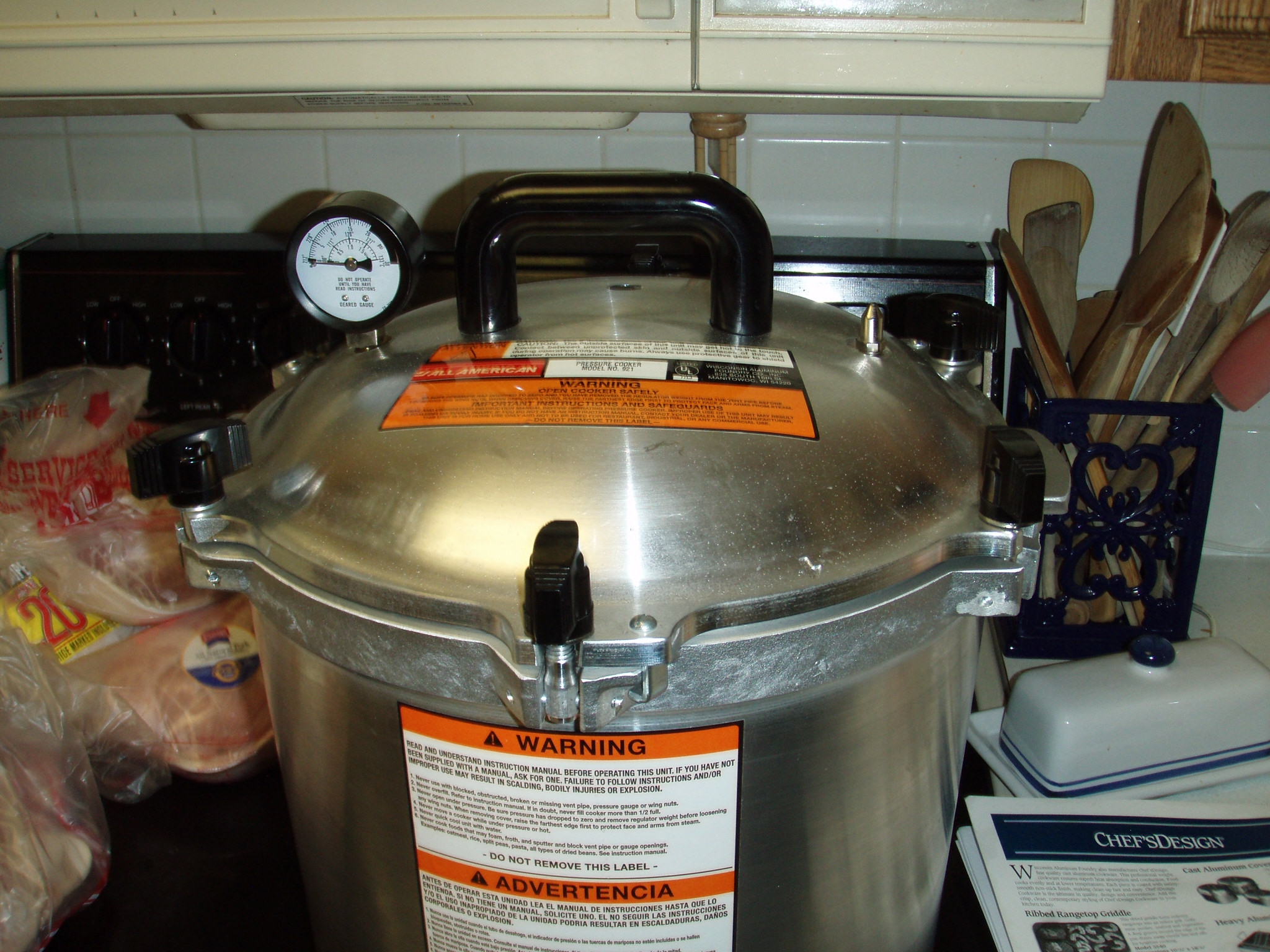
- White Vinegar (dampen your paper towel with it when you clean the rims of the jars.
- A butter knife
- Meat (with or without the bone in it. Your meat does NOT have to be cooked unless it’s ground meat. In which case you should brown it and then pack it.) When I’m bottling fresh fish, I take out the major bones as much as possible, but I don’t bother with the tiny ones. They tend to disintegrate in the jar through the pressure canning process.
 Make sure the meat and fluid only come to the bottom rim.
All Rights Reserved 2012 Preparedness Pro/Kellene
Open the jars and lay the lids off to the side while you work with your meat. Cut your meat to the desired size and place it in the jars. I prefer to only handle the inside of the jars once I’ve started packing them so that I don’t get any fat or oil on the rims as that can compromise the seal. Fill the jars up only to the bottom of the screw rim area on the jar—no further. This is known as “head space/head room.”
 Use a butter knife to remove any air bubbles
All Rights Reserved 2012 Preparedness Pro/Kellene
Once you’ve filled all of the jars with meat, pour in enough warm water to fill in the gaps of the meat packing. Remember, you don’t want to fill the jars any higher than the lowest point of the screw portion of the jar. (If the jar is not a wide mouth jar, then I actually stop right at the bend on the top of the jar, which is just below where the screw joint begins.)
Once you’re done filling in all of you jars with water, then go back with a butter knife and slide it down the inside of the jar. Doing so will allow more of the water to fill in the air gaps of the meat in the jar. I press the meat in a bit towards the center of the jar while I’m doing this to encourage better filling. Inevitably when you’re finished with this process, your jars will need a tad bit more water. Fill accordingly.
 Use a paper towel and white vinegar to wipe off any excess fluid
All Rights Reserved 2012 Preparedness Pro/Kellene
Once you’re finished filling the jars, take a clean paper towel, moisten it with vinegar, and then wipe the outside screw rim of the jar as well as the top rim. You want to make sure that there are no meat pieces, oils, debris, or fat on that section as it will compromise the jar sealing properly. Place the lid firmly on each jar and screw on “finger tip tight.” You don’t want to man-handle these tightly closed at this point.
 Add water up to the bottom rim
All Rights Reserved 2012 Preparedness Pro/Kellene
Place one of the racks that should be a part of your pressure canner set at the bottom of your pan. This is a must as the jars should not come in contact with the bottom of the pot. Fill your pressure canner 2 to 3 inches with water. (see your instruction manual for your particular canner) (Using warm or hot water will result in it taking less time for your canner to come up to full pressure. ) Add 1/4 cup of white vinegar. This will prevent the calcium/hard water stains on the jars and in your canner. Place the filled jars on the bottom rack inside your pressure canner, giving each jar just a bit of wiggle room. (NEVER put your jars directly on the bottom of the canner; always use the rack.) Then place your second rack on top of that layer of jars and top it with filled jars as well.
 Bottom layer of jars in the pressure canner
All Rights Reserved 2012 Preparedness Pro/Kellene
Place the lid on the canner according to manufacturer’s directions WITHOUT the pressure weight. Turn the burner on High. Allow steam to exit pressure valve for 5 minutes, then place the pressure weight on your pan, according to manufacturer’s directions and in consideration of your altitude.
 Uncovered pressure valve
All Rights Reserved 2012 Preparedness Pro/Kellene
Bring your pressure canner up to the appropriate pressure measurement (based on the kind of meat you’re cooking and your altitude) and then adjust/lower the heat to hold that pressure without needing to extract much heat or steam from the pressure weight valve. (This should take anywhere from 60-90 minutes.).
 Make sure you adjust your pressure weight to your altitude requirements. All Rights Reserved 2012 Preparedness Pro/Kellene
Upon finishing the pressure canning, remove the pressure canner lid according to manufacturer’s instructions.
 Yummy canned chicken All Rights Reserved 2012 Preparedness Pro/Kellene
Wipe off all of the jars with a clean, dry cloth and tighten the lids (as they will loosen in their grip during the canning process). Label the contents of the jar simply by writing on the flat part of the lid. I label it with the kind of meat in the jar as well as the month and day it was canned i.e. “Chx Brst 1/10” (translation: chicken breast, January 2010—thanks to all of my years waiting tables) Store in a cool, dry, place. Your canned meat will now store easily and safely for 3 to 5 years and you will love the taste!


242 Comments
wade · January 8, 2010 at 11:38 pm
What size (how many quarts) pressure canner do you have? It looks like it holds 18 jars (two levels with 9 on each)?
Kellene · January 9, 2010 at 4:38 am
it will do 15 jars of pints or quarts total. All American only sells the one size as best as I can tell.
MZ · January 10, 2010 at 7:37 pm
Kellene – they sell about SIX different sizes, ranging from a 10.5 quart to a 41.5 quart. Guess which one I have? 😉
Kellene · January 10, 2010 at 9:15 pm
I had no idea they sold that many different sizes. I have “model 921” and that’s about all I know about the “size”. Sorry, I’m really dense when it comes to knowing “quarts” and such about my pans that I use.
do tell, which one MZ
wade · January 12, 2010 at 4:07 am
Strange. Model 921 is 21 quarts which can only hold 7 quert jars. Are you sure you don’t have the 930 or the 941?
Kellene · January 12, 2010 at 6:46 am
Yup, I got it right off of the box and the lid. I couldn’t make up that kind of geek lingo. ha ha
Mike · June 6, 2016 at 2:57 am
21 1/2 Quarts (Liquid): 19
21 1/2 Quarts (Liquid): 19 Pint Jars, 7 Quart Jars.
So it’s only 21 quarts if you’re talking volume, it will fill up to 21 quarts of liquid.
However, because jars take up space, don’t fit snugly into the pot and require air to flow in between them, the amount of jars must be less than the total volume 😉
Preparedness Pro · June 6, 2016 at 1:51 pm
Yep.
Yep.
jamie · January 8, 2010 at 11:47 pm
I know you said we could can “Bacon” isn’t that a processed meat? Or is it a certain type of process used? Did I miss something?
Kellene · January 9, 2010 at 4:37 am
Most bacon isn’t processed. It’s simply thinly sliced meat from the pig.
Toni · January 9, 2010 at 12:44 am
Thanks for the info. I absolutely think that canning meat is the best thing ever!!! It makes dinners so much easier, especially when you are time constrained. Plus I love how moist it is.
Donna · January 9, 2010 at 2:06 am
When you use your chicken, do you use the broth for the liquid in the recipe or drain? When I would precook my chicken, I would refrigerate the broth, then skim off the fat then process just the broth, straining if necessary.
Kellene · January 9, 2010 at 4:37 am
I would never drain broth. I would at least save it for another recipe if it wasnt’ to be included in whatever I was making.
Debbie · January 9, 2010 at 2:34 am
Hi Kellene, I like to use a little bit of vinegar on my paper towel to wipe the rim before adding the lid and screwing it down, this makes sure there is no grease on it to prevent it making a seal. Also I think you should tell people to let the jars sit and cool for 24 hours in a none drafty place and not move them as this can cause the seal to break, then wipe clean (again vinegar works great to cut any grease that escapes) before writing on the lid.
I agree that having the meat precooked in jars is just great, and makes dinner very easy. I have also started to make some dinners up and I just have to dump the contents into a pot and add a thickener if needed. Check out this site,
if you haven’t already, she has some interesting recipes.
http://creativecanning.blogspot.com/
Kellene · January 9, 2010 at 4:46 am
Thanks for the valuable comment and the site recommendation, Debbie!
Todd · January 9, 2010 at 3:01 am
I’m curious how cheap your chicken is and if it is boneless as well as skinless. We regularly have it for $1.99 but some times we can get it with the bone and skin for cheaper. Not sure how much the savings are till you get rid of the unwanted parts.
Oh and I plan to pick up the 30 quart model any day now. Ebay has them for 262 shipped.
Kellene · January 9, 2010 at 4:39 am
I just bought some dark meat this week for 99 cents a pound. The max I’ll pay for boneless is $1.49 a pound. I just wait for the sales.
Kudos on your new purchase!
jamie · January 9, 2010 at 3:54 am
Yeah boning and filleting are skills. I know the premise, I’ve read how it’s supposed to be done. My efforts have been less than successful. A good thing though is even if you really screw up all that stuff can go in a soup pot or stock pot. Thank goodness, canned and frozen as well.
Todd I like the thigh meat on Chix for almost everything. Much more flavor than most white meat. I can get it here in Idaho anywhere from $.88 to $1.29 per pound.
I don’t like skinless chix, all the flavor is in the skin and the fat on it. I am sure a whole chicken is cheaper by the pound than a skinless breast no matter where you are. Also If you have bone in you get all that extra flavor from the marrow. Most Chickens in supermarkets are less than 4 months old. Yes they are tender but they also lack in flavor.
I still have a way to go for canning. But I have the whole freezing, curing and smoking thing done. I’m very proud of my jerky and Smoked salmon
Still needs some tweaks for flavor but basics are covered and the food is safe.
No one needs a dysentery or a bout of food poising in a emergency situation.
Barbara · January 9, 2010 at 4:12 am
For anyone who hasn’t tried this, canning meat is truly the easiest canning you will do. The jars do not have to be sterilized first although I do run them through the dishwasher just to be sure that they are clean. The flavor of canned meats is luscious – moist and tender. Fast food of the highest quality!
I look for recipes that call for cooked meat or I adjust the recipe to the point where the meat would have been cooked and then do what the recipe requires from that point on. My family loves that we have meat read for really tasty meals made very quickly. Try it.
If you don’t have a pressure canner, check with friends to see who has one that you can borrow and get them to can with you to make it even more fun. 80 pounds of boneless skinless chicken breasts (two boxes from the meat department) is an easy days work for two people and provides about one chicken meal per week for ten months for two families if you each take home 40 jars.
jamie · January 9, 2010 at 5:13 am
I won’t claim to to be be smarter than Kellene she has proven time and again I’m not. But Bacon is brined “cured” then slow smoked. It’s not a raw product in the traditional sense.
Now I’m new to canning but Bacon is not just thin strips of pork.
Does the fat have something to do with it’s preservation?
My Mom told me the used to store cooked bacon in lard. and she is a real throwback for history “Grapes of Wrath” would have been a move up. She said it so matter of fact. Like everyone did not know this?
I’m not trying to troubleshoot you. If bacon is good to can, you have done it yourself with no ill effects I trust you. I would really love to have some additional options with salami for storage. I Just really love dry salami and Sausages and would like a good long term storage solution for them, besides freezing.
I can certainly understand I don’t know, never tried it and all the canning folks say these items don’t can well.
Is a a better option for “Dry Salami” to be stored a different way? Somewhat like cheese. I never would have known about the wonders of cheese wax,or eggs and mineral oil. Though as much as much as I study history I should know better.
Kellene · January 9, 2010 at 7:45 pm
Jamie, you are absolutely correct. I did simply the actual substance of bacon. However, the fat is indeed a preservative. In fact, in the olden days in European nations, rubbing down meats with thick layers of fat was how they stored their meat for long periods of time. However, in spite of the brining process and the occassional slow cooking, bacon is not considered a “processed” meat unlike salami, hot dogs, pepperoni, etc.
When I can bacon, I roll each strip up in small “cinnamon roll” shaped pieces and then stack them in the jar. You can also bottle ground sausage after you brown it and rinse it. I don’t know how to store the dry salami yet.
C Twigg · November 12, 2013 at 9:10 am
Ive use the cheep cooking
Ive use the cheep cooking bacon to quality slices . Parchment paper cut to 1 1/2 length of bacon some do double but to pricy. place bacon top of the sheet, fold rest of paper over the bacon, fold again then roll it. place in the jar and process like normal meat. can play with the size of parchment to fit the jars. also some times we don’t need the whole pack ill do the mini sizes :). when want them just fry them up like normal and the paper is great for fire starter saturated in fat. or make squares place in fridge and rub your Teflon as flavoring and light greasing.
this will keep the bacon uniform. and easy to ply apart. and i love rolling them and layering them to. but i get to greedy and end up cooking it all lol like that. ty for sharing.
Connie · January 9, 2010 at 8:08 pm
This is great! I have ham and turkey in my canner at this very minute. I love it for super fast meals. Thanks for all the tips.
Linda · January 9, 2010 at 8:18 pm
I got into canning turkeys several years ago when my husband’s family raised turkeys commercially. Last year we put it in gear and canned a lot of various types of meat. My favorite is sirloin tips, that’s a roast in a jar as far as I’m concerned. The meat is so wonderful and tender and moist. I’ve done ground beef, sirloin tips, chicken, pork, turkey, and sausage and it’s wonderful. Not only that, it’s a great feeling to see the meat sitting there on the shelf for a busy day or prepared for a leaner time. I’m still in hoarding mode and looking at it mostly but I’ve used some when we had a houseful over the holidays and it was so easy!
Cindy Bowling · January 9, 2010 at 8:30 pm
I looked up the 30 qt All American pressure cooker that sells on Ebay for $262 and it holds 19 pt jars or 14 qt jars. It is 19 inches tall and I’m wondering, do you have to have a powerful stove to use one that big? I have a basic gas stove, and it takes a long time to get water for spagetti boiling in a large pot. Maybe this won’t be an issue with a pressure cooker, but I didn’t want to order something too big for me to use.
Another question. Is canned meat gray looking? My husband doesn’t like “gray” meat. I cooked some pork in a crock pot once, and he wouldn’t eat it because he didn’t like the way it looked. I’m sure he’d eat it rather than starve, but we are going to have to rotate through our inventory.
Kellene · January 9, 2010 at 10:22 pm
I have a flat top stove, Cindy. I just put it on high for the first little bit until I do the 5 minute vent. Then I put on the weight, and about 10 minutes later I’m at the appropriate pressure weight. I then reduce my heat to about 2.5 and it maintains pressure the rest of the cooking time. So I don’t believe that’s “a powerful stove” needed. I thinkthe key is in the quality of the workmanship of the pot.
My canned meat isn’t grey looking in my opinion as shown by my photos.
Aubryn · February 7, 2014 at 7:54 am
New to canning meat here.
New to canning meat here. Questions-1 Must I debone first? 2. I don’t understand what is meant by “and then adjust/lower the heat to hold that pressure without needing to extract much heat or steam from the pressure weight valve. (This should take anywhere from 60-90 minutes.). Hold that pressure for how long? Do you mean hold it at that pressure for 60-90 min? 3. I have a glass top stove but usually use my huge propane outdoor turkey deep fryer with my canning pots instead of the deep fryer pot. Which would be best for meat with a pressure cooker? (I use this set up for all my water bath canning)
Preparedness Pro · February 7, 2014 at 10:24 am
I have used nothing but a
I have used nothing but a glass top stove for the past 10+ years in canning. The earlier generations of the glass top stoves had problems maintaining temperatures for pressure canning. So I suspect that that is why it’s still listed as a warning in the instructions on canners and pressure cookers.
Canning outside is fine BUT you’ve GOT to make sure you maintain pressure and temperature and sometimes the wind causes it to deviate. I watch my temp and pressure very carefully during my meat canning. (I don’t want to kill anyone), so outdoors is not ideal for me.
Your instruction manual will explain better than I have regarding how long you can what items in what size jars. When you pressure can you MUST maintain the heat and pressure for 60 or 90 minutes or even 110 minutes depending on your altitude, what you’re canning, and what size jars you’re canning in.
While you’re pressure canning, you don’t want too much of the liquid to escape so you want to turn your heat down just enough so that the pressure is maintained without your pressure weight making too much of a fuss with its hissing and rocking. If it’s constantly hissing and rocking then you’ve got the heat up too high and you’re allowing way too much liquid to expell via the steam.
Hope this helps! You may want to check out my canning hamburger video on our YouTube channel. Just look for “Preparedness Pro.”
Ed · April 25, 2014 at 4:58 pm
My book that came with my
My book that came with my Presto 16 quart says not to use with out door turkey cookers and such Any thing with over a 12000 BTU burner as it could be dangerous and will damage the pot
Preparedness Pro · April 25, 2014 at 6:17 pm
I’m sorry to tell you this,
I’m sorry to tell you this, but it probably WILL damage the pot because the Presto is a really cheaply made brand. I often advise against getting it, let alone relying on it to save one’s life someday. Did you watch the YouTUbe video I did on pressure cookers and on pressure canners?? I specifically tell people “NO PRESTO” cookers here: https://www.youtube.com/watch?v=6rLP67uZKqU and tell them what they need is metal to metal contact for their pressure canners here: https://www.youtube.com/watch?v=V4MDfhrN9Sw Presto doesn’t match that criteria. I’m sorry. Please dont’ kill the messenger.
Christy · January 10, 2010 at 9:26 pm
I have 2 different sizes of American Canners.
One that holds 7 quart or 16 pt and another that
holds 4 quart or 7 pint..having both sizes gives me options of doing large amounts…11 quart or small amount 4 quart.
The nice thing about these canners is no seal to ever replace or leak.
Metal against metal. Have had these canners for 10 years.
Kathy · May 30, 2016 at 5:37 pm
With the pressure canners,
With the pressure canners, especially the All Americans…I have model 921. You only put in 3 quarts of water and 2 TBSP white vinegar (to keep residue from water mineals building up on jars and making the inside of your canner black). So a powerful stove isn’t needed. I had a glass top stove, gave it up for electric, with burner coils (I broke three sets of burner braces) so switched to gas with cast iron burner “tops”. I love it.
My chicken is beautiful in the jars, easiest meat to can. You can process meat with or without the bones. Make sure you consider the time differences for bone-in meats. I was so afraid my first time meat canning, removed the lid very slowly and was so excited about the way the meat looked, I literally danced with delight. Now I shop 2-3 times a week for marked down mats and can it all the time. I love looking at my “grocery” shelfs in my pantry.
Steven J. Schiro · January 9, 2010 at 10:28 pm
What is the reason processed meats cannot be canned? I have canned fully-cooked hams (purchased after the holidays when they are on close-out at give-away prices) and the results have been great. Why not sausages and wieners? Why not raw ground meats?
I’m not critiqueing your column, just have never seen any previous admonition not to do so.
Steve
Preparedness Pro · February 7, 2014 at 10:18 am
I’m actually changing my
I’m actually changing my opinion on that over the past year in terms of processed meats as it does seem to turn out well and cooked sufficiently. Sometimes the smoking or processing that they put in such meats can give it an off taste that’s difficult to overcome, however, I’ve been canning high quality meats from Zaycon over the past year and have done fine. The trick though is that I dry can it.
I’ve long been canning ground meats, by the way. In fact, you can go to our YouTube page (Preparedness Pro) and see step by step instructions on there. Also, you can look up canning bacon as well as canning sausage on here as I’ve provided detailed instructions for those as well.
m · January 10, 2010 at 12:15 am
I haven’t canned in 30 years
I looked at the 41.5 quart canner on Amazon. It’s metal on metal. No gasket. If memory serves, I have to put vaseline on the edges to form a seal. And, if memory serves, the pot gets so hot the vaseline melts when you put it on?
Am I right and has that changed?
Sue · January 10, 2010 at 12:32 am
Jamie & Kellene:
Re: dry salami – When visiting delis on the east coast and Europe, I often have seen ‘dry’ salami hanging all around the meat counters. Salami, as I understand, can hang for many years in a cool, dry place. You don’t need to do anything to them. Just let them hang. You might see a little bit of powdery mold on the outside of the casing, but that is of no consequence. Salami is very durable. My grandmother use to travel, by plane, from New York to south east Texas. She never got off the plane that she wasn’t carrying a beautiful, whole salami under her arm. She always carried it on board. I don’t know if I was more glad to see her or the salami!
Steve · January 10, 2010 at 4:06 am
I haven’t started canning yet so I have a few questions…
After you’ve canned the meat, is it cooked or partially cooked?
Can you can meat in a non-pressure cooker like other things that just take longer to get done?
Can you can potatoes?
Thanks, keep up the great stuff.
Kellene · January 10, 2010 at 9:20 pm
Steve, I have no experience canning fruits or veggies, so sorry, I can’t help you out there. I do have canned potatoes though, so I imagine that it’s possible
Yes, the meat is fully cooked when you’re finished pressure canning it. And tender, and delicious, etc.
Christy · January 10, 2010 at 9:33 pm
The book STOCKING UP by Rodale Press or the book Putting Food By Ruth Hertzberg
are both excellent resources for dealing with food storage including dehydrating, freezing, root cellar, etc. These books will answer many questions as well as expand your horizons of foods to store and how to.
Kathy · May 30, 2016 at 5:46 pm
Steve, as stated above, the
Steve, as stated above, the meat is cooked. Just heat and eat, or add to other things for an added ingredient. (Hamburger to pasta sauce for meat spaghetti, lasagna,etc)
Meat has to be done in a pressure cooker/canner because it is low acid. High acid foods, like tomatoes can be done in a water bath canner.
I have canned 50+bags of potatoes at a time. So, yes potatoes can be preserved (canned) just search for “canning potaoes” and you see how easy it is to be done. I prefer red potatoes as they don’t fall apart in the long time processing.
If I don’t can it, I dehydrate it, or freeze it. Try to keep freezer items to minimum, in case of long term power outage.
Hope this helps…..
Debbie · January 10, 2010 at 8:04 pm
I got my All American canner from ebay. I wish it could talk, I would love to know the family I got it from and their history. Anyway, the vaseline is mainly used on the new ones to help the lid to come off easily not to make a seal. When I first got it I used the vaseline, but in the past two years I haven’t used it and have had no problems getting the lid off.
Miranda · January 11, 2010 at 12:15 am
I have always bottled chicken and pork without filling jars with water (raw pack). The juices from the meat while being processed seem to fill the jars right up. Have you ever tried that before or heard of a reason why water should be added? I do add water when I bottle ground beef because it is browned before I process and therefore already cooked. Any thoughts? Also, what’s the best way to bottle turkey? I tried once (raw pack) but had a hard time getting the meat off the bones. Should I cook the turkey first in the oven and then bottle the meat? What about a pre-cooked ham?
Kellene · January 11, 2010 at 4:29 pm
As I shared in the article, it’s not necessary to add more water, however I do because it’s “free broth”
You can bottle meat with or without the bones. In the case of a large turkey, personally I’d prefer to cooking it first in the oven and then canning it.
Jake · January 11, 2010 at 3:14 pm
I am getting setup to use the burner for my turkey frier for canning, to keep as much heat as possible out of the house. Also we intend to process our own chicken that we grow, so we don’t have to wait for chicken to go on sale. It probably costs more but, no steriods or other chemicals.
Max · December 17, 2013 at 3:51 pm
Jake, if you grow fodder
Jake, if you grow fodder (sprouted barley or wheat) your price per chicken drops dramatically. I estimate our chickens costing me about $4/chicken at the end of 6 months. We have them in a tractor that is being moved daily onto fresh grass. We canned some venison and grassfed beef roast before and that was some of the best meat I have had in a long time.
Turkey frier is a great idea, I use it to brew my beer and do canning in the summer when it is around 100 degrees here in GA. Just make sure that you have a burner that doesn’t have a timer or you have to come back and reset it every 15 minutes ( ask me how I know that ).
TNDadx4 · January 11, 2010 at 5:41 pm
This is great. We just picked up a lot of chicken breasts from Publix and I was just thinking about how to go about doing this!
Thanks!
dsutor · January 11, 2010 at 5:56 pm
HELP! I really would like that canner, but my canning book says you have to move it off the heat when the processing is done (to a different burner – especially with my electric stove). Is it possible to move that big pot full of canning jars, or should I start strength training now???
Kellene · January 11, 2010 at 6:01 pm
To be forthright, I have no idea why what would be required. You’re right. That’s a ridiculous task of strength! (geesh, no wonder more people don’t can things!) When I’m done canning my jars under full pressure, it’s usually about 10:00 at night and I sure as heck don’t want to hassle with it. So I simply turn off the burner and let the pressure reduce naturally. The pressure is coming down. The worst that happens is that my meat cooks a little longer. So what? It’s still nice and moist. And in fact, I look at it as even safer to eat. In the morning I safely remove the lid, wipe off all of the jars, tighten the lids and put them away.
Janet · March 1, 2010 at 10:16 pm
I have not canned any meat yet. Makes me a bit nervous, but then tomatoes used to do that. Anyway, my husband has me can on a burner outside because he says my flat top stove will crack under the heat and weight. I sure would like to can meat in the house during the winter. How long have you been using your flat top for canning? Any issues?
Also, I’ve never left any bands on after the seal has popped and jars cooled. My experience is that the bands tend to rust over time. Is there a reason you do this?
I’m thinking I’m gonna be one of your biggest fans!
Kellene · March 1, 2010 at 10:25 pm
Janet, I have been canning meat for nearly 10 years. I never knew any different about a flat top stove vs. another kind until the last couple of years. But I have NEVER had any problems with it and it’s not because my stove is some hoyty-toyty brand. I use my Kuhn-Rikon pressure cooker on it and my heavy duty All American Pressure Canner on it. No problems, considerations, or stress in nearly a decade.
Regarding the use of bands–on rare occassions they do rust if you do not properly wipe off the lids after canning. I use them so that I provide one more stronghold to the lids staying on, but for no other reason.
Glad to have you with us!
Jen · January 11, 2010 at 9:14 pm
Hi Kellene ~ Wow, I’m really inspired by this to start canning meats. However, every canning guide I read says that home-canned goods are only good for one year. Could you please comment on this (if you have the time!). I note that your blog says 3-5 years.
Many thanks for all you do!
Kellene · January 11, 2010 at 9:40 pm
I’m positive that the one year guideline is perpetuated by folks covering their butts, that’s all. I KNOW that there are hundreds of thousands of folks in the U.S. right now who have canned goods on their shelves that have lasted significantly longer than one year. Also there have been several studies by a handful of universities and the U.S. army that would dispute the one year only criteria.
Max · December 17, 2013 at 3:55 pm
We have some green tomato
We have some green tomato relish that we put away in the summer of 2010 and it is still delicious. I have some venison that we put away in 2009, and we ate it last week. So the one year guideline is definitely a butt-cover up. As long as you followed the time and pressure guideliness and your seal is not breached you should be pretty good. As the final test, sniff it, if it smells bad, don’t use it.
Miranda · January 11, 2010 at 10:24 pm
I’ve heard/read that canned meat lasts 5-8 years. I wish I could remember the source. I hope that’s right or I’m going to have to eat LOTS of meat in the next little while.
Donna · January 12, 2010 at 1:11 am
I assume that the next time I have a ham, spiral, half, with bone or no bone, I can take the meat and put it in a jar (no bone in jar), process and have ham for soup or casseroles. Correct?
Kellene · January 12, 2010 at 6:54 am
Yuppers! But you can also have a bone in the jar if you choose. Personally, I would can the meat in one, and the bone with broth in another. Ham bones are so great for so many soup dishes. I also can drumsticks whole so that I can have “fried chicken” whenever I want too.
Anita · November 20, 2010 at 3:25 am
How do you use it for “fried chicken”?
Kellene · November 20, 2010 at 5:43 am
I can the whole pieces and when I open the container, I just fry them lightly in some butter. You’ll never have more tender fried chicken. I have a friend who fries them up (more like sears them) before pressure canning. Either way is great.
c twigg · November 12, 2013 at 9:28 am
LOL been married for 30
LOL been married for 30 years lol husband just recently watch me cook lol he had no ideal i use canned chicken thighs, u can use drummies or drumsticks lol. i pat dry them down well, and then dip in batter; more flower fror soft more cornstarch for the crunch. then dip them to get a coating aka pretend a skin is on lol. and a quick deep fry or pan. you just want to cook the batter and heat the meat. from husband all i heard was “that’s why there’s no skin on my bird” lol its fantastic and juicy try thyme in the batter and a cut pc of celery in the deep fryer while cooking the chicken. also good with canned steaks- fried
Debbie · January 12, 2010 at 5:44 pm
I read Jackie Clay’s blog over at Backwoods. She has been canning for YEARS. She sez that you can have canned meat (bottled) even 10 years later and there is no discernible taste or loss of nutrition. She also tells people a lot of instructions on how to can vegetables, meats and fruits. Search the back issues (most found on line) for any info you might want. The site Is:
http://www.backwoodshome.com/blogs/JackieClay/
jamie · January 12, 2010 at 11:49 pm
thanks for all the info
UncleJoe · January 19, 2010 at 12:00 am
After reading this article I finally gave it a try. EASY,EASY,EASY. 8 pounds of chicken. I can’t believe I waited this long to can meat.
Thank you for the nudge that got me started. 🙂
Kellene · January 19, 2010 at 2:07 am
I’m SO glad to hear that!!!
Lynne · January 22, 2010 at 4:00 am
I’ve canned chicken about 4 times now, and beef twice. I looked at your end results and they look nothing like mine – I did raw pack on the chicken, added extra water, and when they’re done, the jars come out missing several inches of liquid – and the chicken is SOOOO dry! What am I doing wrong? I have to can at 13 lbs pressure, but usually maintain about 14lbs. Could that be it? And I can tell that the liquid leaks out of the jars because it’s all over the inside of the canner when I’m done – jars too full maybe? Any ideas? Thanks.
Kellene · January 22, 2010 at 4:13 pm
you’re always going to get some of it leaking out during the pressure process. That’s why you don’t get to hear the “Plink” sound until after you’re done canning sometimes when you’ve wiped them off and they are cooling. Also, be sure that you use the butter knife technique that I do to make sure you’re getting as much liquid down around the chicken also. The difference of one pound of pressure should not be affecting the texture of your meat. So try the knife technique and make sure your jars are screwed on tight before and after you’ve pressure cooked them.
Sue O · February 18, 2010 at 5:17 am
I got together with a couple of friends last Friday and canned some chicken, my first ever. Thank you for such clear instructions. I’m still a bit scared of the pressure cooker, but I feel empowered!
Kellene · March 1, 2010 at 10:26 pm
woohoo! I’m so excited for you!! You’ll love the pressure cooker even more, my friend.
tony · March 3, 2010 at 1:38 pm
I didn’t remove the fat from my hamburger when I canned it last night will it ruin the meat? It was my first time canning ground round and the grand babies came over. I forgot a step, what’s a man to do?
Kellene · March 3, 2010 at 5:28 pm
I do that step to make the meat healthier. But I’ve never read that you MUST do it. I can bacon, sausage, and other fatty meats.
tony · March 4, 2010 at 2:27 am
Thanks Kellene I didn’t want to serve bad food. The hamburger was 93% fat free. Not too worried about the fat for health reasons.
Janet · March 25, 2010 at 8:31 pm
I did it! I canned my first chicken. Why haven’t I done this before??? I do believe it is easier than the veggies. A whole new world has opened up. It’s still cooling so I don’t even know what it looks like, but I wanted to brag. Your site made it look so easy. Also, I used my flat top stove and I think it is actually safer than when I use the water bath canner for pickling. With the WB there is some splashing and that is probably what makes the tops crack.
Thanks so much!
Kellene · June 9, 2010 at 3:18 am
SOOOO glad to hear this. Way to go!!!
Anji Coman · June 9, 2010 at 1:45 am
Can you start out with frozen meat? I buy my chicken frozen. It isn’t a big deal to defrost, but just wondering!
Kellene · June 9, 2010 at 3:18 am
You could have a problem with the glass breaking if you did that. I wouldn’t want to risk it, personally.
Anji Coman · June 11, 2010 at 5:22 pm
I just canned some boneless pork chops. After everything was done, I pulled out the jars, and they were a little greasy. And so was the water – just a bit. But I am worried. Should that have happened??
Kellene · June 11, 2010 at 6:18 pm
Not to worry Anji. That happens quite often for a myriad of worry-free reasons.
michele · July 12, 2010 at 3:52 pm
Hi there, I have canned meat before and have never had any problems. This last time though, the chicken on one of the batches came out with the broth a bit brownish. the county extension office calculated my psi to be 13 on my canner. It did hit 17 for a brief moment before i noticed it and I let the steam release and it went right back down within a couple of minutes. could that have caused it to turn brownish? I also think that i had 1 jar of beef in the same batch. Can you can different meats in the same batch if they have the same procesing time? Thanks for any information, i need to throw away the jars if they are not safe.
Kellene · July 12, 2010 at 4:29 pm
Michele, I have a saying that I go by when it comes to relying on food to feed and nourish my family “when in doubt, throw it out.” I know that can be heart breaking when it comes to something that has taken so much work and cost so much, but it’s better to have PEACE of mind then food poisoning, right? I have NO idea why your broth would have turned brown. I’ve never had that happen before. Yes, it’s perfectly ok to cook two kinds of meat at the same time, just go with the longer cooking instructions.
Take care!!!
imalingat simon · October 6, 2010 at 6:46 am
i intend to start canning meat,chicken breasts,turkey etc. thanks kellene
any other advice u can give incase i cannot easily access pint jars?
James · October 19, 2010 at 4:06 pm
First off I wanted to say great job Kellene! I canned my first ground beef batch by boiling my ground beef, then jarring and processing at 14lbs for 1.5 hrs for quart size. (I have a large family so 2 lbs is more adequate per meal than a pint) Is it ok that the liquid is no longer over the meat inside of the jar? It now appears to be lower than the surface of the meat. Thanks again and great job!
Kellene · October 19, 2010 at 4:16 pm
yes, it’s ok that you don’t have the liquid over the meat. If you think about it, the liquid sinks downward in the commercial containers too.
forris · November 13, 2010 at 4:52 pm
This is one quality article I ever found based on canning meat’s topic. You really give us some insightful information of how to done the canning manually and how to done it correctly. Great article!
Crystal · November 16, 2010 at 5:02 am
Oh, I *so* want a pressure canner now! Can I have one for Chirstmas? I’ll be a good girl, I promise! :O) I’m going to see if anyone I know has one that would be willing to come over for an afternoon for some “play”. :O)
Kellene · November 20, 2010 at 5:35 am
Isn’t it funny what “preppers” do for fun? 🙂
Anita · November 20, 2010 at 5:07 am
I canned some pints of chicken a couple months ago and when I opened them, the seal seemed good, but part of the meat had risen out of the liquid and had a greyish cast to it. Is this normal or am I doing something wrong?
Kellene · November 20, 2010 at 5:35 am
When you pressure can, liquid does indeed escape out of the bottle. It has to in order to create the suction. But the grey cast, I’m not familiar with.It easily could be just the exposure of the chicken to the bit of oxygen that was still in the bottle since it rose out of the liquid. Ultimately, the nose knows though if chicken has gone bad. If is smells poorly, then get rid of it.
grettel · December 1, 2010 at 7:12 am
This is great. We just picked up a lot of chicken breasts from Public and I was just thinking about how to go about doing this!
This is one quality article I ever found based on canning meat’s topic. You really give us some insightful information of how to done the canning manually and how to done it correctly. Great article!
Thanks!
Rose · April 15, 2011 at 9:32 pm
I disagree with you on one thing. That would be that you can’t can processed meats. I have done so and they turn out great! Specifically, I can sliced pepperoni. It is great on pizza. I have canned hot dogs, but have not opened a can yet, so cannot comment on those. I will soon be canning sausage patties as well as hamburger patties, and meatballs can up wonderfully.
Susan Nielson · April 30, 2011 at 3:02 pm
Hi Kellene,
I love your blog. I have now waxed cheese and bottled butter without fear. My question is about canning pumpkin. The USDA says, of course, that it isn’t safe, etc etc.
But there must be a way to do it, since we can all buy cans of pumpkin in the store.
What is your experience, or what can you find out.
Waiting and hoping,
Workerbee
Kellene · May 3, 2011 at 4:34 pm
I’m not familiar with canning pumpkin. However, I’m sure there’s plenty on the internet and in your library about it–especially if you can find older books. Also, check into canning low acid foods.
Aubryn · February 7, 2014 at 8:09 am
Ok I’ve been canning for 30
Ok I’ve been canning for 30 yrs and never did butter. Somebody teach me.
Preparedness Pro · February 7, 2014 at 10:25 am
Just put “canning butter” in
Just put “canning butter” in the search bar and you’ll get several articles to come up with different methods. 🙂
Denise · June 18, 2011 at 5:10 pm
Simply cannot wait to start canning chicken….Thank you for the step by step directions!!!!! Loving this!!!
Keren · June 24, 2011 at 5:57 pm
I purchased a canner a few months ago but have been afraid to use it. Yesterday I bought several large packages of chicken and planned on freezing them today. After reading this article, I now have the confidence needed to can the chicken instead. Thanks for all you do.
Kellene · June 24, 2011 at 6:52 pm
woohoo! Good Cluck!:-)
Cynthia in denver · June 25, 2011 at 5:25 pm
ACK!! My mother and I went to upstate NY when my grandfather passed away in ’01. After his passing, we went to his home to get it packed up. In the basement we found JARS and JARS of canned chicken, dated 1949!!!!!!!!! OH GROSS … AND SLIMY. This brought back that hilarious memory in a time of sorrow!!!
Kellene · June 26, 2011 at 2:03 am
EEWWWWWW!!!
Cheryl Rector · August 20, 2011 at 9:57 pm
Hi Kellene, I am so glad I found your blog! I do not have a pressure canner large enough to can ANYTHING. Mine is only 6 quarts, big enough to make small meals. I DO have a HUGE aluminum pot that is called a canner. It’s what I use to can peaches, jam, ect in a “water bath”. Is there any way I can use that to can meat, and if so, how?
Kellene · August 20, 2011 at 11:31 pm
A water bath is not sufficient for canning meat. You need to be able to build up the pressure. Good news though is that so many people are discarding the old-fashioned, low-tech stuff, so finding a quality used canner should be relatively easy at your local thrift store, on Craig’s list, or e-bay.
Sharon McNair · September 20, 2011 at 1:56 pm
Getting ready to can 10 pounds of ground chuck and and a 9 pound pork loin(cut into small roasts and chops, of course). I started canning meat when I found your blog 2 years ago. You are so awesome, but then, I’ve told you that before, haven’t I? Still wondering though about canning bacon…haven’t been able to find details on your blog about it other than rolling it into spirals and stuffing it in the jar. Since my pressure canner’s instruction booklet does not recommend canning bacon, I don’t know how long to process the bacon or how many pounds of pressure to use. And how can you use it after it’s been canned? Can you unroll it and fry it up for a BLT? FYI…folks once looked at me sideways when I told them I canned my own chicken, beef and pork, but now they realize that I’m not the nutcase they thought I was. I’ve had several friends ask me to teach them and they can’t believe how easy it really is. I’ve been canning my homemade chili too and boy, is that a welcomed dish on a cool fall evening! Thanks so much for all you do….Blessings to you today and always!
Kellene · September 20, 2011 at 2:26 pm
roll each piece up in strips of parchment paper so that the bacon isn’t touching itself. Cook it at 15 pounds of pressure for 75 minutes. That should be plenty. Good luck with all of the canning! I have fallen in love with canning tomatoes. It’s sooo much cheaper than buying the cans of tomatoes and my neighbors are always trying to get rid of some. 🙂 The jars of multi-colored tomatoes look so pretty…yellow, tiny red, orange, etc. I LOVE seeing them on my shelves.
Sharon McNair · September 20, 2011 at 3:38 pm
Yep! Love those canned veggies too. I’ve been canning vegetables since I was a teenager. Ended up with a boatload from our garden this year and also managed by accident to get the best tasting tomato juice I’ve ever had! Along with the sun oven, I think the meat canning is one of the best tips I’ve gotten from you. Thanks again!
Araksya · October 7, 2011 at 1:15 am
Thanks Kellene for step-by-step instructions! It’s easier to can meat than I thought. I am going to try it now!
Vanessa · October 20, 2011 at 3:38 pm
Thanks for all your expert advice! I have a question, I own a regular pressure cooker that I use for canning jam and Veggies, can I use that for the meat (it does not have a way to tell me the psi) or do I need to buy one for canning specifically?
Kellene · October 20, 2011 at 3:45 pm
I never can in a cooker. It’s too risky in terms of not having enough empty volume for the jars which is necessary to build up a suitable pressure. So I’d definitely never attempt to can meat in a cooker. If you’ve read my blog you know I’m not exactly a conservative person when it comes to preserving foods, but when it comes to canning, there’s not a lot that I will push the envelope on. You want metal to metal seal with a canner, not plastic, silicon, etc. (I suggest the All American brand of canner)
WeileMom · February 15, 2012 at 1:29 am
I had never heard of canned meat until I started watching Doomsday Preppers. Does it taste any different? Can it still be used for any recipe? I’m so new to all of this and it freaks me out a little!
Preparedness Pro - Kellene Bishop · February 15, 2012 at 2:37 am
@WeileMom Everyone who’s tried the canned meat done properly keeps writing me that it’s so good and tender. It doesn’t look pretty from the outside of the jar, but it is scrumptious, tender, and stronger in flavor ’cause it’s essentially marinated for years! 🙂
Preparedness Pro - Kellene Bishop · February 15, 2012 at 2:38 am
raw meat actually cooks in the jars, almost as if they are cooking in their very own pressure cooker. You can can cooked me, but it won’t give it a longer shelf-life than the raw meat.
savingandsurviving · February 17, 2012 at 4:26 am
Kellene, am I to assume you remove the skin first or do you can them with skin and all?
Barbara · February 26, 2012 at 3:38 am
I canned some chicken breast and it looks like most of the moisture has boiled out of the jars. Is this a problem.? Two of the jars look like they might not have sealed, how do you tell? Does the meat need to be covered with liquid? Thanks for your help.
Kellene Bishop · February 26, 2012 at 3:55 am
There isn’t a need for the meat to be covered with liquid. Liquid in the jars will always vent out. That’s part of the reason why I put the water in as per my details in this article.
To verify that the jars are sealed, you’ll simply check the flat lid portion. If it’s sealed the lid will be concave; press your finger firmly down on the center of the lid; it should not pop up if it’s sealed. You can also try tapping a spoon on the center of it and you should hear a clear ping. If it’s a low pitched thud, the lid isn’t sealed. (don’t test the jars while they are still hot/warm)
Melissa · March 7, 2012 at 6:49 am
The first batch I tried lost most of it’s liquid. The jars sealed and when I opened one to try it the meat was fine but Very dry and i missed out on some great broth!! Discovered it was because I kept the heat too high , didn’t reduce heat enough. Done several batches since then and once it reaches the right pressure I reduce heat to where it just barely holds that pressure and now I have great broth all the way up to the top!! I did not add water.
Kellene Bishop · March 7, 2012 at 7:53 am
Sounds GREAT. You can use the drier meat in soups instead of wasting it. it will be fine once you get some more hot liquid into it.
Aimee · March 7, 2012 at 10:52 pm
This may seem like a stupid question since I have never canned before, but is the meat still raw when you’re finished canning it? I’m guessing that it is at least least partially cooked or does it end up fully cooked? And where can I find the instructions for specific altitudes and type of meat? If the meat is fully cooked in the can, then how do you adjust your recipe when it calls for full cooking again?
Kellene Bishop · March 7, 2012 at 11:08 pm
It’s completely cooked after you’ve canned it. Each jar is like its very own pressure cooker so it’s cooked but tender and juicy still. So I just modify my recipes using cooked meat. You could eat it right out of the jar fully cooked. (but it would need refrigeration is it was to be open for an extended period of time without consuming all of the ingredients.
Tfree · March 14, 2012 at 1:44 am
Why is it that you are unable to can processed meats??? ie. hot dogs
Also, my husband ‘LOVES’ Tounge tacos from the taco carts… how would tounge be done canned??
Kellene Bishop · March 14, 2012 at 6:01 am
Actually, I need to change that because I’ve learned a LOT more on that topic since writing it originally. I just canned 60 pounds of bacon todayl So thanks for reminding me.
cr · March 16, 2012 at 5:15 pm
Can you can corned beef and would you need to cook it first?
Kellene Bishop · March 16, 2012 at 6:42 pm
it will get PLENTY cooked during the canning process.
Silly Me · March 22, 2012 at 6:47 pm
Can you add salt prior to putting it in the pressure cooker to give it more flavor?
Kellene Bishop · March 22, 2012 at 6:53 pm
Sure.
Aimee · March 23, 2012 at 10:34 pm
What size is your All-American pressure canner? Yours looks like the 21 1/2 quart, but you posted a direct link on another page to the 10 1/2 quart on Amazon.
Diana B. · April 11, 2012 at 9:14 pm
Do you have to use the pressure cooker for canned meats or can I use my new steam bath or the old fashioned boiling canner?
Kellene Bishop · April 12, 2012 at 12:35 am
you definitely must use a pressure canner, not cooker, for canning meats.
Mary Sue Muhlenkamp · May 23, 2013 at 11:57 pm
I can my meat and any other canning in the oven on 225 for 6 hours, turn the oven off and left set for one hour then take them out and turn upside down on an old towel for 20 minutes.
I started doing this when I was working 3rd shift and wandering how to can and sleep too. lol I worked with a gentleman that is from Pennsylvania and said that is the only way they have ever done it. I can do up to 10-12 jars at one time. When putting them in the oven you need to lay something down first so they don’t tip on the rakes, like cookie sheets. I have had them all seal with no problems. Pressure canners always scared me and water baths you always had to make sure there was water in them. Doing this way I can do other things in the house or even take a nap and all is well.
Kellene Bishop · May 24, 2013 at 12:31 am
This MIGHT be a viable method if you’re certain that the food you put in the jars is at 180 degrees or more BEFORE you put them in the oven which means that you’re cooking it twice. That’s why I love the pressure canning methods and the great technological advancements is that I can keep my meat tender and only cook it once so as not to compromise any more nutrition than is absolutely necessary. This method you’re describing is called Open Kettle Canning and it’s not one I’m 100% confident with. But that’s me.
Kristi · July 7, 2012 at 4:13 pm
Kellene – do you have to use water in the cans? Could you possibly use chicken/meat broth or stock as a substitution?
Kellene Bishop · July 8, 2012 at 7:04 pm
Why would you use anything but water? You’ll be making incredible broths as a result of the canning process and the meat marinating in the jars for all that time.
Dee · July 21, 2012 at 3:10 pm
This is a very informative article and I appreciate that you included the photos.
I am fairly new to the canning world. Just one question: Should the jars (and lids) be sterilized before putting the meat into them and processing, like is done in the water bath process for jams and jellies?
Thanks!
Kellene Bishop · July 21, 2012 at 8:42 pm
Everything needs to be clean, yes indeed.
Laura Roberson · July 24, 2012 at 7:20 pm
Thank you so much for the information! I had checked with our local Auburn Extension office for canning info on meats, but the pictures were a great help. Haven’t tried to do the bacon yet, but the other meats have all turned out great. Really appreciate all the info on your site, can’t seem to stop reading it and making notes!
Kelly · July 26, 2012 at 7:35 pm
Just thought you would like to know I have canned bacon, pork stir-fry strips & chicken breasts – all HUGE successes! 🙂 So Excited that I have more “Stuff” to put in jars!:)
vicki cox · July 30, 2012 at 6:13 pm
this will be my first time canning meat. I am starting with chicken thghs that are on this weekend. Approx. how long will meat preserve if canned properly?
Kellene Bishop · July 30, 2012 at 7:30 pm
That all depends on your storage conditions. 5 years on the low end, 10 years on the high end.
KJS · September 25, 2012 at 12:01 am
Kellene — I am trying to get my act together to start canning, but there is one thing that I a little confused about. You always mention keeping the food in a cool, dark place to allow it to last the maximum time, between 68-72 degrees. I live in Houston and the coolest place (without refrigeration) in my house is probably 73-74 degrees, with high humidity — I keep the air somewhat higher because I am always freezing and to keep the electric bills down. What is the max time that my canned food would last in those conditions, and would I be better off to use my extra refrigerator to keep as much as my canned food for maximum freshness? Will that affect the canning to have the meat at a refrigerator-level temperature for long periods of time? Houston is definitely not the easiest place to live for food storage! 🙂 Thanks!
CHERYL · December 8, 2012 at 1:47 am
I bought a smaller portable air conditioner for my food storage. I keep it at 65. I got it on amazon and it wasn’t very expensive. I personally don’t like the cold and didn’t want to pay to cool down the entire house.
Dawn · March 30, 2013 at 1:55 pm
I have a possible solution for all my southern friends. I live in Florida where it is HOT and HUMID. This solution will only work if electricity is still available. I was given an old chest freezer; then I bought a Freezer temperature controller from Amazon ($50). You plug the controller into the power source; set the temperature on the controller; plug your freezer into the controller. I have mine set for 64 and it stays within a couple degrees of that. I found the information on various beer making sites. I am thinking about putting my canned goods in shallow crates and stacking them up inside. Chest freezers are very efficient and so I think it will be cheaper than an a/c. Hope this sparks some ideas.
Shirley · August 26, 2012 at 7:22 pm
I was just wondering if you can can meat you have in freezer that is frozen? I want to thaw it in ref and then try canning, would that work? Our freezer is full and we constantly lose power here and IF the grid should go down we’re in trouble with the frozen items.
Kellene Bishop · August 26, 2012 at 7:28 pm
Yes you CAN. 🙂
Amy · September 23, 2012 at 6:03 pm
Kellene, you gave me the courage to can meat and I thank you. But I fear I did something wrong. I used wide mouth pint jars, sterilized and heated, filled with meat, added just enough hot water to fill and processed for the required 90 min at 15# pressure. My canner only holds 5 wide mouth jars and one of them was lying on its side when I opened the canner and the water and other jars were all greasy on the sides. I let them kool and all the lids seem to have sealed (though I didn’t hear the “pop”) since I cannot push them down in the middle, but I did have to wash them off with a wet rag. Is it possible I might have filled them too full? Right now, one jar is only about half full of liquid, Do you think they’re okay? I don’t know what I did wrong. My first time canning meat. Can I add an empty jar, so none fall over?
Kellene Bishop · September 23, 2012 at 8:16 pm
You will always need to wash off the jars after processing meat. I just use a rag with hot soapy (DAWN) water. And yes, you can put another jar (I’d fill it with water) in there so that the others don’t fall over.
If you can’t push them down in the middle they are SEALED. Ya done good, gurl! 🙂
bob smith · October 10, 2012 at 2:18 am
Just curious….if there is room for an empty jar, why fill it with water? Why not fill it with what you are canning, put a lid on it, and have another jar of canned meat?
Kellene Bishop · October 10, 2012 at 4:24 am
that’s presuming you don’t have anymore meat to can, Bob.
Kellene Bishop · September 25, 2012 at 1:24 am
There’s a point where you might need to work on manipulating the environment such as with a dehumidifier. If you use a dehumidifier, I know it makes the effective temp much cooler. There are several parts of our nation that have this problem, I know. But that’s the best answer I’ve got for you. You’re food will last as little as 50% as the standard time frame with the heat and humidity factor. You’ll just have to get better about rotating it.
dolores · October 22, 2012 at 8:17 pm
Can you dig a cellar in the warm parts of the country to get a cooler temp? Or perhaps use a storm shelter?
Kellene Bishop · October 22, 2012 at 8:22 pm
Root cellars have been used all over the country for decades and decades for coll food storage.
gen · March 5, 2016 at 2:50 am
Many folks can’t dig a root
Many folks can’t dig a root cellar because of high ground water, but, you can use the same idea as homes built with dirt piled over and around three sides and only the front uncovered. That’s what my grandfather did, and he put one of those whirly gig things seen on older home roofs to vent out the rising heat and to help keep air moving to decrease moisture buildup. In the winter he would just fasten a plastic bag over it so his storage wouldn’t get too cold. He used a solid core door and put a closeable opening in it to help pull in air for better circulation. He put screen across it to keep out critters. He closed that during the colder winter months. It wasn’t a large enough opening to make a great change in the overall temperature. An idea.
Brad · November 10, 2012 at 9:10 pm
LOVED this canning tutorial!! Thank you for taking the time to make it.
Why would humidity matter? The food is in a sealed jar.
Susie · October 21, 2012 at 5:06 am
Thank you so very much for sharing this with us Kellene. Do you can all meats the same way?
p.s. I’ve always wanted a daughter. Can I adopt you? lol
Kellene Bishop · October 21, 2012 at 11:29 am
Everything except for processed meats (which I only do in chunks) and ground beef/sausage/turkey/chicken all get cooked before they get put into the can as there’s just way too much surface space potential for bacteria growth.
Adopt me? Well, you should know I’m a Buckeye Fan, feisty, and I”m not voting for Romney or Obama. My dad hung up on me when he learned of the last issue. 🙂 I may just be too much for anyone to handle–except my Prince Charming. *hugs*
Southern Grace · October 25, 2012 at 9:18 pm
You are amazing! Never knew anything about “Being Prepared” until I watched you on NatGeo!! I also had never canned anything before!
Buuuutttttt now you have done it!! I first canned bacon wrapped in the parchment paper. Then I canned chicken breast. Then canned ground beef. ALL from Zaycon of course! Their meat is the best I have ever seen in my lifetime!!! Now I have canned beef roast, pork butt and venison we had in the freezer. We precooked only the ground beef. We process all our meat in pints at 10 lbs. pressure for 75 minutes. MY TIP for the day—anytime there is space left in our canner (not enough product to fill a jar), we always process BUTTER in jars as our fillers!!! Thanks Kellene for being so inspirational!
Kellene Bishop · October 25, 2012 at 11:19 pm
Woohoo!! *Happy Dance*
Hillbilly · October 29, 2012 at 6:03 pm
Kellene,
Thank you for taking the time for giving us this information. I’ve read thru the posts on your “canning meat” article and see that other people have asked about canning hot dogs. This is my first year on canning; I’ve tried bacon, stew beef, hot dogs, sausage (brats and ground) and hamburger. The stew beef turned out perfect. 10 pounds @ 90 minutes, the beef is fork tender and ready for any “heat and eat” dish we want.
The other meats have not done as well as I hoped. The long processing time is breaking down the fibers of the meats. The hot dogs come out like Vienna sausages and the bacon is “bacon bits” and tastes more like country ham when fried up. I know that I should “ALWAYS” follow the Ball Blue book for process times to insure all critters and botchy bugs are killed during canning so our meat is sterile and safe. But this is overkill in my opinion.
I tried an experiment with a batch of hot dogs where I processed them for 10 minutes @ 10 pounds. I waited 2 weeks and opened a jar up; they smelled like hot dogs and grilled up perfect, just like fresh hot dogs. How do you keep your meats coming out as close to fresh tasting as possible with out it turning into baby food? (Soft mush) from the long processing times.
I will be trying the Johnsonville brats again this weekend. I figure I start with 10 pounds @ 20 minutes because they are raw pork. One pack will fit into a quart jar perfect. I believe in the saying “store what you eat, and eat what you store.” But, my family wants nothing to do with the hotdogs and bacon because of how soft they become.
I know hot dogs are not the perfect survival food but I want to add variety into the rice and beans. I’m interested in what you have tried for yourself to improve the final product.
Thanks again for all you do and God bless.
Hillbilly
Kellene Bishop · October 29, 2012 at 6:39 pm
Your processing times, frankly, scare me. I’ve NEVER had my hamburger, bacon, steak, beef roast, pork roast come out tasting like baby food or mushy. It’s so tender and juicy and the meat tastes even beefier as it sits in its broth all that time on the shelves.
Processing hot dogs and such isn’t a good idea because it’s so dense, which is why I don’t risk it. The only exception to that is if you cut them up into bite-sized pieces. You CAN do a water bath on COOKED meat that you have at 150 degrees. The All American instruction manual that you can find online will tell you more on that. Maybe you’d enjoy that more?
Brad · November 10, 2012 at 9:46 pm
I wanted to get your thoughts about canning Smoked Boston Butts. When I smoke them I normally do 2 of them at a time (it takes about 9 to 12 hours on the smoker) and we have plenty of meat left over. We normally eat the rest of it as left overs. I was wondering… how would I go about canning this food that has already extensively cooked? Or should I even try?
Kellene Bishop · November 11, 2012 at 2:27 am
You’re going to get a texture that you may not be a fan of. I’d suggest that you try canning just one pint/quart of them first. You’ll can according to hot water bath instructions. It will tell you how hot the meat has to be and what you do from there. Okey dokey? I’m not a pro at water bath canning (even though it’s much easier to do than pressure cooking.) You will like Canning Granny’s blogspot though. She’s also got a page on Facebook. She’s a total pro at canning.
Kellene Bishop · November 11, 2012 at 2:29 am
The answer to your question is located in the most recent article that is posted on the home page. 🙂
Kristin · November 28, 2012 at 7:59 pm
Thanks for the very helpful directions with pictures.
As my sister, a friend and I canned last weekend, we had a question: Why handle the jars only by the inside? We were thinking it should be the opposite. Any enlightenment you can give would be great! Thanks again.
Kellene Bishop · November 29, 2012 at 6:11 am
I’ve modified the sentence to clarify for you.
Jen · November 30, 2012 at 7:30 pm
Absolutely loving your blog! One question, my plan was to prepare meals and can them, such as slow-cooked pork roast with beans and seasonings (Chalupa), Beef Stroganoff meat in gravy, turkey soup, etc. What I am understanding from this is that I should not can already cooked/prepared and seasoned meats. Is that correct? Your help is sooo appreciated!
Kellene Bishop · December 1, 2012 at 10:22 am
Nope, that’s just USDA/Extension services gobblety gook. However, I don’t believe you’ll like the texture of any pastas cooked and then canned. They get so soggy. But veggies, meat, legumes, and vegetables are typically all right to can.
Karen Fredlund · December 7, 2012 at 9:30 pm
okay Kellene on canning meats I have always been told by my grandmother and I looked it up online, that you need to boil it for 10 to 15 minutes after you open it to kill any botulism that might be in it. What a pain but I wanted to use my canned chicken for chicken salad so I boiled it to be safe. If I baked it in oven casserole I probably wouldn’t need to . Same for veggies. I see no mention of that anywhere on you blog . Whats your take on this ?
Ann · December 7, 2012 at 9:49 pm
Have 2 questions: I tried canning the Zaycon bacon and opened one jar several weeks later. To me, the bacon looked raw so I fried it in the frying pan. Is this what it is supposed to look like when unwrapped from the jars? Just wanted to make sure I did it right.
#2. I also purchased the Zaycon ham. How do you preserve it–canned or frozen? Your help is much appreciated!
Marge · December 7, 2012 at 10:25 pm
Karen, We eat it right out of the jar on crackers and make chicken salad sandwiches. No heating or boiling needed. After 7 years of this I am still upright.
Kellene Bishop · December 7, 2012 at 10:38 pm
Yes, it will look “raw” as you put it, in other words, void of the browning and such because you haven’t cooked it in any way to be “brown” up to that point.
I don’t preserve the ham, it’s smoked and thus doesn’t have a great texture after being smoked and then pressure canned. I just freeze it and eat it up soon cause it’s so dang good.
Kellene Bishop · December 7, 2012 at 10:40 pm
That wouldn’t be accurate information, Karen. You don’t have to boil the canned chicken or tuna that you can buy at the stores. You’ll lose all of the tenderness and flavor if you do that too. You can eat it right out of the jar just as the other reader mentioned. The same is true for veggies. Someone’s just being a bit paranoid by suggesting the need to cook them after being canned.
Darlene · December 7, 2012 at 11:53 pm
Kellene, we love pork loin roasts that have been marinated with garlic and teriyaki sauce. Have you ever pressure canned this and how was it? I hate to make a mess of such a nice piece of pork. Thanks for any advice!
Darlene
CHERYL · December 8, 2012 at 1:50 am
All most every time I can, a couple of jars don’t seal. I thought you said to lightly tighten the lids but in this article it says to screw on tightly. Do you think this is my mistake?
Tammy · December 8, 2012 at 4:06 am
Two questions: Our local grocery stores often have frozen meatballs as a BOGO special. Is it possible to let them thaw, then can them? Or might they turn to mush? Second, I’ve canned chicken and its great for making shredded chicken BBQ sandwiches, but I don’t always want my meat to be that soft. I’d like more “solid” pieces for various recipes. Is this possible? Thanks!
Karen Fredlund · December 8, 2012 at 5:16 am
good to know , thanks for the tips
Kellene Bishop · December 8, 2012 at 8:06 am
Sure you can do that. I suspect though that they are already cooked and just need to be warmed up, but that’s how folks typically can meatballs–cooking first so that they hold their shape and then can them.
I can my chicken in the largest possible pieces that I can so that I don’t get pigeon-holed into just one kind of chicken. When I get my Zaycon order of chicken breast, I stuff the entire half of a breast in the jar and then a second piece typically, for this very reason. You can try that or you could partially cook the chicken, much like you would the meatballs from scratch, and then can them.
Kellene Bishop · December 8, 2012 at 8:10 am
Finger tight is the standard way to put the lids on. I must have written a rookie type of line. I’ll fix that. As for why your jars aren’t sealing, it could be something as simple as particles or fat along the ridge of jar. Also, be sure you’re not covering the jars with water, rather you’re just putting two to three inches of water in the canner. I’ve got to tell you, I’ve never heard of someone consistently having problems with a couple of jars not sealing; that’s an odd one indeed. However, it’s great that you check and double check your seals before putting them away–for situations just like this. Way to go.
Denise in NJ · January 1, 2013 at 6:53 pm
I almost always get one jar that doesn’t seal.
Kellene Bishop · January 1, 2013 at 8:54 pm
So glad that doesn’t happen to me! That would drive me bonkers.
Kellene Bishop · December 8, 2012 at 8:17 am
Sounds like a GREAT idea. I’m tickled that you “get it” in terms of protecting your investment of food!
Kellene Bishop · December 8, 2012 at 8:50 am
I’ve not done that recipe specifically but here’s what I know will result if you do…you’ll love it because the pork will be marinating in those fabulous flavors for the years that you keep it on the shelf. Heaven!!! I don’t believe you’ll be making a mess AT ALL! Just let me know what time to show up for dinner. 🙂
Dia · December 8, 2012 at 12:15 pm
You have answered so many questions about food processing for me in this section! I feel confident enough from your knowledge and experience to go beyond what I am presently doing with my meat canning. I do appreciate your telling about the pressure canner that you use. I am looking for one that will can the size above quart jars. I am trying to formulate an Italian marinara sauce and some Italian sausage for canning. Any help would be appreciated.
Sandra Dornick · December 8, 2012 at 2:09 pm
I never realized canning meat was so easy. My eyes have been opened. I realize there may come a day when grocery store shelves could be empty and I how important it is going to be to enhance my food resources other than emergency food buckets. I’m thankful that there are those so willing to share.
Kellene Bishop · December 8, 2012 at 8:21 pm
Anything larger than a quart size is NOT suitable or recommended for canning–neither water bath nor pressure canning. However I do use the half-gallon size all the time for my dry canning in which I use the FoodSaver to extract all of the oxygen from the jar. (See “FoodSaver Saves the Day” article on here or go to our YouTube page–youtube.com/preparednesspro and see the video I have posted for using the FoodSaver.)
Denise in NJ · January 1, 2013 at 6:55 pm
I think the larger jars are actually meant for pickling.
Kellene Bishop · January 1, 2013 at 8:54 pm
Not from what I’ve learned; They’ve been used primarily for “Open-kettle” canning which is not considered true canning.
Denise in NJ · January 2, 2013 at 4:39 am
I’ve never heard of open kettle canning but I know my grandmother used gallon jars for fermenting pickles and also cabbage into sauerkraut.
charlotte in Kansas · April 15, 2013 at 8:42 pm
in years past “open kettle” was consideres canning, at least for the use of glass jars, technology has caught up and science proved it was not safe so it was discarded
charlotte purcell · April 15, 2013 at 8:20 pm
half-gallon and gallon jars were first used many years ago when families were much larger and you needed more food to make a meal. you had to add processing time to what was allowed for a quart but I don’t know how much. I have a very old Kerr canning book that I can look at and see if there is a time given for halves don’t know about gallons. As for open kettle canning it is where foods especially fruits, peaches, apples maybe pears, were cooked in a pan on the stove top and the boiling cooked fruits were put directly in the clean jars and the tops and rings screwed down and allowed to cool. the cooling product caused a vacume and the jar would seal. it is not recommended today. Tomatoes were canned in this manner but they didnot keep well and were not safe for use. I have canned some open kettle long ago but now I have gone to water bath for fruits. will cook until just tender and then put in the jars and into the water bath and let boil 25 min once it has reached a rolling boil. 20. min is considered steirile and this is giving a little time in case it wasn’t boiling good when you started timing. Have had no problems by doing this and few jars that didn’t seal. Guess I’m getting old because I remember some of the older things or maybe it was the fact my mama was an older woman and she knew them and passed them on to me.
alice · September 10, 2013 at 8:33 pm
I do grape juice this way.
I do grape juice this way. Hot jars, boiling juice right out of the steam juicer, wipe the rims, and put the lids on. They seal, and the sugar content of grape juice is so high that it’s pretty safe. I think I’ve had one or two over the years not seal completely, but when I go to open it it’s pretty obvious that I don’t want to be drinking it.
old sparky · December 11, 2012 at 12:11 am
Hi, nice reading here. I havnt canned meat since I was about 10. Then I helped my mom put up a whole beef. She is long gone so I cant ask her. My wife and I canned chicken breasts yesterday they came out perfect. We bought several round roasts cut them in chunks added them to quart jars leaving a inch head space (raw pack) with a tsp of salt oh and ran a thin plastic around the meat to went air, processed @ 15 pounds for 90 minutes. The finished product shows meat a little over half full on jars with liquid about 3/4. Did I need to pack tighter?
thanks for the help
Kellene Bishop · December 11, 2012 at 1:00 am
I don’t worry about the meat shrinking as it’s cooked. That’s just how meat is; it’s what it’s supposed to do. Just don’t expect Martha Stewart perfect. All is well. Enjoy!!!
Jen · December 20, 2012 at 8:04 am
Thanks, Kellene. That is So Exciting! I appreciate that you’re willing to take flack from some to help Many! Blessings!
Denise in NJ · January 1, 2013 at 7:00 pm
Yesterday I canned some chicken soup. I had made the broth the day before, then put some of the chicken meat and veggies in each jar with the broth. I followed the directions for my canner from the manual (3 qts water in canner, 90 minutes at 10 lbs pressure for my altitude) but when it was all cooled and I opened it up there was only about a couple of ounces of water left. So it got me to wondering about what might happen if the pressure canner runs dry and what effect that might have on the safety of the food.
Kellene Bishop · January 1, 2013 at 8:41 pm
If the canner does run dry, it will continue to cook the ingredients inside your jars but more so as if each of the jars on the bottom are directly on a burner. This will obviously risk the jars to break. This is just one of many reasons why a person needs to never put the jars directly on the bottom of the pan; the trivets should always be used. If you had two levels of food, then a dry canner will also result in your top level of food not receiving the appropriate heat and pressure which will result in spoilage.
I always fill my pressure canners as full as full of water as I can without covering the bottom row of jars. However, when I’m canning pints or have or even quarter pints (when I’m doing my own dog food) then I purposefully put the pints on the bottom so that I can get my water level as high as possible and them I can confidently fill the rest of the canner with the half or quarter pints.
Denise in NJ · January 2, 2013 at 4:52 am
I did have the jars on the trivet – 3 quarts and 2 pints to be exact. It came to about 1 1/2 inches up the jars. I thought it should have more water and I checked the instructions again and it distinctly said “3 qts is all you need”. After depressurizing there was water under the trivet but the top of the trivet and the inside walls of the canner were dry. I had always read that if there isn’t enough water then you don’t get enough steam and it doesn’t reach the proper temperature to be safe. This was my first shot at chicken soup – I had made 6 qts for dinner and there were 4 qts left (not a huge loss if I screwed up) so I decided I would try canning it instead of freezing it. Since I’m new to this I am having a difficult time figuring out if the soup is safe to eat or not.
Lisa Enman · January 19, 2013 at 11:44 pm
Hello Kellene!
I am brand new to the canning world, although my grandparents we pros at I was too young to learn at the time, i just canned my first batch of blueberry and strawberry jam and they came out DELISH, i wanted to know since i am Italian and love making meatballs, sausage and gravy(spag. sauce) i was wondering can i cook my meats as i usually do and then can the meat with the gravy when im finished cooking it ?
love your blog! thanks for the valuable info!! LISA 🙂
Kellene Bishop · January 20, 2013 at 2:45 am
I have several readers who’ve canned meatballs, meatloaf, hamburger patties, etc. I’d suggest canning then without the gravy and stock up on the items you need that are shelf-stable to MAKE the gravy easily OR you can bottle just the gravy if you’d like. It’s been my experience though that I’m not too crazy of dairy based canned items though.
Lisa Enman · January 20, 2013 at 3:14 pm
Thank you!
how about canning a meat sauce?
reason i ask is because the juices from the meat are what make the gravy so tasty…..
Kellene Bishop · January 21, 2013 at 6:48 pm
There’s a great canning blog called “canning grandma” Do a search on it and I think you’ll find what you need in that regard. She’s focused on that exclusively, whereas I’m focused on preparing in a broader manner. I’ve enjoyed and have had others enjoy her site a lot. I only know canning based on what I do and thus my repertoire is limited.
June · February 25, 2013 at 2:47 pm
Hi Kellene,
I bought an All American pressure canner, 30 quart, which means i can double stack my jars. I want to can chicken, but you state the water should not cover the bottom jars. . . How does this work? Do i still just fill the water to the level on the bottom layer of jars where the glass curves in? Does the top layer of chicken get canned okay if i do this? What to do?!
I am a NOVICE and think i got a tad over-eager when i bought this. I will have to can A LOT to have it pay for itself. . . 😕
Kellene Bishop · February 25, 2013 at 7:51 pm
Yes, filling it up to that point is sufficient. However, you should know, it’s not a life or death scenario if the jars do get covered–it’s just that when you’re pressure canning with fat, you’re likely to have some jars not seal afterwards occasionally, that’s all. You’ll be a canning fool before you know it! *Happy Dance*
Bonavere Collett · March 27, 2013 at 4:40 am
Dear Kellene, I love canning meats. Have done Zaycon and am getting others to do it. My hubby likes chicken thighs more than breast so I pack about three thighs (raw) and (with thigh bone still in) into a wide-mouth pint. Pressure at 12# pressure for 90 minutes. Comes out great and my dog loves the bones as they are chewy tender. (He NEVER gets raw bones) so these pressure cooked bones are a real treat. Hubby happy, dog happy! What more can you ask? I do white meat, too. I’m grateful for your shared knowledge and ‘spirit’.
Chris Vince · August 13, 2013 at 7:23 am
You should NEVER feed your dog cooked bones. At least not the usual cooked. However, if the canned bones are almost like mush they may be fine. Cooked bones like from baked or fried chicken can splinter and cause digestional problems. Raw bones are actually the best for them. Helps clean their teeth and strengthens their jaws.
Kellene Bishop · August 13, 2013 at 8:03 am
I never feed by dogs bones–even raw ones just because there’s still that “chance” and they’re little things. However, I do put cartilage in there when I cook and big bones so as to pressure cook the marrow out of the bones. If it can’t be liquified, it shouldn’t be in the food that you feed the dogs.
Cathy Talbott · April 8, 2013 at 5:03 pm
so this is my first time canning so I don’t much. On the Ball Mason jar I found it say’s they will Preserves food for up to 1 year, but you said the canned meet will keep for 3 to 5 years. so which one is right? also dose the bigger the jar have a short shelf life then smaller jars? or dose the size of the jar matter in shelf life?
Kellene Bishop · April 8, 2013 at 10:29 pm
That’s correct, Cathy. Just as food expiration dates aren’t based on any science, merely the opinion of lawyers, so too is the information that you’re referencing. It has nothing to do with actual capabilities or generations of actual experience. It’s just attorney’s covering their hind ends. 🙂
Amy · April 17, 2013 at 8:16 pm
Kellene, what adjustments would you make to can different sizes of jars. I am canning chicken and a ran out of pint jars so I used a quart jar. so in my canner I have 4 pints and 1 quart, the pints are covered with water but I can’t add enough water to cover the quart jar. Any suggestions?
Kellene Bishop · April 17, 2013 at 8:43 pm
the typical rule of thumb is 70 minutes for pints and 90 for quarts. If there’s a mix of sizes, I always go with the one that requires the longest time. You don’t need to cover the jars. In fact, my rule of thumb now is to put enough water to go up 2/3rds of the way up the bottom layer of jars.
susan viles · April 26, 2013 at 2:25 am
i canned some homemade chicken soup and i used the old fashioned boiling canner to process it so that it would be sealed. Is that ok? will my soup be spoiled because i didnt use a pressure canner?
Kellene Bishop · April 26, 2013 at 3:35 am
I wouldn’t rely on a water bath for the canning of meat. Old Timers did what’s known as “open kettle canning” which is essentially what you’re describing; and they did so for years, but I personally wouldn’t rely on that method for safety. Sorry…
Tiff · June 12, 2013 at 12:26 am
Hey – I canned chicken for the first time! Although, I just rolled up each chicken breast and stuck it in a pint size jar, instead of cutting it into pieces, and processed it raw. I loved how easy it was. After opening, my chicken looks the same as my friend’s (she chops hers). She says I should chop it, and that I’m setting myself up for problems because the large piece won’t get hot enough to kill everything. What are you thoughts?
Kellene Bishop · June 12, 2013 at 2:18 am
YOU did it right. The larger the piece of chicken you put in there, the more tender it will be. You’re friend’s will end up tasting less moist and flavorful as a result of chopping it. She’s incorrect on the prophecy of “problems’ with large piece. So long as you have the proper temperature and pressure for the proper time, you’ll be just fine. Remember, people can meatloaf and large meatballs successfully and those are dense foods as well. Just follow the instructions and you’ll be fine.
Jay · July 1, 2013 at 2:29 am
Hi Kellene,
I canned 6 pounds of bacon today and I think I have water in it. I know you are supposed to finger tighten the bands on when you put the jars in the canner, but what does that mean? I thought I did that, but the jars have been out on the counte for about 5 hrs now and the juice is still runny. Can water get in ot he jars if the bands are not ight enough?
My first time canning ( I have the All American 921)..love your posts, you are my hero!!!
God Bless Jay
Kellene Bishop · July 1, 2013 at 6:53 pm
Yes, that can happen, but it’s nothing to fret about. You’ll just need to be careful when you’re frying it; make sure you cover pat dry the bacon pieces before frying otherwise you’ll get a lot of spattering.
LAURIE LONG · July 12, 2013 at 9:22 pm
Thanks Kellene! You are the greatest! I canned my first chicken thighs yesterday, and they came out perfect! I am excited to do other things too..I am currently disabled, but able to do this in small batches, and hope to do it daily now that fresh produce is coming inLOL! Thanks for everything
Tami Pennington · July 24, 2013 at 10:32 pm
I live in Alaska and and seriously wanting to start canning meats but im seriously confused. Your article was very helpful but I have some questions. What is the difference between a pressure cooker and a pressure canner? Being from Alaska with the temps being so cold in the winter can I just store my canned goods in a closet as I keep my house between 70-72 degrees in the winter?
Kellene Bishop · July 25, 2013 at 2:56 am
You can cook in a pressure canner but you cannot can in a pressure cooker due to the fact that they are much smaller and typically do not have sufficient volume/space to build up sufficient pressure.
Bob · October 2, 2013 at 3:01 am
I’m still wondering how long
I’m still wondering how long it will take to pressure cook elk meat. I guess I”m hearing 60 to 90 minutes at the “high” level…i.e. two red bars on pressure valve?
Preparedness Pro · October 4, 2013 at 10:30 pm
Elk would be done the same
Elk would be done the same amount of time as your tougher meats–110 minutes at 10 pounds of pressure unless you’re high altitude, which would then be 15 pounds of pressure. Sounds YUMMY!
Shawna · October 26, 2013 at 3:31 am
Kellene, you are such an
Kellene, you are such an inspiration to me in so many ways! But today it was canning meat. I have wanted to this for so, so very long but never had everything all at once to actually do it. In fact About a year and a half ago I given a 40 lbs box of our favorite chicken and had to give much of it away because I did not have all of the supplies to can it, nor did I have room in my freezer to store it. Over the past year or so I saved my Swagbucks and was able to get a nice big All-American Pressure Canner for about $80 out-of-pocket. I was able to get Quart & Pint sized jars from my Grandma who no longer needed them. I bought Tattler lids when they were on sale and volunteered at a few Zaycon events to get my chicken for free. So today was my first experiment canning 40lbs of chicken. Let me share with you my experience. I used the pint sized jars and ended up filling 41 jars. I also had a packed of the smoked pork from Zaycon that I had opened and decided to can some of that as well which needed up being 6 cans. I found that I could fit 16 pint jars in my canner, so I had to do 3 batches in total. Did I mention how nervous I was doing this? Well I was, I read your article above as well as the EZ PZ canning sausage along with every comment for each and watched your YouTube video on canning hamburger. You see I had questions and I knew you weren’t available at the time, so I tried my best to find all of my answers. Here are a few things I wasn’t sure about, but with a little searching figured some of them out. (Just in case someone else has the same concerns.) When using pint jars and stacking in the pressure canner, do you still only use 2-3 inches of water? I decided Yes! And thankfully all turned out well. Some of my rings were a little rusty, is this ok? I boiled, scrubbed, and dried them to get most of the rust off. I only used ones that had just a little. For the smoked pork I did a test and added water to 3 do the jars and no water to the other 3, I will have to wait and see how these turn out and which way I like it better. There was quite a bit of natural chicken juice at the bottom of the bags so I used this, along with water to fill my jars. Because I had to do 3 batches I was not comfortable leaving the other bottles of chicken on the counter while my first and second batches cooked, so I put them in the fridge and took them back out about when there about 20 min remaining of the current batch. I also put a kettle of water on so that I could put hot water in the cooker when I was ready to start my next batch to help reduce the heating time. I wasn’t sure if i could used the water from the previous batch or if my cooker needed to be cleaned one not, so I dumped the water and gave it a good rinse before starting a new batch. I wasn’t sure on the cooking time, so I just did 75 min @ 15 lbs of pressure (I am in Az and hope that was fine) Lastly, I thought of this on my own, when it was time to do the quick release I turned the fan on above my stove to help remove the steam from the air. All in all I think it turned out good, just a word of caution to any first timer, it does take time to can so make sure to start early. I found it took about 2 – 2 1/2 hours just for the cooking time, so plan accordingly. Kellene pls feel free to make any comments or corrections as necessary.
Preparedness Pro · October 28, 2013 at 6:33 pm
The only time I add water
The only time I add water when canning meats is if such meat makes for a great broth. So chicken and beef, yes. However, bacon, sausage, ham, ground turkey–nope. I don’t. But it’s not “wrong” to do so, it’s just not preferred in taste, in my opinion.
If the rings have rust on them, I don’t use them because it tells me that they are already on their way to disintegrating and they COULD impact the flat lid with enough time and proper humidity circumstances. However, when I wash and dry lids, there’s often some superficial rust, which I just rub off and then still use them. I hope that makes sense, Friend.
You cooked at the max time for just about anything, so you’re just fine with that.
And lastly, I’m SOOO Dang proud of you! Way to go!!!
Andrew I · November 4, 2013 at 4:01 pm
Q: is it bad to overfill
Q: is it bad to overfill pressure canner with water (warm water approximately 1 inch below lid ring)? Will this affect canning effectiveness?
Preparedness Pro · November 4, 2013 at 9:27 pm
Andrew by overfilling the
Andrew by overfilling the amount of water needed you increase the amount of time it takes to heat up and bring to pressure and the length of time it takes to drop pressure. Read your instruction manual and follow their recommendations. (by C for Prep Pro)
Steve · November 14, 2013 at 9:45 pm
Great article but I confess I
Great article but I confess I got confused. Do you can chicken raw or do you cook first? I’m more comfortable with a hammer in my hand than a canning jar but I’m trying to learn.
Preparedness Pro · November 18, 2013 at 7:26 pm
Raw and you want to stuff it
Raw and you want to stuff it in there are large as you can in order to get more tender. The smaller the pieces, the less tender it can be.
pamela in scotland · February 17, 2014 at 1:44 pm
Hello – I am planning a long
Hello – I am planning a long haul boat trip and am thinking of canning meat with sauce and veg together – effectively a stew that just needs warmed up when opened – does that sound workable? any advice would be welcomed as food preparation on a boat is pretty difficult and gas fuel scarce. thanks
Preparedness Pro · February 17, 2014 at 9:01 pm
Sounds exciting! And yes, you
Sounds exciting! And yes, you can can meat with veggies and gravy/sauce, etc. The only suggestion I would make is to use FRESH veggies, not canned or frozen. You’ll like the texture MUCH better.
Do you use butane on the boat? I would, if it were me. It’s economical, stable, and doesn’t pose the inside use danger like the other fuels do in terms of carbon monixide poisoning. You’d have to do a heck of a lot of indoor cooking with butane to get that danger. (though it’s wise to have a window open when you’re cooking with any fuel indoors.)
Christina · March 3, 2014 at 9:07 pm
Can I can the meat that I
Can I can the meat that I have in my deep freeze? It is almost a year old.
Preparedness Pro · March 3, 2014 at 11:45 pm
Christina it definitely is
Yes, you can CAN the meat that’s been in your freezer for a while. That’s actually what I end up doing a couple time a year is cleaning out the freezer and making dog food and cat food with what we didn’t eat. The pressure canning reincorporates the moisture into the food just as it would if I were to pressure cook something.
Jolene · March 5, 2014 at 1:44 am
For the length of time to
For the length of time to fully cook the meat is it 60-90 minutes after you reach the pressure or from start?
Preparedness Pro · March 5, 2014 at 1:58 am
75 in pints, 90 in quarts.
75 in pints, 90 in quarts AFTER you’ve reached the proper pressure. I have a video on YouTube too that you can take a look at. Just go to our YouTube Channel: Preparedness Pro.
Connie Gomez · March 26, 2014 at 6:07 pm
Kellene…
Kellene…
just received our All-American canner. This warning is on the box: “Do not use on Glass, Ceramic, or Flat Top ranges”
It is model 915, bought on Amazon!
Your advice please…
Frigidaire the electric stove manufacturer stats the top will accommodate 50 pounds.
Do you know why the WARNING?? We plan to can meat in a week….
Thank you!!!!
Dennis and Connie
Preparedness Pro · March 26, 2014 at 7:06 pm
Yes, the first generation of
Yes, the first generation of flat top stoves wouldn’t maintain the heat and thus the pressure. I have the super large (921) All American and am able to use it on my flat top just fine. If you’ve got a first generation flat top, I would suggest you use a propane burner top instead.
jacinto · May 21, 2014 at 7:02 am
how would u can the lil
how would u can the lil smokey breakfast sausages. do u cook them first? how about pork chops ? anyone tried them before? thanks for the tips on this page.
Preparedness Pro · May 22, 2014 at 2:04 am
You can dry-can either of
You can dry-can either of those with no problem! (See my Sausage canning article on here)
Cris · June 8, 2014 at 8:42 am
Hi! I want to can ground pork
Hi! I want to can ground pork sausage-cured. I was thinking instead of water, to submerge it in olive oil or corn oil for pressure canning. Any thoughts? I was thinking maybe but will help
Preserve the meat better and safer. The pork sausage meat is cured in Prague powder by the way. Am I being too careful? I will use a pressure cooker only so not sure how much pressure is actually in there since there’s no gauge. Any tips on how long I should have it in there or do I add to the jiggler weight? Do you think I can stack the second layer without a 2nd rack? I only have 1 rack. Thanks for the help.
Preparedness Pro · June 10, 2014 at 12:58 am
The two oils you’ve mentioned
The two oils you’ve mentioned will actually cause your product to go rancid very quickly. Oils, when exposed to high heat and oxygen go rancid–especially when they are synthetic oils like you’ve mentioned here. There’s absolutely no benefit to you storing your meat this way. Either can them with water or can them completely dry.
Also, if you can’t guage the rocking or the actual pressure from a thermometer, then it’s not safe to use for pressure canning your food. When in doubt, don’t–when it comes to food. If you have a rocker “aka jiggler” then there are instructions on the web to tell you how you can know what your temperature and pressure is at by the amount of noise the rocker is making. But you’ve said “pressure cooker” here which is very different than a “pressure canner.” You can cook in a canner but you cannot can in a cooker because there isn’t enough space volume to build up the pressure. So I’m a bit confused as to what question you’re asking.
Roberta · July 14, 2014 at 5:41 pm
I am really very interested
I am really very interested in learning to can my food for preparedness in the future.However I have a glass top stove.Can I use a glass top to can food with a pressure cooker?
Thank you
Roberta
Preparedness Pro · July 14, 2014 at 6:47 pm
So long as you have a good
So long as you have a good quality canner and you don’t have a 1st or 2nd generation flat top stove, you should be fine. I can on my flat top all the time.
The Star · October 7, 2014 at 7:42 pm
Yo! Onced canned/cooked,
Yo! Onced canned/cooked, will jars be okay if they freeze (country-woodstove living)??
Preparedness Pro · October 7, 2014 at 10:07 pm
You risk the loss of your
You risk the loss of your seal if your jars freeze. That’s VERY common. The glass can also break with extreme temperatures in the freezing. That’s why a lot of folks who are roughing it in the wild use a root cellar.
Nancy C. · November 7, 2014 at 5:24 pm
Why do you have to rinse
Why do you have to rinse ground sausage before canning it?
Joy · December 29, 2014 at 6:18 am
Wow thanks for all the
Wow thanks for all the information! I have canning fruits and veggies for years. I don’t know why I never thought about meat my mind has been blown. One question do you need to add salt to the meat?
Preparedness Pro · December 30, 2014 at 10:49 pm
You can season the meat to
You can season the meat to mesh with what dish you’re preparing but you can also use some salt in it to enhance the preservation process and to enhance the flavors.
Sallie · September 30, 2015 at 1:13 pm
So I have never canned
So I have never canned anything. After this process is meat considered cooked and ready to eat?
Preparedness Pro · September 30, 2015 at 6:31 pm
Yes, just like a can of tuna
Yes, just like a can of tuna or chicken you purchase from the store. You could eat it right out of the can without any heat.
Comments are closed.