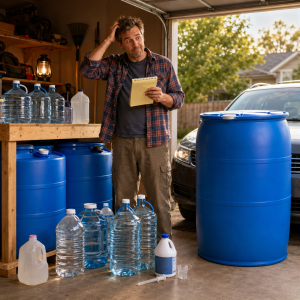
 Water storage should be simple.
Find a safe container. Fill it with safe water. Store it properly. Use it when needed.
And yet, somewhere between the kitchen faucet and the basement shelf, emergency water acquired more rules than a homeowners association. Never put it on concrete. Replace it every six months or it becomes dangerous. Add bleach to everything. Never trust plastic. Boil questionable water and all problems disappear.
Mention water storage in a group of prepared people and someone will eventually lean forward and explain that their neighbor’s cousin once stored a gallon jug incorrectly in 1987.
So let’s separate sensible precautions from the water-storage myths that simply refuse to drown.
Myth No. 1: Stored Water “Expires” After Six Months
Water does not reach its six-month anniversary, glance at the calendar, and suddenly become unsafe out of spite.
The CDC recommends replacing water that you fill and store yourself every six months, while commercially bottled water should be managed according to the date on the container. That six-month guideline is a practical rotation standard. It gives you a regular opportunity to inspect containers, catch leaks, maintain quality, and reduce the likelihood that poor handling or storage has compromised the supply. (CDC)
Properly stored water does not automatically transform into swamp broth at midnight on Day 181.
The better habit is to inspect your supply regularly. Look for leaking containers, damaged seals, cloudiness, unusual odors, algae growth, bulging, brittleness, or evidence that contaminants have reached the container or dispensing area.
And when you rotate water, you do not need to perform a ceremonial pouring-down-the-drain. Use it for laundry, cleaning, watering plants, flushing toilets, or practicing with your emergency cooking equipment.
Preparedness should reduce waste, not create a twice-yearly basement baptism.
Myth No. 2: Every Container of Stored Tap Water Needs Bleach
Not necessarily.
If you fill a properly cleaned and sanitized food-grade container with safe municipal tap water, additional bleach generally is not needed merely because the water is going into storage. Municipal water has already been treated, and the CDC recommends using food-grade containers that will not transfer toxic substances into the water. (CDC)
Bleach is for water that actually needs emergency chemical disinfection—such as untreated or microbiologically questionable water when safer water and boiling are unavailable.
For one gallon of clear water, CDC emergency guidance calls for eight drops, or slightly less than one-eighth teaspoon, of regular unscented household bleach containing 5% to 9% sodium hypochlorite. Stir thoroughly and allow the water to stand for at least 30 minutes. If the water is cloudy, colored, murky, or very cold, use twice that amount. (CDC)
The exact percentage on the bleach label matters. EPA guidance, for example, specifies eight drops per gallon for 6% bleach but six drops for 8.25% bleach. (US EPA)
Use only ordinary, unscented liquid chlorine bleach. Splashless, scented, color-safe, gel, and additive-containing products are not interchangeable with standard disinfecting bleach.
This is also not the moment to stand over a barrel saying, “That looks like about a capful.”
Survivor Steve treated already-safe tap water, then added extra bleach “for insurance.” His emergency supply could now sanitize a municipal swimming pool.
More is not always more prepared.
Myth No. 3: Water Stored on Concrete Will Automatically Become Contaminated
Concrete does not possess supernatural powers of infiltration.
The long-circulating claim that mysterious chemicals will travel directly through the bottom of a plastic barrel and poison the water is generally an oversimplification. The quality of the container, what it previously held, the seal, surrounding chemicals, temperature, sunlight, and physical damage are far more important considerations.
But that does not mean placing water directly on a garage floor is always the best choice.
Garage concrete may become quite warm in hot weather and can transfer that heat to the container resting on it. The CDC recommends storing emergency water in a cool location, out of direct sunlight, and away from gasoline, pesticides, and other toxic substances. (CDC)
A garage floor may also be exposed to vehicle fluids, pesticides, fertilizers, solvents, moisture, and temperature swings. Containers sitting directly on the floor can be harder to inspect underneath, and small leaks may remain unnoticed.
So no, concrete does not instantly poison stored water. But placing containers on a sturdy platform or insulating barrier can protect them from heat transfer, moisture, abrasion, spills, and whatever Survivor Steve accidentally knocked over while looking for jumper cables.
Your water barrel does not require a handcrafted mahogany throne.
A strong board or suitable platform will do.
Myth No. 4: Any Container That Once Held Food Is Safe for Water
A former food container may be better than a former gasoline container, but that does not automatically make it a good long-term water container.
Thin disposable milk jugs are especially poor candidates. They can be difficult to clean thoroughly, become brittle, develop pinhole leaks, and retain residue in seams and handles. Juice and milk containers may also harbor organic material that is difficult to remove completely.
The CDC recommends FDA-approved food-grade water storage containers whenever possible. Food-grade containers are designed not to transfer toxic substances into the water. (CDC)
Never use a container that held pesticides, fuel, solvents, cleaners, or other toxic materials. Washing it enthusiastically does not turn it into a beverage dispenser.
And label every water container clearly.
Include the date it was filled and the source of the water, such as:
TAP WATER
RO WATER
WELL WATER
COMMERCIALLY BOTTLED WATER
This matters because municipal tap water, reverse-osmosis water, well water, and commercially bottled water do not necessarily begin with the same treatment history or residual disinfectant protection.
Six months from now, “clear liquid in blue barrel” is not a sufficiently detailed water-quality report.
Myth No. 5: Clear Water Is Safe Water
Water can look as innocent as a mountain stream in a television commercial and still contain harmful bacteria, viruses, parasites, chemicals, or toxins.
Clarity tells you that the water is clear.
It does not provide laboratory results.
Likewise, cloudy water is not automatically poisonous. Sediment may simply be suspended in it. However, cloudy water should generally be allowed to settle or be filtered through a clean cloth, paper towel, or coffee filter before boiling or chemical disinfection. (CDC)
This is why a preparedness plan should include more than one treatment method and some understanding of what each method can—and cannot—do.
A portable filter may remove sediment and certain organisms but may not remove viruses or dissolved chemicals. Chemical disinfection can kill many disease-causing organisms but is less effective against some parasites. Boiling kills germs but does not remove every other hazard.
Clear water may still need treatment.
And murky water is not improved by staring at it suspiciously.
Myth No. 6: Boiling Makes Any Water Safe
Boiling is one of the most reliable ways to kill disease-causing microorganisms in water.
The CDC recommends bringing clear water to a rolling boil for one minute. At elevations above 6,500 feet, boil it for three minutes. (CDC)
But boiling does not remove fuel, pesticides, heavy metals, salts, radioactive materials, or many other chemical contaminants. In some cases, boiling may actually concentrate certain contaminants because water evaporates while the dissolved substance remains behind.
Water contaminated by fuel or toxic chemicals cannot be rescued with an enthusiastic saucepan.
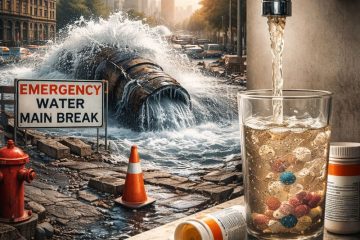
The type of emergency matters. A boil-water advisory caused by a broken water main is different from a chemical spill, industrial accident, or flood contamination warning. Follow instructions issued for the specific event rather than assuming one treatment method fixes every possible problem.
Boiling is an excellent tool.
It is not an exorcism.
Myth No. 7: Your Swimming Pool Is a Giant Drinking-Water Tank
A backyard swimming pool contains an impressive amount of water, making it extremely valuable during an emergency.
Its best uses, however, are generally sanitation, cleaning, and toilet flushing—not drinking.
Pool water may contain chlorine, stabilizers, algaecides, salts, debris, microorganisms, and whatever the neighborhood children contributed during the previous summer.
Could specialized treatment potentially make some pool water drinkable under extreme circumstances? Possibly, depending on exactly what is in it and whether the treatment system can remove those specific contaminants.
But that requires more knowledge than, “I bought a filter with an impressive mountain printed on the box.”
Use pool water for non-drinking needs whenever possible so that your safely stored drinking water lasts longer.
A toilet does not care whether the water tastes faintly of inflatable flamingo.
Myth No. 8: One Gallon per Person per Day Covers Everything
One gallon per person per day is a widely used minimum planning figure for drinking and basic sanitation. FEMA recommends storing at least a three-day supply for evacuation and, when possible, a two-week supply for the home. (FEMA)
But one gallon is not a magical quantity perfectly suited to every person, climate, activity level, or household.
Hot weather, illness, pregnancy, nursing, physical labor, certain medications, children, and older adults may increase drinking needs. Pets need water. Dehydrated and freeze-dried foods require water. Washing dishes, cleaning wounds, maintaining basic hygiene, and flushing toilets require more.
Nobody becomes less interested in washing their hands simply because the power is out.
Treat one gallon per person per day as the starting point, not an all-inclusive water resort.
Calculate what your household will realistically require for drinking, cooking, medications, pets, and sanitation. Then store as much as your available space, structural conditions, and budget safely allow.
The Myth Hiding Behind All the Others
The largest water-storage myth may be the belief that owning containers of water means you have a complete water plan.
Stored drinking water is the best place to begin because it is immediately available. It does not require you to find a source, carry it home, filter it, disinfect it, or heat it while everyone waits.
But every stored supply is finite.
A stronger water plan includes several layers: drinking water, sanitation water, collection containers, a way to transport water, a method for removing sediment, a reliable way to kill germs, and a treatment method appropriate for the contaminants you might realistically encounter.
You also need a safe way to dispense stored water without repeatedly dipping hands, cups, or questionable kitchen utensils into the container. A perfectly clean supply can become contaminated through careless handling after it is opened.
And practice moving and using your stored water before an emergency.
A full 55-gallon water barrel weighs more than 450 pounds. Once filled, it is no longer a portable container.
It is a basement landmark.
Survivor Steve discovered this after filling his barrel in the driveway. It remains there today, beautifully prepared for emergencies involving only the left side of his vehicle.
Store Water—Not Folklore
Water preparedness does not need to be complicated, but it does need to be thoughtful.
Use food-grade containers. Begin with safe water whenever possible. Keep containers sealed, clearly labeled, cool, protected from sunlight, and away from toxic chemicals. Record both the filling date and the water source. Inspect the containers regularly. Rotate home-filled water according to current recommendations. Understand what your treatment methods can and cannot accomplish.
Most importantly, do not let conflicting folklore prevent you from storing anything at all.
A less-than-perfect water supply that has been safely stored is far more useful than the flawless system you are still researching while every available container remains empty.
Because during an emergency, nobody has ever opened an empty barrel and said:
“Well, at least I successfully avoided placing it on concrete.”
0 Comments