Why Your Most Valuable Prep Might Be Your Neighbor
 I recently came across a social media post that asked a simple question:
“How many of your neighbors do you know by name?”
The answers were eye-opening. Some people knew everyone on their street. Others admitted they had lived in the same home for years and couldn’t identify a single neighbor beyond “the guy with the blue truck” or “the lady with the barking dog.”
That got me thinking.
Most of us can tell you exactly how many gallons of water we have stored. We know how many cans are in the pantry. We know where the flashlights are, where the first-aid supplies are, and where we tucked away the extra batteries. But how many of us know whether our neighbors have medical training? Own a chainsaw? Have a generator? Need extra help during a storm? Or would simply appreciate someone checking on them after a difficult day?
It’s a strange blind spot when you think about it.
We’ve spent decades becoming more connected to the world and, in many cases, less connected to the people living fifty feet away.
There was a time when borrowing a cup of sugar wasn’t considered poor planning. It was called having neighbors. People knew each other’s names. They chatted over fences. They loaned tools. They watched each other’s homes when someone traveled. If a storm rolled through, they checked on one another. If someone got sick, meals appeared as if by magic. No app was required. No subscription was needed. No password was necessary. Just people helping people.
Somewhere along the way, a portion of the preparedness community embraced the “lone wolf” mentality. You know the type. The belief that true preparedness means never needing anyone, never asking for help, and standing entirely on your own two feet.
I’ve come to believe that’s one of the most flawed preparedness philosophies out there.
A few years ago, I learned that lesson firsthand when my chimney caught fire.
If you’ve never experienced a chimney fire, I don’t recommend adding it to your bucket list. One minute everything is normal, and the next minute you’re standing in your driveway watching flashing lights, listening to sirens, answering questions from firefighters, and trying to manage a level of chaos that wasn’t on your calendar that day.
To make matters even more entertaining, I had four dogs at the time. As the fire department worked, I was trying to figure out what to do with them. I finally decided the safest option was to put them in my car while everything was going on.
That’s when I heard a voice behind me.
“You can put them in our house.”
I turned around and saw my neighbor standing there.
Now here’s the embarrassing part.
This was the same neighbor I’d grumbled about more than once because they had planted a pine tree near my driveway. Every year that tree seemed determined to coat my vehicle with enough sap to qualify as a commercial adhesive. In my mind, they’d become “the pine tree neighbor.”
Yet when my home was in distress, none of that mattered to them.
They weren’t thinking about trees.
They weren’t thinking about past irritations.
They saw a neighbor who needed help and immediately offered it.
I never took them up on the offer, but I have never forgotten it.
In fact, as I write this article, I have to admit something even more embarrassing: I still don’t know their names. I think I know their last name but only because of all of their mail I keep getting.
I’m going to remedy that.
Standing in that driveway taught me something important. Preparedness isn’t about proving you never need anyone. It’s about building a life that’s resilient enough to weather challenges. And one of the greatest sources of resilience you’ll ever have is other people.
The lone wolf sounds impressive in theory, but human beings have survived and thrived through cooperation for thousands of years. The strongest preparedness plan isn’t one that eliminates the need for others. It’s one that recognizes the incredible value of having others.
Even Survivor Steve understands this, although perhaps not intentionally.
Survivor Steve has enough gear to survive almost any inconvenience known to mankind. He has backup batteries for his backup batteries. His pantry inventory system probably requires a flowchart and a committee meeting. If preparedness equipment were an Olympic sport, Survivor Steve would at least qualify for regionals.
But even Survivor Steve would have a hard time replacing a good neighbor.
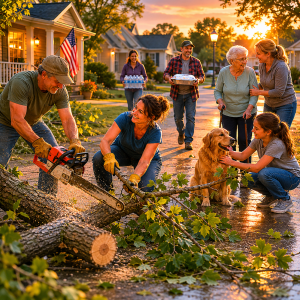
When a tree falls across a driveway, it doesn’t matter how many cans of soup you own if the neighbor next door has the chainsaw.
When the power goes out, the person with the generator suddenly becomes very popular.
When someone gets injured, the retired nurse down the street becomes one of the most valuable people in the neighborhood.
When an elderly resident needs help clearing snow, a willing teenager can be more useful than an entire garage full of equipment.
Preparedness often looks far less dramatic than we imagine. Most emergencies aren’t movie scenes. They’re power outages, ice storms, job losses, illnesses, unexpected expenses, transportation problems, and family emergencies. And most of those challenges become easier when people work together.
Think about the resources already sitting quietly on your street.
Someone knows plumbing.
Someone understands electrical work.
Someone can repair small engines.
Someone has medical experience.
Someone has tools you don’t own.
Someone has skills you haven’t learned yet.
Someone may need help in areas where you’re strong.
That’s social capital.
It’s the value that exists within relationships, trust, goodwill, and mutual support. Unlike food storage, social capital doesn’t sit on a shelf. It lives in conversations, shared experiences, favors exchanged, and relationships built long before they’re needed.
The interesting thing about social capital is that it behaves differently than almost every other preparedness resource. If you share a can of soup, you have one less can of soup. If you share knowledge, encouragement, friendship, or assistance, both people usually end up with more than they started with.
That’s a remarkable return on investment.
Unfortunately, social capital isn’t something you can build overnight. You can’t wait until the middle of an emergency and suddenly decide you want a relationship with the people around you. Trust grows slowly. It develops through small interactions over time. A conversation while getting the mail. Helping someone carry groceries. Returning a misplaced package. Sharing vegetables from the garden. Checking on a neighbor after a storm.
Small things become meaningful things.
Meaningful things become relationships.
Relationships become resilience.
One of the most overlooked preparedness questions isn’t, “What should I store next?”
It may be, “Who do I know?”
Do your neighbors know your name? Do they know they can count on you? Would they notice if something was wrong? Would you notice if something was wrong with them?
Those questions aren’t as exciting as discussing generators or freeze-dried food. They won’t generate heated debates about the best flashlight or the ideal water filter. But they matter.
Because preparedness isn’t just about surviving difficult times.
It’s about helping one another through them.
Preparedness is love expressed in advance.
Sometimes that love looks like a stocked pantry.
Sometimes it looks like a well-equipped first-aid kit.
And sometimes it looks like finally learning the name of the neighbor you’ve been calling “the pine tree guy” for the last several years.
0 Comments