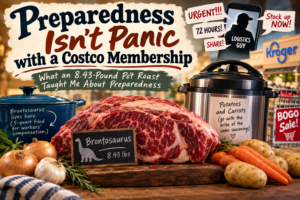
 There is currently an 8.43-pound bone-in chuck roast sitting in my kitchen.
I call him Brontosaurus.
Brontosaurus came into my life because Kroger committed one of my favorite acts of kindness: a BOGO sale on chuck roast. Buy one. Get one free. There are few combinations of words in the English language that command my attention quite like “free” attached to something I already buy.
So naturally, I bought two.
Then I went back another day because apparently I believe in making hay while the chuck roast is on sale. They were out, but Kroger gave me a rain check.
SCORE!
That means I ultimately scored FOUR enormous chuck roasts at BOGO pricing. This, my friends, is preparedness.
Not because I believe the beef supply is about to collapse. Not because someone on Facebook typed “URGENT!!!” in all caps. And certainly not because Brenda’s brother-in-law’s neighbor works with a guy whose daughter is dating somebody in logistics.
You know Logistics Guy. We all know Logistics Guy.
Logistics Guy apparently has access to information so highly classified that the federal government, major corporations and news organizations don’t know about it yet—but Brenda does. And now, fortunately for civilization, so does Facebook.
The warning usually goes something like this: “I have a VERY reliable source who works in logistics. He says something BIG is coming. Stock up on food, water, fuel, batteries, cash and toilet paper for at least 30 days. You have 72 hours. SHARE THIS BEFORE THEY TAKE IT DOWN!”
Ah, yes.
They.
The busiest people in America.
Apparently “they” spend their days suppressing Facebook posts written by people who use seventeen exclamation points while simultaneously coordinating the collapse of Western civilization.
I’ve been teaching preparedness for a very long time, and this kind of nonsense does preparedness no favors. Preparedness isn’t panic with a Costco membership. It’s a lifestyle of paying attention, thinking ahead and using your resources wisely.
Which brings me back to Brontosaurus.
I didn’t buy four chuck roasts because I was afraid. I bought them because they were half price. That’s not panic. That’s Tuesday.
I know my household will eat them. I have freezer space for them. They won’t go to waste. And by purchasing something I routinely use when it was deeply discounted, I stretched my food dollars and added several substantial meals to my food supply at the same time.
No fear required. No emergency required. No Logistics Guy required.
That’s one of the beautiful things about living a prepared lifestyle. You don’t have to wait until everyone else decides something is an emergency before you start getting ready for life’s disruptions. In fact, waiting until something goes wrong is usually the most expensive possible time to prepare.
If a winter storm is already bearing down on your community, everybody suddenly wants batteries. If the power has already gone out, everybody wants a generator. If there’s suddenly concern about the food supply, everybody wants canned goods. And if somebody announces a toilet-paper shortage, apparently perfectly rational adults lose all sense of proportion and begin purchasing bathroom tissue as though they intend to mummify the neighborhood.
Preparedness turns that entire process upside down. Instead of asking, “What should I buy because I’m scared?” ask, “What do I already use that I can buy wisely when the opportunity presents itself?”
That’s how a pantry gets built and a freezer gets filled. It’s how emergency supplies accumulate without requiring a second mortgage or a televised national crisis. Watch sales. Use coupons. Take advantage of BOGOs. Buy a little extra when the price is genuinely good. Rotate what you store and learn to cook with what you have.
But there’s another part of preparedness that matters even more: developing the ability to hear an alarming claim without immediately handing it the keys to your nervous system.
When somebody tells you there’s an imminent shortage, ask where the information came from. Is there an identifiable source? Can you verify it independently? Is there actual evidence of a disruption? Are manufacturers, distributors, utilities or other credible sources reporting anything that supports the claim?
Or are we six people removed from a mysterious gentleman named Todd who “works in logistics”?
Because preparedness without discernment isn’t preparedness.
And this is exactly where Spiritual Preparedness comes in.
There’s a reason Spiritual Preparedness is #1 of my 10 Principles of Preparedness. Discernment isn’t merely the ability to determine whether something on the internet is true. Spiritual preparedness gives us a foundation from which to recognize what deserves our attention, what deserves our action and what deserves to be left alone.
Fear is loud. It demands immediate action. It tells us that if we don’t do something RIGHT NOW, we’ll be sorry.
Discernment doesn’t need seventeen exclamation points.
When we’re spiritually prepared, we’re much better equipped to respond deliberately instead of reacting emotionally. We can seek guidance, gather reliable information, use wisdom and make decisions from a place of peace rather than allowing somebody else’s fear to become our emergency.
That’s important because preparedness fueled primarily by fear can become endless. There’s always another threat, another rumor, another thing we’re supposedly running out of and another Logistics Guy announcing that Thursday is apparently our last opportunity to purchase aluminum foil.
Real preparedness should create more peace in our lives, not less.
It should mean that when something genuinely disruptive happens—a storm, job loss, illness, supply interruption, unexpected expense or one of life’s countless other curveballs—we have options. We don’t have to predict the emergency. We simply build capability before we need it.
Sometimes that means storing water. Sometimes it means learning a skill. Sometimes it means strengthening our finances or relationships. Sometimes it means listening to that quiet spiritual prompting that tells us something deserves our attention.
And sometimes it means walking into Kroger, spotting a spectacular BOGO sale and bringing home enough beef to concern the structural engineer who designed your freezer.
Today, one of those roasts is becoming Sunday dinner. Brontosaurus is currently occupying my seven-quart Dutch oven because the five-quart looked at him and filed for workers’ compensation. The potatoes and carrots have been reassigned to the pressure cooker because apparently 8.43 pounds of beef believes in territorial expansion.
I’m tricking the vegetables into thinking they were cooked with Brontosaurus by using the same seasonings and beef broth. Brontosaurus is hogging the entire seven-quart Dutch oven. How rude! A person has to have their root vegetables with their roast!
And somewhere out there, Logistics Guy is probably warning Brenda that the Great Potato Shortage of 2026 begins Thursday.
I’ll be fine.
I bought mine on sale.
Preparedness Pro-ism: Preparedness doesn’t eliminate problems. It simply shrinks them.



0 Comments