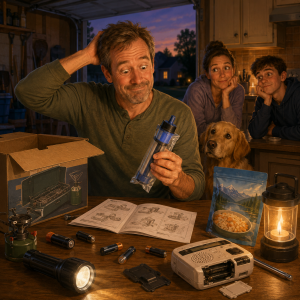
 There is a sentence that has quietly sabotaged more preparedness plans than procrastination, misplaced batteries, and instruction manuals printed in six-point type combined.
“I’ll figure it out.”
It sounds confident. Capable, even. It suggests that when the moment arrives, we will square our shoulders, assess the situation, and summon some hidden reservoir of practical brilliance. Apparently, emergencies turn ordinary people into a combination of MacGyver, Florence Nightingale, and somebody’s grandfather who could repair a tractor with baling wire.
Unfortunately, emergencies are not known for improving our concentration.
They tend to arrive with darkness, noise, confusion, frightened family members, barking dogs, incomplete information, and at least one person repeatedly asking, “What are we going to do?” Your hands may be cold. Your phone battery may be low. The instruction booklet may be missing. And whatever piece of equipment you confidently planned to “figure out” will suddenly have three valves, two warning labels, and a mysterious lever nobody remembers seeing before.
That is not the ideal learning environment.
Emergencies Are Terrible Classrooms
There is nothing wrong with figuring things out. Human beings have survived for thousands of years by observing, adapting, experimenting, and occasionally discovering that the red berries were not the right berries.
The problem is choosing the crisis itself as the time for the first lesson.
Survivor Steve owns a portable emergency stove. He bought it four years ago, placed it carefully on a shelf, and has never removed it from the box. He believes this is evidence of excellent preparedness because the stove remains in pristine condition.
Technically, so does a museum exhibit.
When the power goes out, Survivor Steve plans to open the box, locate the fuel, decipher the instructions, assemble the stove, determine where it can be used safely, and prepare dinner while everyone watches him with the encouraging patience normally reserved for someone defusing a bomb.
He will figure it out.
Eventually.
The rice may be ready by Thursday.
Preparedness equipment is valuable only when it can be used safely and effectively. Owning an item and knowing how to use it are not the same thing. A water filter sitting unopened in a closet is an interesting possession. A water filter you have assembled, tested, cleaned, and used is a preparedness resource.
The difference is practice.
Familiarity Is One of the Best Supplies You Can Store
People sometimes resist practicing because they do not want to “waste” emergency supplies. They save the batteries, preserve the fuel, keep the filter sealed, avoid opening the first-aid kit, and assume that the freeze-dried meal in the silver pouch is going to taste exactly like the fresh version pictured on the label. Apparently, optimism is now considered a cooking method.
The problem is that food preparedness requires practice too. Freeze-dried and dehydrated foods vary widely in flavor, texture, preparation time, water requirements, and portion size. Some need more seasoning. Some need more soaking. Some produce six servings only if everyone at the table has the appetite of a distracted hummingbird. It is far better to discover all of that on an ordinary Tuesday than during a crisis when dinner is already carrying enough emotional responsibility.
That instinct is understandable. It is also how people end up owning equipment they do not know is defective, incomplete, impractical, or apparently designed by an engineer who harbors personal resentment toward humanity.
Practicing does not require consuming your entire reserve. You do not need to burn through six months of propane to learn how your camp stove works. You do not need to drain every water container to test the spigot. You do not need to stage a three-day blackout complete with emotional collapse and canned peas eaten by candlelight.
You simply need enough experience to remove the mystery.
Open the box. Read the instructions. Inspect the pieces. Assemble the item. Use it once. Put it away properly. Then do it again several months later without assuming you remember everything because you once glanced at the manual during an especially productive Saturday.
Familiarity reduces hesitation. It shortens the time between recognizing a problem and taking useful action. It also reveals gaps while the stores are open, the lights are on, and nobody is waiting for you to produce potable water.
That is a far more pleasant time to discover that your filter requires an adapter you do not own.
“I Know Where It Is” Is a Close Relative
“I’ll figure it out” has several cousins. One of the most popular is, “I know where it is.”
You know where the flashlight is.
You know where the extra batteries are.
You know where the wrench for the water shutoff is.
You know where the insurance papers are.
You know where the manual for the generator is.
You know where everything is until the lights go out and the house rearranges itself.
Suddenly, the flashlight is somewhere in the kitchen. The batteries are in a drawer. Which drawer is unclear, but everyone agrees it is definitely one of them. The wrench was moved to a safer place. The safer place has now achieved complete operational secrecy.
Preparedness requires more than vaguely remembering that something exists in the building.
Critical items should have designated locations. Everyone who may need them should know those locations. Flashlights should be where they can be reached in the dark. Necessary accessories should be stored with the equipment they serve. Instructions should remain with unfamiliar tools rather than being filed away in a location so secure that future archaeologists will struggle to recover them.
Survivor Steve keeps his emergency radio in the basement and its charging cable upstairs in a box labeled “Miscellaneous.”
“Miscellaneous” is where organization goes to avoid accountability.
Practice the Whole Process, Not Just the Interesting Part
People often practice the part of a task that seems obvious while ignoring everything surrounding it.
They test the generator but do not practice connecting appliances safely.
They light the camp stove but do not cook an actual meal on it.
They buy a water filter but never collect water, prefilter sediment, clean the equipment, or determine how much time it takes to produce enough drinking water for the household.
They assemble an evacuation bag but never carry it farther than the hallway.
They learn where the main water shutoff is but never confirm that the valve can still be turned.
They purchase a manual can opener without noticing that it requires the grip strength of an Olympic lobster.
The complete process matters because emergencies rarely present us with isolated tasks. “Make dinner without electricity” involves lighting, ventilation, fuel, cookware, water, preparation, sanitation, and cleanup. “Leave the house quickly” involves people, pets, medications, transportation, weather, communication, and knowing where everyone is supposed to go.
The equipment may be the easiest part.
A realistic practice session reveals the surrounding problems. It tells you whether the light is bright enough, the container is large enough, the bag is too heavy, the instructions are unclear, the children can participate, and the dog considers your evacuation drill an exciting opportunity to disappear beneath the bed.
Those lessons are much cheaper during practice.
Start With Mild Inconvenience
Some people hear the word “practice” and imagine spending a weekend pretending civilization has ended.
That is not necessary.
You can build practical confidence through small, manageable experiments. Cook one dinner without using electricity. Turn off the water at the main valve and confirm that everyone knows where it is. Spend one evening using only emergency lighting. Walk around the block carrying your evacuation bag. Prepare drinking water with your stored filtration equipment. Use the weather radio. Inflate the emergency mattress. Open the first-aid kit and identify what is actually inside it.
Try one task at a time while conditions are calm.
The goal is not to make your household miserable in the name of readiness. The goal is to transform unfamiliar actions into familiar ones.
When you practice under mild inconvenience, you create mental pathways that remain available under greater stress. You are not beginning from zero. You have already held the tool, followed the steps, solved the obvious problems, and learned which part requires three hands and a vocabulary that should not be used around children.
That experience matters.
Teach More Than One Person
A preparedness plan that depends entirely on one knowledgeable person is not really a household plan. It is a one-person performance with an anxious audience.
The person who knows how to operate the generator may not be home. The person who knows the combination to the safe may be unreachable. The person who understands the water filter may be sick. The person who knows where the pet carrier is may have stored it behind seventeen seasonal decorations and a broken vacuum cleaner.
Skills should be shared.
More than one adult should know how to shut off the water, operate essential equipment, locate important documents, access emergency contacts, and follow the household communication plan. Older children can learn age-appropriate tasks. Even younger children can understand where flashlights are kept, whom to contact, and what to do when adults issue clear instructions.
This does not mean conducting family preparedness meetings with flip charts, laser pointers, and mandatory name tags.
It means including people when you practice.
Let them use the equipment. Let them ask questions. Let them make small mistakes while the consequences are small. A household becomes more resilient when useful knowledge is distributed rather than residing in one person who is expected to be everywhere at once.
Give “Future You” a Fighting Chance
One of the kindest things you can do for yourself is prepare for the fact that Future You may be tired, frightened, distracted, and operating with fewer resources than Present You enjoys.
Label things clearly.
Store connected items together.
Write down essential steps.
Keep printed instructions where they will be needed.
Test equipment before relying on it.
Replace missing parts.
Practice enough that the process feels familiar.
Present You has lights, internet access, time, and possibly snacks. Present You should handle the confusing parts.
Future You may be standing in the garage during a thunderstorm while Survivor Steve asks whether the generator takes regular or premium gasoline.
Do not make Future You begin with research.
Replace “I’ll Figure It Out” With “I’ve Done This Before”
Preparedness is not about knowing everything. Nobody knows everything. There will always be unexpected problems, changing circumstances, and moments when improvisation is necessary.
But improvisation works much better when it rests on a foundation of experience.
“I’ll figure it out” assumes that knowledge will appear when needed.
“I’ve done this before” carries knowledge into the situation.
That is the goal.
You do not need to master every emergency skill this week. Choose one item, one system, or one task you have been postponing. Open it. Read it. assemble it. Test it. Use it. Teach someone else.
Then choose another.
Little by little, the mystery disappears. Hesitation becomes familiarity. Equipment becomes capability. A collection of supplies becomes an actual preparedness plan.
Because the middle of an emergency is a terrible time to discover that your brilliant plan was mostly unopened boxes and optimism.
Preparedness doesn’t eliminate problems. It simply shrinks them.


0 Comments