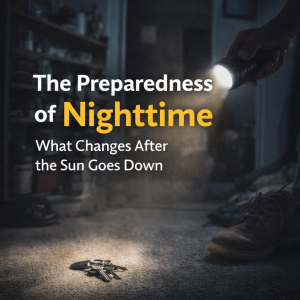
 There’s something about nighttime that changes everything.
Same house. Same neighborhood. Same supplies.
But flip off the lights—or lose them unexpectedly—and suddenly the world feels… different.
Not dangerous, necessarily.
Just unfamiliar.
That hallway you walk down ten times a day? Now it’s a maze.
That drawer you can open with your eyes closed? Apparently not anymore.
And that one chair? Oh, it has been waiting for this moment.
Night has a way of exposing things.
Not just what you have…
…but how well you can function when everything feels just a little off.
When Confidence Gets… Negotiable
During the day, most of us move through life with a quiet confidence.
We know where things are.
We trust our surroundings.
We operate on autopilot.
At night, that autopilot gets a little… glitchy.
Your senses shift.
- Vision decreases
- Sounds feel louder
- Depth perception gets questionable
- And your imagination suddenly decides to contribute
That bump in the night?
Could be nothing.
Or it could be your brain saying, “Let’s explore every possible scenario… just in case.”
Lighting: The Most Overlooked Superpower
Here’s where preparedness gets practical.
Most people think of lighting as a convenience.
Prepared people understand it as a capability.
Because not all light is created equal.
- Do you have light you can grab instantly?
- Can you move through your home without turning on overhead lights?
- Do you have lighting in multiple locations—or just one “somewhere around here” flashlight?
There’s a big difference between:
“I have a flashlight…”
and
“I can function confidently in the dark.”
The Midnight Test You Didn’t Know You Needed
Here’s a simple (and slightly humbling) experiment:
Tonight, try navigating your home in low light.
No flipping every switch. No lighting up the whole place like it’s a runway.
Just enough light to move.
Notice:
- where you hesitate
- what you can’t find
- what suddenly becomes harder
It’s amazing how quickly you’ll discover:
“Oh… I thought I had this handled.”
Nighttime has a way of revealing the gaps we didn’t know were there.
Routines Matter More in the Dark
During the day, you can compensate.
You can see clearly.
You can adjust easily.
You can recover quickly.
At night?
You rely more on habit.
- knowing where things go
- putting items back in the same place
- having a predictable flow to your environment
Because when visibility drops, familiarity becomes your greatest advantage.
And let’s be honest…
Nothing tests your system like trying to find something quietly in the dark without waking up the entire household like you’ve just launched a kitchen renovation project at 2 a.m.
The Mental Game Changes Too
Here’s something people don’t talk about enough:
Nighttime affects your mindset.
Things feel:
- more urgent
- more uncertain
- more intense than they might actually be
A small problem at noon feels manageable.
That same problem at midnight?
Feels like a full-blown situation.
That’s not weakness—it’s human.
Which is why preparedness at night isn’t just physical.
It’s mental.
The more familiar and practiced your environment is, the less your brain fills in the blanks with worst-case scenarios.
Security Feels Different After Dark
Let’s talk about the obvious—but often unexamined.
Security at night isn’t the same as security during the day.
- visibility is reduced
- movement is harder to track
- and reaction time matters more
This doesn’t mean you need to turn your home into a fortress.
It simply means asking:
- Can I move through my space confidently at night?
- Do I know what’s normal… and what isn’t?
- Can I respond calmly without scrambling?
Preparedness here isn’t about fear.
It’s about familiarity and function.
The Goal Isn’t Perfection—It’s Confidence
Here’s the takeaway:
Nighttime doesn’t create new problems.
It reveals the ones that are already there.
The difference is, during the day you can work around them.
At night?
You feel them.
Preparedness isn’t just about what you have stored on a shelf.
It’s about how well you can function when conditions change.
And nighttime is one of the simplest, most overlooked “changed conditions” you can prepare for.
Because when the lights go out…
You don’t want your first thought to be:
“Where is that flashlight again?”
You want it to be:
“I’ve got this.”
And maybe—just maybe—
you’ll finally stop losing arguments with that chair. 😄