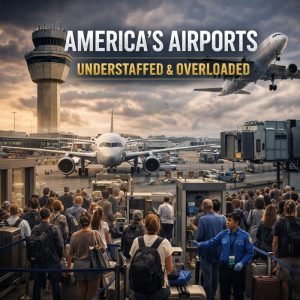
 Airports are one of the only places where it’s socially acceptable to eat a cinnamon roll at 6:12 a.m., wear sweatpants in public, and stand barefoot in a security line holding your laptop like an offering.
And we’ve all just agreed this is fine.
But airports are more than travel hubs.
They are critical national infrastructure — moving people, cargo, medical shipments, and time-sensitive goods across the country every single day.
And here’s the rude little wake-up call:
America’s aviation system is impressive… but it’s strained, aging, and running tighter than most people realize.
Passenger Demand Isn’t Slowing Down
One reason airports feel so stretched is simple:
The skies aren’t getting quieter.
Global passenger traffic is projected to reach around 5.2 billion travelers in 2026, meaning air travel demand is still climbing. Airports are being asked to handle more people, more flights, more complexity — even while many facilities are already operating near capacity.
That’s not a future issue.
That’s a now issue that’s growing.
Aging Airports: Built for Another Century
Many major U.S. airports were built decades ago, and while renovations happen, the underlying bones of the system are aging.
The American Society of Civil Engineers gave U.S. aviation infrastructure a grade of D+, citing outdated facilities, capacity issues, and underinvestment.
That doesn’t mean airports are falling apart.
It means they’re doing an enormous modern job with infrastructure designed for yesterday’s volume.
Air Traffic Control: The Sky’s Most Overworked Orchestra Conductors
Now let’s talk about the part most travelers never see:
Air traffic control.
Controllers are essentially the orchestra conductors of the sky — coordinating thousands of flights safely, every day.
And here’s the “Whoa!” fact:
The FAA employs about 14,000 air traffic controllers, but the system is still estimated to be 3,000 to 3,800 controllers short of ideal staffing levels.
That shortfall has real consequences.
Before recent funding boosts, many controllers were working exhausting schedules — 10-hour days, six days a week — just to keep up with demand at major hubs.
Training new controllers isn’t quick either. The FAA has seen hundreds of thousands of applicants, but certification takes months and often years, so shortages can’t be fixed overnight.
And these gaps aren’t theoretical.
In late 2025, staffing shortages were so severe that nearly half of the busiest U.S. airports reported controller shortages contributing to delays and cancellations.
So yes — flights get delayed because of weather…
But sometimes they get delayed because we don’t have enough trained humans in the tower.
That’s not collapse.
That’s margin running thin.
TSA: The Permanent Bottleneck Nobody Can Ignore
And then there’s the part of airport life everyone jokes about… but nobody can function without:
Security screening.
Love them or hate them, TSA is a permanent fixture of modern travel. Airports don’t run without it.
But TSA staffing shortages have also been a recurring strain point, contributing to longer checkpoint lines and slower airport flow during high-demand periods. TSA has even warned that staffing disruptions can have severe impacts on screening capacity.
Security isn’t a side feature.
It’s part of the infrastructure.
If screening capacity slows, everything backs up — passengers, gates, schedules, even cargo timelines.
Delays Ripple Nationwide Like Dominoes
Air travel is a connected web.
A slowdown in Newark doesn’t stay in Newark.
It becomes missed connections in Atlanta.
Delayed cargo in Chicago.
Your cousin sleeping on an airport floor in Denver next to a Cinnabon.
Airports are one of the clearest examples of infrastructure with very little slack.
Cargo: Airports Are Supply Chain Infrastructure Too
Airports aren’t just about vacations.
They move:
Medical supplies
Organ transport
High-value electronics
Time-sensitive shipments
So disruptions aren’t only “my flight got delayed.”
They can affect critical deliveries that depend on air cargo capacity.
A Better Ending: What This Means for the Rest of Us
So what do we do with all this?
We don’t panic.
We don’t swear off flying and start traveling exclusively by covered wagon.
We simply adjust our assumptions.
Airports are a perfect reminder that modern convenience isn’t guaranteed — it’s managed.
By aging facilities.
By complex technology.
By air traffic controllers working overtime.
By TSA officers keeping the system moving.
Air travel still works.
It’s still extraordinary.
But it’s also a system operating with very little breathing room.
Preparedness here isn’t dramatic.
It’s practical.
It looks like:
Packing essentials in your carry-on.
Keeping your phone charged.
Building flexibility into travel plans.
And remembering that delays aren’t always personal…
Sometimes they’re just the sound of a massive system doing its best under enormous strain.
The wise traveler doesn’t expect perfection.
They carry margin.
And margin, as always, is peace.