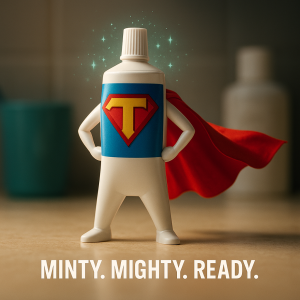
toothpaste as a MacGyver hack
I’ve always thought toothpaste was a little dramatic. It sits there in its shiny tube, bragging about whitening, brightening, breath-freshening, plaque-fighting—all while silently judging you for that late-night cocoa. But once you start exploring what toothpaste can actually do, you begin to wonder if it’s been hiding its true résumé, waiting for the right moment to burst onto the preparedness stage like, “Surprise! I do tricks.”
For starters, toothpaste is a surprisingly decent gap filler. I discovered this after a certain someone I know (cough Steve) swung a backpack—with a HAM radio, three granola bars, and emotional baggage—straight into the drywall. The resulting crater looked like a meteor strike in suburban form. A little smear of toothpaste? Boom. Temporary patch job. Sure, it’s not going to impress a home inspector, but it’ll keep you from explaining why your wall has a bellybutton.
But here’s the important part: use plain white toothpaste.
No gel. No glitter. No “Cinnamon Firestorm.” The goal is camouflage, not creating a modern art installation of regret.
Toothpaste works because it dries quickly and holds its shape, making it handy for those “I swear I’ll fix it properly later” moments. But it’s strictly a temporary fix. Over time it can crack, crumble, or yellow like it’s trying to cosplay as antique parchment. And if the area is humid—like a bathroom—it won’t last long enough to fool anyone. Humidity is its kryptonite.
It also plays best with tiny holes, not craters. If your dent looks like Steve tried to practice a tactical shoulder roll indoors, toothpaste won’t save the day. It’s a quick disguise for minor mishaps, not a miracle-worker for drywall tragedies.
But wait, there’s more!
Then we have metal polishing, which feels suspiciously like toothpaste trying to moonlight as a maid service. Give it to a tarnished spoon, a rusty zipper, or that dingy piece of jewelry you “swore looked better when you bought it.” Toothpaste buffs things back to a polite level of respectability. It won’t make your grandma’s silver heirlooms auction-ready, but it will keep Steve from announcing, “These look haunted.”
Choosing the Right Toothpaste for Polishing (Because Not All Tubes Are Created Equal)
Before you go buffing every metal surface in your house like you’re auditioning for a role as “Enthusiastic Polisher #3,” it helps to know that not every toothpaste is good for polishing. Some will shine your silver like magic, and others will act like you’ve smeared sugary cement onto your belongings.
The best choice? Plain, white toothpaste.
No gels. No stripes. No “Now with Whitening Burst Crystals™!” Just the old-school chalky stuff that looks like it came straight from the budget aisle at a grocery store that still sells lima beans in cans.
Why?
Because plain toothpaste contains gentle, non-gel abrasives like hydrated silica or calcium carbonate—tiny scrubbing particles mild enough for teeth but mighty enough for tarnish. These abrasives help lift gunk and buff metal without scratching it like a cat that wasn’t held enough as a kitten.
What you don’t want:
-
Whitening toothpaste: These often contain hydrogen peroxide or harsher abrasives that can be too aggressive on delicate metal finishes. Great for teeth. Bad for heirlooms.
-
Gel formulas: They look pretty, but they have fewer scrubbing particles—like the skincare equivalent of “moisture water mist essence toner.” Lots of vibes, fewer results.
-
Anything with added coloring: Unless you’d like your silver bracelet to develop a faint, Smurf-adjacent hue.
If you stick to the classic white paste, you’ll get a gentle, effective polish without damaging your metal treasures—or having to explain to Steve why the family candlestick now looks “unexpectedly iridescent.”
Moving outdoors for a moment—because of course we are—let’s talk bug bites. You haven’t known true perseverance until you’ve watched a grown adult become unhinged over a single mosquito bite. A dab of toothpaste offers cooling relief, reduces swelling, and lets you pretend you’re in charge of your own destiny again. Minty triumph is still triumph.
Why the Mint Matters (a.k.a. The Science Behind the Tingle)
If you’ve ever slapped a glob of minty toothpaste onto a bug bite and felt that glorious cooling wave wash over your skin, that wasn’t wishful thinking or divine intervention from the Patron Saint of Mosquito Survivors. That’s menthol—the star ingredient in most peppermint toothpastes—working its frosty magic.
Menthol triggers the cold receptors in your skin, which basically tells your nerves, “Hey, focus on this cool sensation instead of the itch that’s making you contemplate moving to Antarctica.” It doesn’t cure the bite, but it does give you a blessed break from the scratch-until-you-regret-everything spiral. The toothpaste also dries the area a bit, helping shrink the swelling and giving the bite a chance to calm down.
Just one note of caution: only minty toothpaste works. If you smear some gentle, fruity, child-approved bubblegum toothpaste on your arm, all you’re doing is moisturizing your misery. Mint is the muscle here. Mint is the magic. Mint is the reason Steve has finally stopped clawing at his arm like he’s reenacting a nature documentary about itchy raccoons.
And one of the most underrated tricks? Nonverbal communication. Toothpaste is excellent for leaving notes—on mirrors, rocks, windows, anything smooth—without needing a Sharpie that somehow always disappears when you need it most. Whether you’re signaling a direction, marking a path, or reminding Steve we do not store beef jerky under pillows, it works.
This is the part where toothpaste seems to lean over and whisper, “See? I’m more than a minty morning chore.” And it’s right. Preparedness isn’t about buying every gadget on the shelf; it’s about noticing the quiet usefulness in everyday things.
When we start recognizing the hidden value in ordinary items, we also start recognizing the hidden value in ourselves—resilient, resourceful, and capable of more than we thought. And if we can learn that from a tube of toothpaste… well, that’s a sweeter kind of self-reliance than anything you’ll find in the dental aisle.
So go ahead. Tuck an extra tube in your kit. Not because it’ll save your life in some dramatic movie moment, but because it just might save your sanity. And some days, that’s an even bigger win.