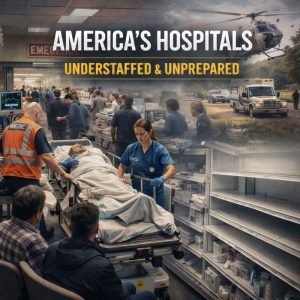
 Hospitals occupy a special place in the American imagination.
We assume they’re like Costco.
Always stocked.
Always staffed.
Always ready.
You show up, and the system just… handles it.
But here’s the rude little wake-up call:
Modern healthcare is extraordinary… but it is not infinite.
Hospitals are part of our national infrastructure, and like every other system we’ve talked about, they are impressive…
And strained.
And running tighter than most people realize.
The Tipping Point Can Be Shockingly Small
People picture hospital overload as something that only happens during hurricanes or pandemics.
But sometimes the tipping point is…
A simple three-car pileup.
Seriously.
Emergency departments often operate with very little extra slack. They’re built to handle steady demand, not endless surges. So when a multi-vehicle accident happens, or a bad flu wave hits, or an icy morning sends a dozen people slipping into the ER like it’s an involuntary skating rink…
The system can clog fast.
It’s not that the hospital isn’t good.
It’s that hospitals are like restaurants during dinner rush:
They can handle a full house…
But not five unexpected tour buses pulling up at once.
A few extra patients doesn’t just add a few extra minutes.
It can cascade into longer waits, crowded hallways, delayed admissions, and staff running at maximum capacity.
Hospitals Are Sized for Normal… Not for Everyone at Once
Here’s a “Whoa” reality most people never consider:
Hospitals are not built to serve an entire community all at once.
They’re built to serve a predictable slice of the population at any given time.
Even in a city of 100,000 people, the local hospital might only have a few hundred staffed beds. That’s not because anyone is careless — it’s because healthcare systems are designed around averages, staffing realities, and financial sustainability.
A hospital isn’t equipped for 100,000 patients.
It’s equipped for the normal daily flow… plus a little extra.
Which means the margin is thinner than people assume.
If even a small percentage of the community needs urgent care at the same time — a flu surge, a heat emergency, a pileup, a disaster — the system can tip quickly.
Hospitals don’t fail because they’re weak.
They strain because they’re finite.
The ER as Primary Care: The Waiting Room Traffic Jam
And here’s another “Whoa” factor:
A significant segment of the population uses the emergency room the way the rest of us use a family doctor.
Not always because they want to.
Often because they don’t have access to primary care, can’t get timely appointments, lack insurance, or have nowhere else to go.
So the ER becomes the default front door of medicine.
Which means emergency departments are trying to do two jobs at once:
Handle true emergencies…
And serve as the primary care clinic for people with nowhere else to turn.
That’s like calling the fire department because your toaster is smoking…
And then being surprised when the fire station is busy when an actual house fire breaks out.
It’s not a moral judgment.
It’s a system reality.
When ERs are clogged with non-emergency needs, capacity shrinks for the real emergencies — strokes, trauma, heart attacks, disasters.
Staffing Shortages: A Bed Isn’t a Bed Without People
Hospitals don’t run on buildings.
They run on people.
And one of the biggest constraints today is staffing.
The U.S. faces shortages and strain among:
Nurses
Emergency staff
Primary care physicians
Specialists
Mental health professionals
Burnout and retirements have made staffing one of the tightest choke points in healthcare.
A hospital bed isn’t really a bed if there’s no nurse available to staff it.
That’s the part most people don’t realize.
Rural Healthcare: Where Distance Becomes a Medical Problem
And now for the “Heaven forbid” reality:
Rural America often has limited access to care.
Some rural counties have no hospital at all.
Others have small facilities that can stabilize patients…
But not handle major trauma, complex surgery, or intensive care.
In rural areas, an emergency isn’t just an emergency.
It can be a transportation problem.
It can mean:
Long ambulance rides
Limited specialist access
Delayed treatment
Overwhelmed small facilities
Heaven forbid there’s a disaster in a rural area—because the nearest major hospital may be an hour away, and the local system may already be thin.
Hospitals Aren’t Warehouses: Drug and Device Shortages Are Real
Here’s another “Whoa” reality:
Hospitals don’t just need doctors and beds.
They need stuff.
Medications. IV fluids. Oxygen supplies. Surgical materials. Medical devices.
And in recent years, the U.S. has experienced significant shortages of pharmaceuticals and medical supplies — including critical hospital medications.
Hospitals have reported shortages of things as basic as:
Antibiotics
Pain medications
Chemotherapy drugs
IV saline and fluids
Anesthetics used in surgery
When shortages happen, hospitals don’t stop functioning…
But care becomes harder.
Providers substitute medications, delay procedures, or ration limited supplies.
Modern healthcare depends on a just-in-time supply chain.
And just-in-time doesn’t always leave deep backup.
So What Can Households Do Without Panic?
This is where Preparedness Pro comes in.
Not fear.
Not distrust.
Just wisdom.
Preparedness isn’t about replacing hospitals.
Hospitals are essential.
Modern medicine is a gift.
But self-reliance means reducing unnecessary dependence on an overwhelmed ER for minor, manageable needs.
That looks like:
Keeping copies of medical records and prescriptions
Basic first aid skills
A stocked home wellness kit with over-the-counter essentials (see Jase-get $10 with this link- or The Wellness Company to have basic antibiotics on hand, etc.)
Establishing primary care before crisis hits.
And for some families, thoughtfully physician-guided preparedness measures — including properly prescribed “just-in-case” medications for predictable situations, administered responsibly and legally
Because sometimes preparedness isn’t about expecting disaster…
It’s about not needing the emergency room for something that can be handled calmly at home.
A Fresh Closing Thought
Hospitals will still be there.
Doctors and nurses are still heroes.
The system is still extraordinary.
But it is also stretched.
And when a three-car pileup can tip an ER into chaos, the most peaceful thing a household can do is build a little margin.
Not panic.
Margin.
So when life throws its inevitable curveballs, you’re not helpless.
You’re steady.
And that steadiness…
Is its own kind of healing.



0 Comments