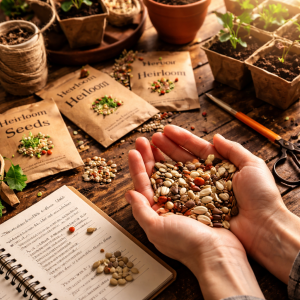
 There’s something almost magical about a tiny seed.
Inside that little speck is an entire future harvest waiting patiently. Tomatoes. Beans. Squash. Lettuce. All quietly tucked into something small enough to lose between the couch cushions.
And yet that tiny seed represents something much bigger than food.
It represents independence.
When you can grow food from seeds you’ve saved yourself, you’ve created a cycle that can continue year after year… long after the grocery store shelves have been picked over or supply chains have hiccupped again.
That’s why seed saving is one of the most powerful preparedness skills you can learn.
But like most preparedness skills, it works best when you practice it before you ever need it.
There’s another benefit to growing and saving your own seeds that often gets overlooked.
Health.
When you grow your own food, you control what goes into the soil, what gets sprayed on the plants, and what ends up on your plate. There are no mysterious chemical treatments before shipping, no preservatives added after harvest, and no wondering how many miles your food traveled to reach your kitchen.
It’s just food… the way it was meant to be.
That kind of control matters. Especially today when so many people are trying to eat cleaner, avoid unnecessary chemicals, and reconnect with what real food actually looks like.
Saving seeds doesn’t just protect your ability to grow food in the future. It protects the quality of the food you grow.
And that’s a form of preparedness that benefits you every single day, not just during a crisis.
Gardening Is a Skill—Not Just a Purchase
A lot of people buy seeds and tuck them away thinking they’ve checked the box on food preparedness.
But seeds are like a musical instrument.
Owning a violin doesn’t mean you can play Mozart.
Gardening is the same way. It takes practice, observation, and a little humility. Plants have a way of reminding us who’s really in charge.
You learn:
What grows well in your soil.
What struggles in your climate.
What pests show up uninvited.
And perhaps most importantly…
What you actually enjoy growing and eating.
There’s no point planting rows of kale during a crisis if everyone in your house secretly wishes it would disappear.
Better to discover those preferences now.
Start With Seeds That Can Reproduce
If the goal is long-term food security, heirloom seeds are essential.
Unlike hybrid seeds, heirloom varieties produce plants whose seeds can be saved and replanted year after year while maintaining the same characteristics.
That means one tomato plant today can turn into hundreds of tomato plants over time.
My favorite source for heirloom seeds is Baker Creek Heirloom Seeds, and their website rareseeds.com is a treasure trove.
Every year when their catalog arrives, I sit down with it like it’s a good novel. I’m not exaggerating when I say I can happily spend an hour flipping through those pages imagining what next year’s garden might look like.
It’s part inspiration.
Part planning.
And part dreaming.
How I Store My Seeds
Seeds are living things in a kind of suspended animation. Treat them well, and they’ll reward you with years of viability.
The key principles are simple:
Cool
Dry
Dark
I store mine in a location where temperatures remain steady and humidity is low. Light and moisture are enemies of seed longevity, so keeping them protected from both makes a big difference.
Over the years I’ve also developed my own little seed catalog. I keep notes about:
Planting depth
Spacing
Soil preferences
Sunlight needs
And lessons learned from previous seasons
Those notes become incredibly valuable because they turn gardening from guesswork into experience.
How Long Have People Been Saving Seeds?
Seed saving may feel like a rediscovered skill today, but for most of human history it was simply called farming.
Long before seed companies, catalogs, or garden centers existed, families saved seeds from their best plants every year. Those seeds were carefully dried, stored, and replanted the following season. It was how food production continued generation after generation.
In fact, many of the crops we grow today exist because countless farmers before us patiently saved and selected seeds over centuries. Tomatoes, beans, squash, corn, and countless other crops were gradually improved as farmers chose seeds from the strongest, healthiest plants.
That process didn’t just preserve food—it adapted crops to local climates. Seeds saved in one region slowly became better suited for that specific soil, rainfall, and temperature pattern.
In other words, our forefathers weren’t just saving seeds. They were building resilient food systems without even realizing it.
And they were very good at it.
When stored properly—cool, dry, and protected from light—many seeds can remain viable for years, sometimes decades. Farmers often kept seed jars from previous harvests as a form of security, knowing that if one crop failed, they still had the ability to plant again.
Some seeds have even demonstrated remarkable longevity. Scientists have successfully germinated seeds found in ancient tombs and archaeological sites hundreds or even thousands of years old when conditions preserved them well.
While we shouldn’t expect our garden seeds to last centuries, the lesson remains clear:
With proper care, a small supply of seeds can provide food for many years.
That’s exactly why seed saving has always been one of the quiet foundations of self-reliance.
And it still is today.
One Method That Changed Everything for Me
Over the years I’ve experimented with a lot of gardening techniques.
Some worked well.
Some… not so much.
But one approach that consistently impressed me is the Mittleider Gardening Method.
The best way I can describe it is this:
It’s like hydroponics for people who don’t want to spend a fortune.
The system uses simple materials, careful nutrient balance, and smart spacing to produce surprisingly high yields—even in difficult soil conditions.
What’s fascinating is that this method has been used around the world to improve food production in developing countries. In some places it has literally helped transform local economies by enabling families to grow more food in smaller spaces.
That’s the kind of practicality preparedness should aim for.
Affordable.
Sustainable.
Repeatable.
I’ve written several articles about the Mittleider Method here on the blog if you’d like to explore it further.
The Real Goal
Seeds remind us of something important about preparedness.
The goal isn’t just storing food. It’s creating systems that continue producing food year after year.
One plant becomes many.
One harvest leads to the next.
When you save seeds, you’re not just preparing for a difficult day—you’re investing in a future where your family can continue to eat well no matter what happens around you.
And all of that possibility begins with something small enough to fit in the palm of your hand.
A seed.
0 Comments