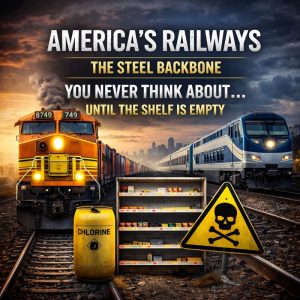
 Most people don’t wake up in the morning and say,
“Ah yes, I wonder how the freight rail network is doing today.”
We wake up and say things like:
“Where are my socks?”
“Why is my phone already dying?”
“Did the dog always look this judgmental?”
And yet…
Railways are one of the most important pieces of infrastructure in the entire country.
They move the goods that make modern life work: food, fuel, chemicals, building materials, and consumer products. The U.S. rail network spans roughly 140,000 miles of track, and freight rail moves close to 2 billion tons of goods every year.
That’s not quaint.
That’s critical.
Rail is basically America’s circulatory system in steel form.
And like any circulatory system…
When it gets clogged, everything downstream feels it.
Derailments: More Common Than People Realize
Even though the industry works hard on safety, derailments still happen regularly.
Federal data shows the U.S. averages roughly 1,000 to 1,300 derailments per year — about three derailments a day on average.
Most of these are minor, often in rail yards at low speeds, but even minor derailments can disrupt shipping schedules, require repairs, and create ripple effects through the network.
Rail doesn’t have infinite detours.
When something hiccups in the wrong place, the whole system slows.
Hazardous Materials: A Quiet but Essential Role
Here’s another piece most people never consider:
Rail isn’t the only way hazardous materials move across America, but for many critical chemicals, it’s often the most practical way to transport large volumes.
Things like chlorine for water treatment, fertilizer inputs, and industrial fuels move efficiently by rail because moving the same amount by truck would require thousands more shipments — and far more strain on roads and supply chains.
Modern life depends on materials we never think about…
Until they don’t arrive.
And Yes… Rail Moves People Too
Rail isn’t only about freight.
Even in a car-heavy country, passenger rail still carries a stunning number of people.
Amtrak alone serves tens of millions of passengers each year, and commuter rail systems in major metro areas carry millions more.
Rail is a lifeline for travelers, workers, and regional economies — even if you personally haven’t ridden a train since that one childhood field trip where someone spilled juice and it became a sticky memory forever.
The Price Tag of Repair: Not Pocket Change
Now let’s talk about the elephant on the tracks:
Rail infrastructure is expensive.
The American Society of Civil Engineers has estimated that bringing U.S. rail systems — especially passenger and public rail corridors — into a state of good repair requires hundreds of billions of dollars in investment over the coming decades.
Freight railroads invest heavily in their own networks, but the broader rail ecosystem still faces major needs: aging bridges, outdated tunnels, congestion chokepoints, and deferred upgrades in many regions.
In other words:
This is not a weekend DIY project.
Staffing Shortages: Fewer People Want the Job
Railroads also depend on skilled crews, dispatchers, maintenance workers, and engineers.
And like many industries, rail has faced a growing workforce challenge.
Part of today’s staffing strain isn’t just retirements — it’s that fewer people are applying for rail jobs the way they used to.
Rail work can be demanding, schedule-heavy, and unfamiliar to younger generations who aren’t growing up seeing it as a natural career path.
When crews are short, trains can sit idle — not because the cargo isn’t ready, but because the people needed to move it aren’t available fast enough.
That’s not collapse.
That’s constraint.
And constraints create delays.
Why This Matters to Everyday Households
Rail disruptions don’t usually show up as “Railway Crisis” on your front porch.
They show up as:
Odd gaps on store shelves
Delayed building supplies
Fuel delivery timing issues
Longer waits for materials you didn’t know were coming by rail
Most shortages don’t start at the grocery store.
They start hundreds of miles away on tracks, at switches, or in congested hubs where bottlenecks ripple nationwide.
Modern life runs beautifully…
But it runs tightly.
What You Can Do (Without Buying a Train)
Preparedness isn’t panic.
It’s peace.
Rail preparedness doesn’t mean building a railroad in your backyard.
It means margin:
Keep a pantry buffer so a shipping delay doesn’t become a household emergency.
Don’t wait until you’re out of essentials to replace them.
Understand that supply chains are long, interconnected, and occasionally fragile.
Because the question isn’t:
“Will trains stop running forever?”
The question is:
If the system slows down… will you feel helpless… or just mildly inconvenienced?
Infrastructure is the backbone of society.
Self-reliance is the backbone of the home.
And the goal isn’t fear.
The goal is steady confidence—even when the steel backbone wobbles.