 Electricity is one of the greatest magic tricks of modern life.
You flip a switch—light.
You plug something in—power.
You press a button—and your leftovers become dinner again.
It’s so normal that we barely notice it… until it disappears.
And then suddenly, the house gets real quiet.
Not peaceful quiet.
More like, “Why is the fridge not humming and why is my phone at 12%?” quiet.
The electric grid is the invisible engine behind nearly everything we do. It powers hospitals, water treatment plants, fuel pumps, grocery stores, banking systems, traffic lights, and yes… your air fryer.
But here’s the rude little wake-up call:
The grid is incredible.
It’s also aging, strained, and operating with less margin than most people realize.
An Aging Machine Doing a Modern Job
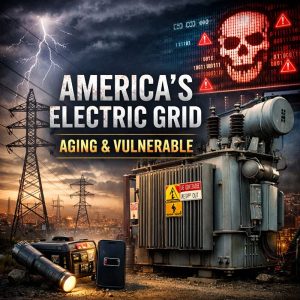
Much of America’s electric grid infrastructure is around 40 years old, with major components even older.
That doesn’t mean it’s about to fail dramatically.
But it does mean we’re asking a system built for yesterday’s demands to handle today’s reality:
Electric vehicles
Data centers
More extreme weather
More people plugged in all the time
More everything running at once
It’s like trying to power a modern smart home with the electrical panel from 1978 and a hopeful shrug.
Demand Has Shifted (Not Just Increased)
One surprising modern twist is how electricity demand has changed in recent years.
It’s not that working from home magically created electricity use out of thin air—offices were using power too.
The difference is where and when that demand hits the grid.
Commercial buildings are designed for heavy, centralized electrical loads, with robust wiring and infrastructure built for thousands of workers.
Neighborhoods, on the other hand, weren’t designed for every house to become a mini office building at 10 a.m. on a Tuesday—computers running, air conditioners humming, space heaters glowing, and three people streaming something in the next room.
The grid isn’t strained only by how much electricity we use…
It’s strained by how demand shifts into places and patterns the system wasn’t optimized for.
Downtown towers are built for electricity marathons.
Suburban cul-de-sacs? Not so much.
Transformers: The Grid’s Biggest Bottleneck
Now let’s talk about one of the least glamorous but most critical pieces of the entire system:
Large power transformers.
These are the massive machines that help distribute electricity across regions. And here’s the part most people don’t realize:
These are not off-the-shelf parts.
They are custom-built, enormous, and difficult to replace quickly.
In fact, replacing a large transformer can take 12 to 18 months—or even longer.
And here’s the kicker:
A significant share of these transformers are imported, because U.S. manufacturing capacity is limited. Many come from countries like Mexico, China, South Korea, Canada, and India.
So if a major transformer fails, the solution isn’t always, “Send someone out next week.”
Sometimes the timeline looks more like:
“Order it… wait a year… ship it… install it… then breathe again.”
That’s not panic-worthy.
It’s just reality in a system where key components are part of a global supply chain.
Weather Doesn’t Help
The grid is increasingly tested by storms, heat waves, wildfires, and cold snaps.
Extreme weather isn’t just inconvenient.
It’s infrastructure stress.
When ice loads down lines, when hurricanes flood substations, when heat pushes demand past capacity—outages happen.
Not because the world is ending…
But because systems have limits.
Cyberattacks on Utilities Are Rising — Fast
The electric grid isn’t just wires and poles anymore — it’s digital networks, control software, and operational technology that can be targeted online. That means vulnerabilities aren’t only physical; they’re also cyber.
In fact, research shows that cyberattacks on U.S. utilities increased by about 70% in a recent year compared with the previous year, highlighting how much more frequently utilities — including grid-related systems — are being probed, targeted, or hit by malicious actors online.
And this trend matches broader patterns seen across critical infrastructure, where cyber threats have been steadily rising year over year as systems become more connected and sophisticated adversaries look for weak spots.
This doesn’t mean the grid is about to collapse because of a hacker (that’s still extremely unlikely). But it does mean utilities now have to defend not only aging physical equipment, but complex digital systems as well — and that dual challenge raises the stakes when we talk about resilience.
Why This Matters to Everyday Households
Electricity isn’t just lights.
It’s refrigeration. The safety of someone’s insulin and food.
It’s medical devices.
It’s communication.
It’s water pumping.
It’s the ability to buy groceries when card readers go down.
When the power goes out, life doesn’t instantly become a disaster…
But it does get inconvenient fast.
And the question becomes:
Do you have margin?
Or do you have candles from 2009 and a phone charger that only works if you hold it at a 37-degree angle?
What You Can Do (Without Becoming “Generator Steve”)
Preparedness isn’t panic.
It’s peace.
And electric preparedness is surprisingly simple:
Have flashlights and batteries that actually work.
Keep a power bank charged.
Consider a small solar charger for phones and essentials.
Know how to eat without relying entirely on the microwave.
If you live somewhere outage-prone, a generator may make sense—but you don’t need to power your whole neighborhood.
You just need breathing room.
Because the goal isn’t to fear the grid.
The goal is to respect it.
Modern life runs beautifully…
But it runs tightly.
So the real question isn’t:
“Will the grid fail forever?”
The real question is:
“If the lights flicker tonight… will you feel helpless… or just mildly inconvenienced?”
Infrastructure is the backbone of society.
Self-reliance is the backbone of the home.
And the goal isn’t fear.
The goal is steady confidence—even in the dark.


