Do your neighbors know the language?
(Because sometimes the most powerful preparedness tool is a phrase no one else understands.)
Every family has its quirks. Maybe yours has that one cupboard no one opens because it’s the unofficial avalanche zone. Maybe you’ve got a sibling who communicates exclusively in sarcastic eyebrow lifts. Or maybe you’ve got Steve, who insists his bug-out bag needs a snorkel “just in case.” But buried among all the chaos, there’s something far more valuable — something that can protect your home faster than any gadget on a prepper shelf.
I’m talking about a shared family code language.
Phrases. Signals. A simple, ordinary-sounding line that means something very specific to the people who matter.
The idea isn’t new. In one episode of Blue Bloods, Detective Danny Reagan used a totally innocent phrase — “Just don’t hurt my family” — while his sister was being held at gunpoint. To the criminal, it sounded like begging. But to the sister? It meant:
Get ready. Move now. I’m taking the shot.
That’s the power of a pre-memorized, pre-agreed-upon phrase.
It’s camouflage for communication.
Even in my own past life, I had a phrase for my husband. A certain version of his name that only meant one thing: TROUBLE. The moment he heard it, something in his face went from “helpful husband” to “Jason Bourne with an errand list.”
You see this idea pop up everywhere once you start noticing.
In the novel Alas, Babylon, a simple phrase becomes the signal between friends that everything — and I mean everything — has officially hit the fan. It’s subtle enough to blend in. Strong enough to say what needs saying.
And every household should have something just like it.
Not because we’re paranoid. Not because gloom-and-doom prepping is the family hobby. No — because a family that lives with intentional self-reliance can coordinate silently without turning into Morse code marionettes during a crisis.
Think of situations where a secret phrase could keep your people safer:
Someone knocks on the door and you don’t like the vibe.
Your spouse hears the phrase you agreed on and knows to grab the phone, close the bedroom door, or move away from windows without spooking the visitor.
You’re in public and something feels off.
A sentence as simple as “Did we ever feed the cat?” suddenly means:
Stay close. Eyes up. We’re leaving.
To the rest of the world, you’re talking about kibble.
To your crew, you’re talking strategy.
A friend group goes out together and needs a low-profile exit plan.
That one phrase becomes your socially acceptable way of saying,
“Time to go. This situation is turning into a Lifetime movie.”
Kids need a way to signal something is wrong without alerting a stranger.
A phrase, a nickname, or a question only you and they recognize becomes their lifeline.
Elderly parents or neighbors need an emergency phrase.
Something they can say on the phone that sounds normal but means,
“Call 911. I’m not alone.”
And here’s the best part:
Your phrase doesn’t have to sound cool, dramatic, or Tom-Clancy-approved.
In fact, the more ordinary it sounds, the better it works.
Code phrases are the duct tape of emergency communication — simple, versatile, and invisible until the moment you need them.
But having one isn’t enough.
You need:
-
Practice. The phrase should trigger an automatic response, not a family meeting on what it might mean today.
-
Clear meaning. Every person must know exactly what action that phrase requires.
-
A few variations. One for “leave,” one for “danger,” one for “call for help,” one for “pretend nothing’s wrong but DO THE THING.”
-
Consistency. Use the phrase and the action it corresponds to the same way every time.
And don’t forget your extended circles — your trusted friends, your church group, your neighborhood watch team, your kids’ carpool buddies. Anyone you’d rely on during an emergency can benefit from being included in the code-phrase world.
Because here’s the truth that sits at the center of all self-reliance:
Communication saves time. Time saves lives.
And a well-crafted secret phrase?
That’s communication in its fastest, smartest, quietest form.
It’s preparedness without theatrics.
Protection without panic.
A plan that fits in a single sentence.
And it might just be the most important foreign language your household ever learns.
Your Family Needs More Than One Phrase — You Need a Whole Codebook (Even If It Fits in Your Head)
One secret phrase is helpful, but relying on just one is like trying to build a house with only a hammer. Effective silent communication takes a set of phrases — each one ordinary and innocent to outsiders, but laser-specific to the people who share your roof, your trust, and your emergency plans.
Think of it like your family’s private foreign language.
Not dramatic. Not spy-movie theatrical.
Just clear, consistent communication wrapped inside normal conversation.
Here’s what every household or tight friend group should aim for: multiple coded phrases or signals that each correspond to different levels and types of action.
A few examples of a good multi-phrase system:
1. The “Eyes Up” Phrase
A gentle warning that something feels off.
Doesn’t mean run. Doesn’t mean panic.
Just means: Stay alert. Don’t drift. Pay attention.
Something like:
“Remind me to check the mailbox later.”
To strangers, it’s boring.
To your people, it’s a shift from casual to aware.
2. The “We Leave NOW” Phrase
A phrase that ends ALL debate.
No questions, no hesitation, no “why?” speeches.
Everyone stands, grabs their stuff, and moves.
Something like:
“I think we left the oven on.”
which, in your household, actually means:
Exit. Don’t look back.
3. The “Call for Help” Phrase
Used when someone can speak normally but needs immediate backup.
Perfect for phone calls when someone else is listening.
Something like:
“Did you ever fix that squeaky drawer?”
which really means:
Call 911. Something is wrong.
4. The “Danger Is Here But Don’t React” Phrase
This is the Blue Bloods-style phrase.
Something calming, casual, but with teeth behind it.
Like Danny Reagan’s line:
“Just don’t hurt my family.”
or your own past household version of using a specific name to signal TROUBLE.
To outsiders? Totally normal.
To insiders? Brace yourself. Act at the exact moment we discussed.
5. The “I Need to Leave This Situation Quietly” Phrase
Works in social settings, parking lots, grocery stores, anywhere.
A socially acceptable phrase that means,
Come with me. No questions. Now.
Something like:
“Can you help me find that thing in the car?”
To everyone else: an errand.
To your people: Go-time.
6. The “All Clear” Phrase
You need a return-to-normal phrase too.
Because once adrenaline hits, people tend to hover in crisis mode.
Something like:
“We’re good. Let’s grab dinner.”
which really means:
Situation resolved. Everyone breathe.
The Power Is in the Practice
A coded family language is only effective when:
-
Every person knows the phrases
-
Every phrase ties to one clear action
-
No one improvises meanings
-
The responses become automatic
-
You practice calmly, not during chaos
This isn’t paranoia — this is preparedness as a lifestyle.
It’s communication without panic.
Action without noise.
Protection without escalation.
Police families do it.
Military families do it.
Tight-knit friend groups do it.
Neighborhood watches should do it.
And households embracing self-reliance?
They can gain a huge advantage with it.
Because when trouble comes — whether it’s danger, discomfort, or just a moment when you need everyone on the same page instantly — nothing beats a sentence that sounds like nothing, but means everything to the people you love.
Examples of Code Phrases for Kids, Elderly Parents, and Neighbors
For Kids (Simple, Natural, Easy to Remember)
Kids need phrases that feel like everyday conversation — nothing complicated, nothing that requires acting skill. Just short, believable sentences that fit their real world.
1. “Can I go get my jacket?”
Meaning:
I feel unsafe. I want out. Come with me now.
Perfect for a playdate, school, or public setting.
2. “I think I forgot my homework.”
Meaning:
I need you to come here immediately. Something is wrong.
Teachers don’t bat an eye.
Parents know it means move.
3. “What time are we having dinner?”
Meaning:
I need help but can’t say it aloud.
Sounds totally normal.
Signals quiet distress.
4. “Is it okay if we go home now?”
Meaning:
This situation doesn’t feel safe. Please extract me.
Simple. Honest. And extremely effective.
5. “Can you check the trunk?”
Meaning:
We need to leave now. No questions.
Kids can say it naturally.
Parents know it’s the exit cue.
For Elderly Parents (Respectful, Natural, Non-Escalating)
Elderly loved ones often need a way to signal danger without alarming someone nearby — especially if they’re on the phone or dealing with a suspicious person.
1. “Can you bring me that recipe again?”
Meaning:
Call 911. Someone is here and I don’t feel safe.
Harmless to the listener.
Devastatingly clear to you.
2. “Did you ever find that photo album?”
Meaning:
Stay on the phone with me. Don’t hang up. Something’s happening.
This one bridges confusion and danger beautifully.
3. “If you’re coming by, knock loud so I hear you.”
Meaning:
Come over now. I need in-person help.
Sounds like typical senior talk.
Signals urgency.
4. “Don’t forget to water my plant.”
Meaning:
The person with me is not safe. Proceed carefully.
A golden phrase for phone calls.
5. “Let me tell you about the neighbor’s dog.”
Meaning:
Someone is listening. Don’t ask direct questions. Follow our script.
Perfect for confusion-heavy moments.
For Neighbors (Friendships + Neighborhood Watch Style)
These work for community groups, watch teams, church friends, or any close-knit circle who keeps an eye out for one another.
1. “Did you borrow my ladder again?”
Meaning:
I need eyes on my house. Something’s wrong.
Friendly, harmless, neighborly.
2. “Are you grilling tonight?”
Meaning:
Look outside. There’s activity I need you to see.
Especially useful after dark.
3. “Did your power flicker too?”
Meaning:
I need you to come over right now. Don’t wait.
Totally normal.
Summons backup instantly.
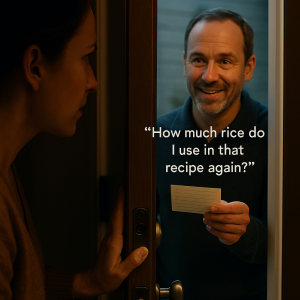
4. “Can I get that recipe you mentioned?”
Meaning:
Call authorities. Don’t come here. I’m not safe.
A vital distinction.
5. “Is your dog loose again?”
Meaning:
Walk outside and check the street. Something is unfolding.
A subtle “get into observation mode.”
Teaching the System
Your family — and any trusted circle you include — should know:
-
Exactly what each phrase means
-
Exactly what action to take
-
Never to improvise or change meanings
-
To practice calmly so it becomes second nature
This doesn’t have to be dramatic.
You don’t need to sit in a circle chanting code words like a cult.
Just introduce them naturally, review occasionally, and make sure everyone — kids, adults, neighbors, elderly parents — knows their part.
Why This Matters
Because communication errors waste time.
And in an emergency, time is everything.
This system lets you:
-
Signal danger without escalating it
-
Coordinate silently in public
-
Protect your kids without frightening them
-
Help elderly parents signal distress without tipping off a predator
-
Work with neighbors without broadcasting problems
-
Move as a team, not as scattered individuals
It is one of the simplest, most powerful preparedness tools a household can have — and it doesn’t cost a dime.
Just intention.
Just planning.
Just the willingness to say, “This could protect us.”
The world doesn’t need to understand your phrases.
They only need to work for you.
Because danger doesn’t always announce itself…
but you can make sure your family knows exactly what to do when it quietly walks in.